

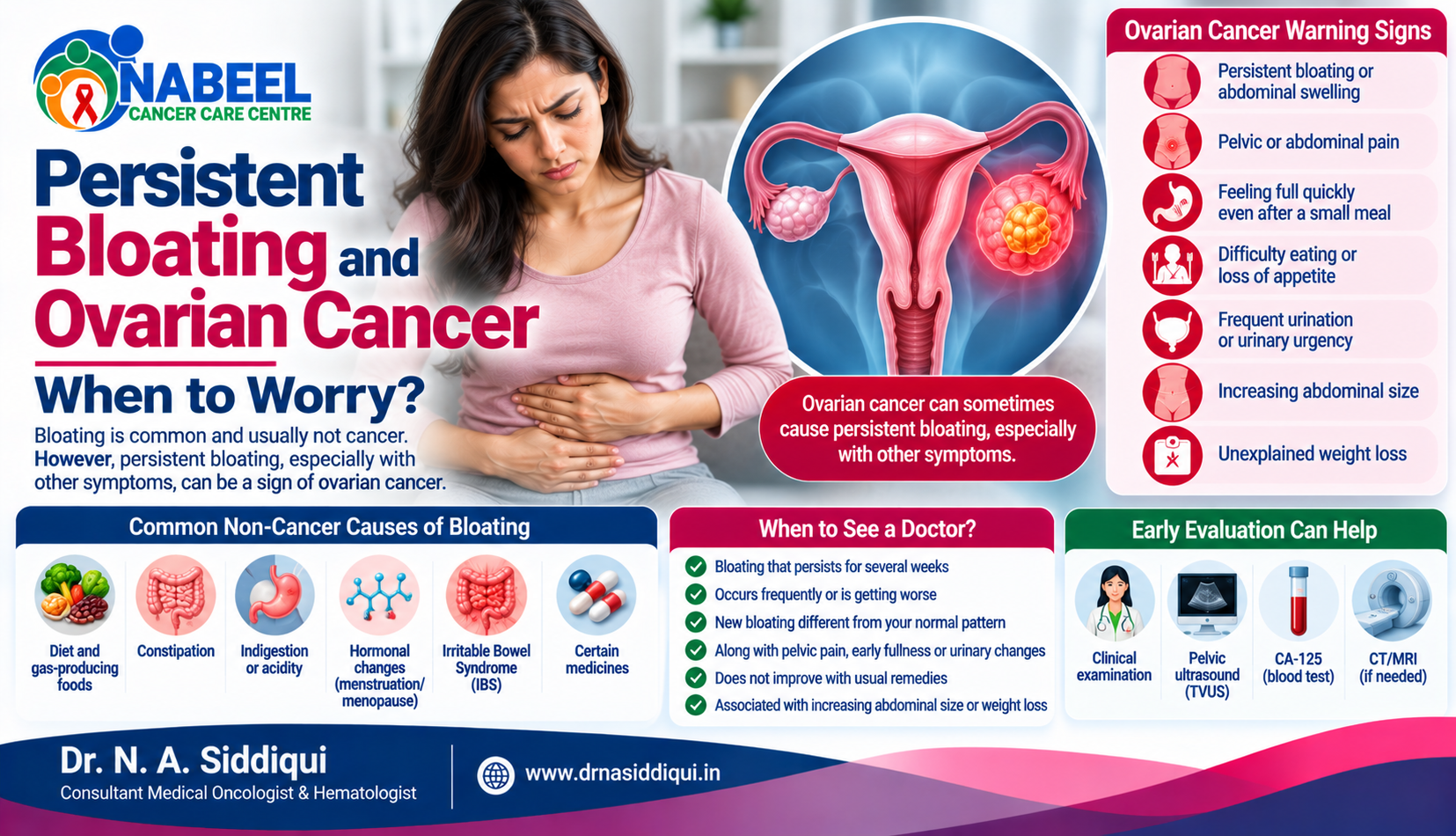
Persistent Bloating and Ovarian Cancer: When Should You Worry?
Bloating is extremely common.
Almost everyone experiences abdominal fullness, gas or swelling from time to time. In most cases, the cause is related to diet, constipation, indigestion, hormonal changes or another non-cancerous condition.
However, bloating that is new, persistent or occurring much more frequently than usual should not always be dismissed as a digestive problem.
Persistent bloating can sometimes be one of the symptoms of ovarian cancer, especially when it occurs together with pelvic or abdominal pain, difficulty eating, feeling full quickly or changes in urination.
Importantly, these symptoms do not automatically mean ovarian cancer.
Nevertheless, recognizing a persistent change from your normal pattern can help you know when medical evaluation is appropriate.
For a broader overview of possible warning symptoms, read Early Signs of Cancer.
What Does Bloating Mean?
Bloating is a sensation of:
- Abdominal fullness
- Tightness
- Pressure
- Gas
- Swelling
- Increased abdominal size
Sometimes you may feel bloated without obvious swelling.
At other times, the abdomen may visibly appear larger or more distended.
For example, temporary bloating after a large meal is common and usually settles within a short period.
In contrast, persistent abdominal swelling that occurs repeatedly without an obvious explanation may need further assessment.
Is Bloating a Symptom of Ovarian Cancer?
Yes, it can be.
Bloating is one of the recognized symptoms associated with ovarian cancer.
Other common symptoms can include:
- Pelvic or abdominal pain
- Feeling full quickly
- Difficulty eating normal-sized meals
- Urinary urgency
- Frequent urination
However, all of these symptoms are far more commonly caused by non-cancerous conditions.
Therefore, the important issue is not simply whether bloating is present.
Instead, doctors consider:
- How often it occurs
- How long it has been happening
- Whether it is becoming worse
- Whether it is different from your usual digestive symptoms
- Whether additional warning signs are present
The American Cancer Society notes that ovarian-cancer-related symptoms tend to be persistent and different from normal, and symptoms occurring more than about 12 times in a month deserve medical discussion.
What Is Ovarian Cancer Bloating Like?
There is no single type of bloating that confirms ovarian cancer.
However, ovarian-cancer-related bloating may be:
- Persistent
- Frequent
- New for the patient
- Progressive
- Associated with visible abdominal enlargement
- Unrelated to a particular food
- Present despite dietary changes
- Associated with pelvic pressure
- Associated with early fullness
For example, someone who normally experiences occasional bloating after certain foods may notice that their abdomen now feels swollen almost every day.
Similarly, clothes around the waist may suddenly feel tighter even without actual weight gain.
Nevertheless, symptoms alone cannot diagnose ovarian cancer.
If bloating is unexplained and persistent, further evaluation may help determine the actual cause.
For detailed information about ovarian-cancer diagnosis and treatment, visit Ovarian Cancer Doctor in Lucknow – Dr. N. A. Siddiqui.
Occasional Bloating vs Persistent Bloating
Understanding the difference can be useful.
Occasional Bloating
Temporary bloating may occur because of:
- Heavy meals
- Gas-producing foods
- Constipation
- Menstruation
- Indigestion
- Food intolerance
Usually, this type of bloating comes and goes.
Furthermore, it often improves after:
- Passing stool
- Passing gas
- Dietary changes
- Menstruation
- Treating constipation
Persistent Bloating
Persistent bloating is different.
It may:
- Occur most days
- Continue for several weeks
- Become progressively worse
- Not respond to usual remedies
- Be associated with other symptoms
Therefore, persistent bloating deserves more attention than occasional post-meal fullness.
Warning Signs to Watch With Persistent Bloating
Persistent bloating becomes more important when accompanied by additional unexplained symptoms.
1. Pelvic or Abdominal Pain
Pelvic discomfort is common and can have many benign causes.
For example, menstrual cramps, constipation and urinary problems may cause lower abdominal discomfort.
However, ovarian cancer can also cause persistent pain or pressure in the abdomen or pelvis.
Therefore, ongoing bloating combined with unexplained pelvic pain deserves evaluation.
2. Feeling Full Quickly
Feeling full after eating only a small amount of food is called early satiety.
This can occur with several digestive conditions.
Nevertheless, it is also a recognized symptom associated with ovarian cancer.
For example, someone who previously ate a normal meal may suddenly feel full after only a few bites.
If this becomes a persistent new pattern, particularly alongside bloating, it should be discussed with a doctor.
3. Difficulty Eating
Some patients describe:
- Loss of appetite
- Reduced meal size
- Abdominal pressure after eating
- Difficulty finishing meals
Again, these symptoms do not automatically indicate cancer.
However, persistent difficulty eating combined with abdominal swelling or pelvic discomfort deserves investigation.
4. Frequent Urination
Frequent urination is common in conditions such as:
- Urinary infection
- Diabetes
- Overactive bladder
- High fluid intake
However, ovarian cancer can also produce urinary frequency.
Therefore, a new combination of frequent urination and persistent bloating may warrant assessment.
5. Urinary Urgency
Urinary urgency means suddenly feeling that you need to pass urine.
Although urinary infections commonly cause urgency, unexplained persistent urgency may also occur with pelvic conditions.
Consequently, if urinary symptoms appear together with persistent bloating or pelvic pressure, tell your doctor about the full symptom pattern.
6. Increasing Abdominal Size
Visible abdominal enlargement deserves attention when it:
- Continues to increase
- Is not explained by weight gain
- Occurs with pain or pressure
- Occurs with reduced appetite
- Occurs with unexplained weight loss
In ovarian cancer, abdominal enlargement can sometimes be related to the tumor itself or fluid accumulation called ascites.
However, many non-cancerous conditions can also cause abdominal swelling.
Can You Gain Weight With Ovarian Cancer?
Changes in abdominal size can sometimes be confusing.
A person may notice that the abdomen is becoming larger while overall body weight remains stable.
In some situations, fluid accumulation can increase abdominal size or body weight.
On the other hand, some patients may experience unintentional weight loss while the abdomen becomes more swollen.
Therefore, the relationship between weight and ovarian cancer is not always straightforward.
Persistent unexplained abdominal enlargement deserves evaluation regardless of the number on the weighing scale.
Common Non-Cancer Causes of Bloating
Most bloating is not caused by ovarian cancer.
Several common conditions can produce similar symptoms.
Gas and Diet
Certain foods can increase intestinal gas.
For example:
- Beans
- Lentils
- Carbonated drinks
- Certain vegetables
- Large meals
Food-related bloating usually has some relationship with eating and may improve after dietary adjustment.
Constipation
Constipation is one of the most common causes of abdominal fullness.
It may produce:
- Bloating
- Abdominal discomfort
- Hard stool
- Reduced bowel frequency
However, a new persistent change in bowel habits should still be discussed with a doctor when unexplained.
Irritable Bowel Syndrome
Irritable bowel syndrome, or IBS, commonly causes:
- Bloating
- Abdominal pain
- Constipation
- Diarrhea
- Changes in bowel habits
Symptoms may fluctuate over time.
Nevertheless, a completely new pattern—especially with weight loss, persistent swelling or another concerning symptom—may require reassessment.
Food Intolerance
Lactose intolerance and other dietary intolerances can lead to:
- Gas
- Cramping
- Diarrhea
- Bloating
Typically, symptoms have some relationship with specific foods.
Menstrual and Hormonal Changes
Many women notice bloating around their menstrual period.
Generally, hormone-related bloating follows a pattern and improves.
In contrast, bloating that becomes persistent throughout the month is different and may warrant further evaluation.
Can Menopause Cause Bloating?
Yes.
Hormonal changes around menopause can affect digestion, body composition and bowel habits.
Therefore, some women notice increased bloating during this period.
However, menopause should not automatically be used to explain a new persistent abdominal symptom.
This is particularly important because ovarian-cancer risk increases with age.
Consequently, persistent bloating after menopause should be discussed with a healthcare professional.
Who Is at Higher Risk of Ovarian Cancer?
Anyone with ovaries can potentially develop ovarian cancer.
However, certain factors may increase risk.
These can include:
- Increasing age
- Family history of ovarian cancer
- Family history of breast cancer
- Certain inherited genetic changes
- BRCA1 or BRCA2 mutations
- Lynch syndrome
- Personal history of some cancers
- Endometriosis in some situations
Therefore, family history matters.
If several close relatives have had ovarian, breast, pancreatic or certain other cancers, discuss hereditary cancer risk with your doctor.
Some patients may benefit from genetic counseling or testing.
Does Family History Matter?
Yes.
A strong family history can increase ovarian-cancer risk.
For example, inherited changes involving BRCA1 and BRCA2 can increase the risk of breast and ovarian cancers.
Similarly, Lynch syndrome can be associated with increased risk of several cancers.
However, most people with bloating do not have hereditary ovarian cancer.
The purpose of family-history assessment is to identify women whose baseline risk may be higher and who may need individualized counseling.
Can Ovarian Cancer Occur Without Family History?
Yes.
A woman does not need to have a family history of ovarian cancer to develop the disease.
Therefore, symptoms should not automatically be ignored because:
- No relative had ovarian cancer
- No relative had breast cancer
- Genetic testing has never been recommended
Family history is only one part of risk assessment.
How Is Persistent Bloating Evaluated?
Doctors first try to determine whether the symptom is gastrointestinal, gynecological, urinary or related to another condition.
Therefore, evaluation generally starts with a detailed medical history.
Questions may include:
- When did the bloating begin?
- Does it occur every day?
- Is the abdomen visibly swollen?
- Does eating make it worse?
- Do you feel full quickly?
- Is there pelvic pain?
- Has your appetite changed?
- Are bowel habits different?
- Is urination more frequent?
- Have you lost weight?
- Are your periods abnormal?
- Is there a family history of ovarian or breast cancer?
Afterward, an examination and selected investigations may be recommended.
For a broader overview, see Cancer Tests & Diagnosis.
Pelvic Examination
A healthcare professional may perform a pelvic examination to assess the uterus, ovaries and surrounding pelvic area.
However, early ovarian tumors can be difficult or impossible to detect by physical examination alone.
Therefore, a normal pelvic examination does not necessarily end the evaluation when symptoms remain concerning.
Pelvic and Transvaginal Ultrasound
Ultrasound is commonly used to examine the ovaries and pelvic organs.
A transvaginal ultrasound can provide detailed images of:
- Ovaries
- Uterus
- Pelvic structures
It may help identify:
- Ovarian cysts
- Solid masses
- Complex masses
- Other pelvic abnormalities
However, ultrasound appearance alone cannot always determine whether an ovarian mass is cancerous.
Further evaluation may therefore be required.
What Is CA-125?
CA-125 is a blood marker that may be elevated in some women with ovarian cancer.
However, it is important to understand its limitations.
CA-125 can also be elevated in several non-cancerous conditions.
Likewise, some ovarian cancers may not produce a markedly elevated CA-125.
Therefore, CA-125 alone cannot diagnose or rule out ovarian cancer.
Instead, doctors interpret it together with:
- Symptoms
- Imaging
- Menopausal status
- Clinical findings
- Other relevant tests
Can CA-125 Be Used as a Routine Ovarian Cancer Screening Test?
Not reliably for average-risk women without symptoms.
At present, there is no recommended routine population screening test that has been shown to effectively screen average-risk women for ovarian cancer.
Therefore, CA-125 and transvaginal ultrasound should not be interpreted as simple stand-alone screening tests for everyone without symptoms.
However, the situation is different when a patient already has persistent symptoms or an ovarian abnormality.
In that setting, these tests may form part of a diagnostic evaluation rather than screening.
Does a Pap Smear Detect Ovarian Cancer?
Generally, no.
A Pap test is primarily used to screen for cervical cell changes.
It does not reliably screen for ovarian cancer.
Therefore, having a recent normal Pap test should not prevent someone from reporting persistent bloating, pelvic pain or early fullness.
CT Scan for Suspected Ovarian Cancer
If ultrasound or clinical assessment identifies a suspicious abnormality, CT imaging may be recommended.
CT can help evaluate:
- Ovarian or pelvic masses
- Lymph nodes
- Abdomen
- Liver
- Peritoneum
- Other possible areas of disease
As a result, CT can provide important information for staging and treatment planning when ovarian cancer is suspected.
More information about imaging and cancer diagnosis is available at Cancer Tests & Diagnosis in Lucknow.
Does Every Ovarian Mass Mean Cancer?
No.
Ovarian cysts and masses are common, and many are benign.
For example, premenopausal women frequently develop functional ovarian cysts.
Other benign ovarian conditions can also produce complex imaging findings.
Therefore, doctors consider several factors before estimating cancer risk, including:
- Age
- Menopausal status
- Symptoms
- Ultrasound characteristics
- Mass size
- Blood tests
- Family history
A suspicious ovarian mass requires appropriate specialist evaluation, but it should not automatically be assumed to be cancer.
Does Ovarian Cancer Need a Biopsy?
Cancer confirmation requires pathological examination of tissue.
However, the diagnostic pathway for suspected ovarian cancer is different from that for many superficial tumors.
In some patients, tissue is obtained during surgery.
In other clinical situations, particularly when disease appears advanced and systemic treatment may be needed first, image-guided biopsy may be considered.
Therefore, not every ovarian mass undergoes a simple needle biopsy before surgery.
The safest diagnostic approach depends on the individual situation.
For a general explanation of tissue diagnosis, visit Biopsy for Cancer in Lucknow.
What Happens If Ovarian Cancer Is Confirmed?
After diagnosis, doctors determine the type and stage of ovarian cancer.
Treatment planning may depend on:
- Histological type
- Cancer stage
- Disease distribution
- Patient’s age
- General health
- Suitability for surgery
- Previous treatment
- Molecular or genetic findings
Treatment may include:
- Surgery
- Chemotherapy
- Targeted therapy
- Maintenance treatment
- Other individualized systemic therapies
The exact sequence varies from patient to patient.
For detailed oncology information, visit Ovarian Cancer Doctor in Lucknow – Dr. N. A. Siddiqui.
Can Ovarian Cancer Be Treated?
Yes.
Treatment depends strongly on:
- Stage
- Cancer subtype
- Extent of disease
- Response to previous treatment
- Molecular characteristics
- Patient fitness
Some patients may undergo surgery first followed by chemotherapy.
In contrast, selected patients with more extensive disease may receive chemotherapy before surgery.
Additionally, targeted maintenance treatments may be appropriate for certain patients depending on tumor biology and genetic findings.
Therefore, treatment should be individualized rather than selected solely from the stage number.
Why Are BRCA and Molecular Tests Important?
Genetic and molecular information can influence ovarian-cancer treatment as well as hereditary-risk counseling.
For example, doctors may consider testing related to:
- BRCA1
- BRCA2
- Homologous recombination deficiency in selected settings
- Other hereditary cancer genes
These results may sometimes influence treatment options, particularly maintenance strategies.
Furthermore, identifying an inherited mutation can have implications for close family members.
Persistent Bloating After Menopause
Persistent bloating after menopause deserves particular attention when it represents a new pattern.
This does not mean that the symptom is likely to be ovarian cancer.
Indeed, digestive problems remain common after menopause.
However, because ovarian-cancer risk rises with age, unexplained persistent bloating accompanied by pelvic pain, early satiety or urinary changes should be assessed.
Bloating With Pelvic Pain
Bloating together with pelvic pain can result from many conditions.
For example:
- Constipation
- Fibroids
- Ovarian cysts
- Endometriosis
- Urinary conditions
- Gastrointestinal disorders
may all cause similar symptoms.
Nevertheless, ovarian cancer is also one possible cause.
Therefore, persistence and progression are more important than any single symptom.
Bloating and Feeling Full Quickly
This combination deserves attention when it is new and persistent.
For example, you may notice that:
- You cannot finish normal meals
- You feel full after a few bites
- Your abdomen remains swollen
- Your appetite has decreased
Although gastrointestinal conditions may explain these symptoms, ovarian cancer should be considered among the possible causes when they remain unexplained.
Bloating and Frequent Urination
Bloating together with frequent or urgent urination may occur because of conditions affecting either the urinary tract or pelvis.
However, a pelvic mass can sometimes place pressure on the bladder.
Consequently, a persistent combination of these symptoms deserves clinical assessment.
When Should You See a Doctor for Bloating?
Consider arranging a medical evaluation when bloating:
- Is new
- Occurs frequently
- Persists for several weeks
- Becomes progressively worse
- Causes visible abdominal enlargement
- Does not respond to usual dietary changes
- Occurs with pelvic or abdominal pain
- Occurs with early satiety
- Occurs with urinary urgency or frequency
- Occurs with unexplained weight loss
- Is associated with abnormal vaginal bleeding
The goal is not to assume ovarian cancer.
Instead, the goal is to determine why the bloating is persistent.
When Is Urgent Medical Attention Needed?
Bloating by itself is rarely an emergency.
However, seek urgent assessment if abdominal swelling occurs with:
- Severe or sudden abdominal pain
- Persistent vomiting
- Inability to keep fluids down
- Fainting
- Severe weakness
- Difficulty breathing
- Heavy vaginal bleeding
- Rapidly worsening abdominal swelling
These symptoms may result from many conditions and require timely evaluation regardless of cancer risk.
Dr. N. A. Siddiqui – Ovarian Cancer Treatment in Lucknow
Dr. N. A. Siddiqui is a Consultant Medical Oncologist & Hematologist in Lucknow.
His qualifications include:
- MBBS
- MD (Medicine)
- DNB (Medical Oncology)
- MRCP (UK)
- PDCR
- Certificate in Immuno-Oncology
- ESMO Certified Medical Oncologist
For patients with confirmed ovarian cancer, medical-oncology assessment may include review of:
- Histopathology
- Cancer subtype
- Stage
- CT or other imaging
- Previous surgery
- Chemotherapy history
- BRCA or other relevant molecular tests
- General health
Based on the complete clinical picture, treatment may involve chemotherapy, targeted treatment, maintenance therapy and multidisciplinary coordination with gynecologic cancer surgeons.
For detailed information, visit Ovarian Cancer Doctor in Lucknow.
Additionally, patients with a confirmed or suspected malignancy who require broader oncology consultation can visit Cancer Doctor in Lucknow – Dr. N. A. Siddiqui.
Frequently Asked Questions
Is persistent bloating always ovarian cancer?
No. In fact, digestive problems, constipation, dietary factors and hormonal changes are much more common causes. However, new persistent bloating should be evaluated when unexplained.
How often does ovarian-cancer bloating occur?
There is no exact pattern for every patient. Nevertheless, ovarian-cancer symptoms tend to be persistent and occur more frequently than a person’s normal occasional bloating.
Is bloating every day a sign of ovarian cancer?
Not necessarily. Daily bloating can result from many benign conditions. However, persistent daily bloating that represents a new change deserves medical assessment, particularly when other symptoms are present.
What symptoms occur with ovarian cancer bloating?
Possible associated symptoms include pelvic or abdominal pain, feeling full quickly, difficulty eating, urinary urgency or frequency, constipation and abdominal swelling.
Can ovarian cancer cause weight loss and a swollen stomach?
Yes, this combination can occur. However, it is not specific to ovarian cancer and requires medical assessment.
Can ovarian cancer cause constipation?
Yes, changes in bowel habits, including constipation, can occur. Nevertheless, constipation is extremely common and usually has non-cancerous causes.
Does a normal Pap smear rule out ovarian cancer?
No. A Pap test is designed primarily for cervical screening and does not reliably detect ovarian cancer.
Does a normal CA-125 rule out ovarian cancer?
No. CA-125 can be normal in some ovarian cancers and elevated in benign conditions. Therefore, it should never be interpreted alone.
Can ultrasound detect ovarian cancer?
Ultrasound can identify ovarian masses and characterize their appearance. However, it cannot always confirm whether a mass is malignant.
Is there a routine screening test for ovarian cancer?
There is currently no recommended routine population-screening test for average-risk women without symptoms. Therefore, recognizing persistent symptoms and discussing individual risk with a healthcare professional remains important.
Does every ovarian cyst need surgery?
No. Many ovarian cysts are benign and may only require observation or follow-up imaging. Management depends on age, symptoms and imaging characteristics.
When should I see an oncologist?
Initial bloating may be evaluated by a physician or gynecologist. If imaging identifies a suspicious ovarian mass or cancer is confirmed, referral to the appropriate gynecologic cancer team and medical oncologist may be required.
Conclusion
Bloating is common and, in most cases, it is not caused by ovarian cancer.
However, persistent bloating should not simply be dismissed when it represents a clear change from your normal pattern.
Pay particular attention when bloating:
- Happens frequently
- Continues for several weeks
- Becomes progressively worse
- Occurs with pelvic or abdominal pain
- Occurs with early fullness
- Makes eating difficult
- Occurs with frequent or urgent urination
- Causes increasing abdominal size
- Occurs with unexplained weight loss
Most importantly, persistent bloating does not automatically mean ovarian cancer.
Instead, it is a symptom that deserves evaluation when it is new, frequent or unexplained.
If examination or imaging identifies an ovarian abnormality, additional testing can determine whether it is a common benign condition or something requiring cancer-specific evaluation.
Early attention to persistent changes can help avoid unnecessary delay in diagnosis.
Medical Disclaimer: This article is for general educational purposes only and does not replace medical examination, diagnostic testing or individualized treatment advice.