

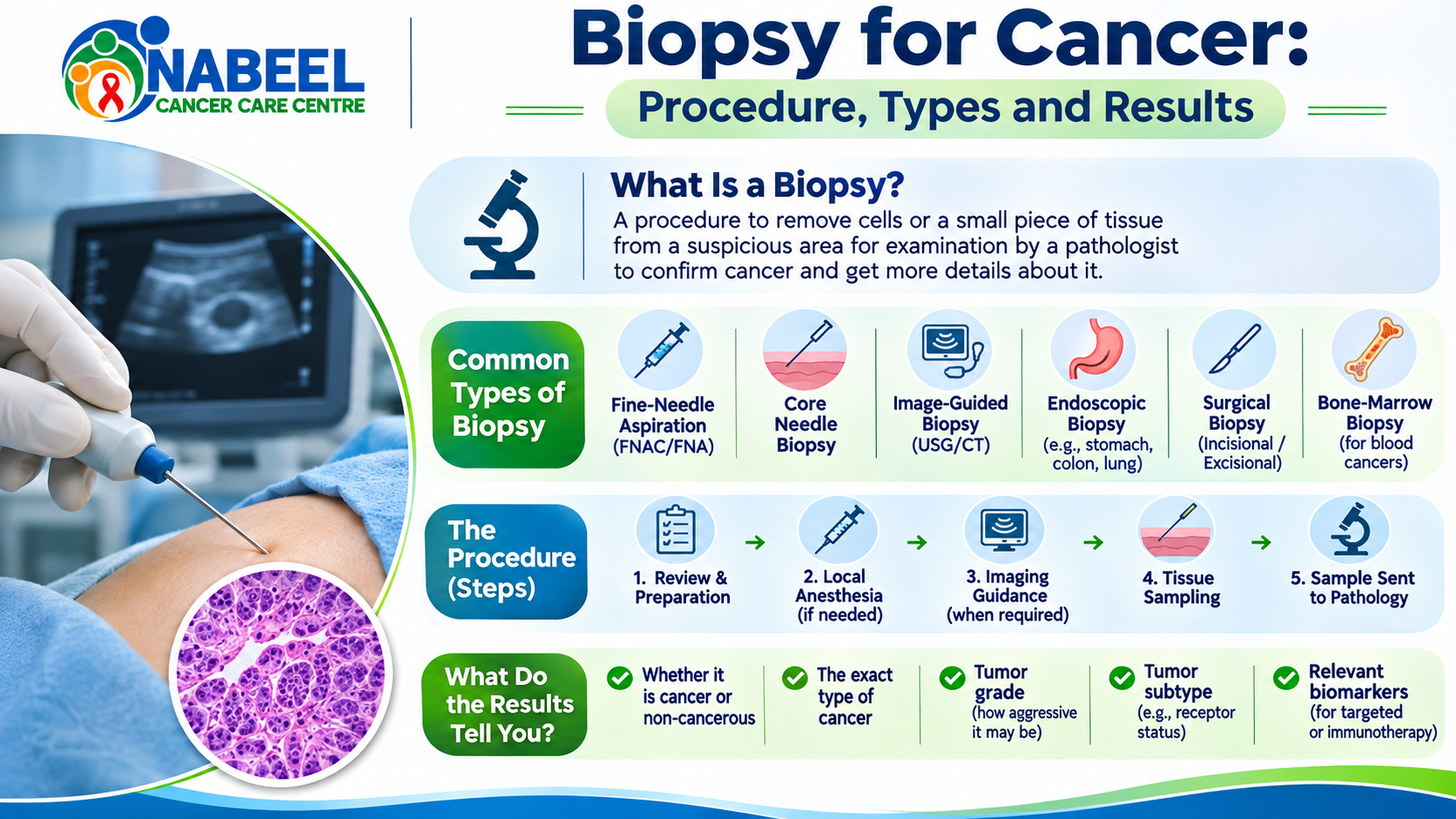
Biopsy for Cancer: Procedure, Types and Results
A scan can show a suspicious lump or mass. Likewise, blood tests or symptoms may raise concern about cancer. However, these findings do not always confirm exactly what the abnormality is.
For many solid cancers, a biopsy is one of the most important tests used to establish a definite diagnosis.
During a biopsy, a doctor removes cells or a small piece of tissue from a suspicious area. Afterwards, a pathologist examines the sample under a microscope and may perform additional laboratory tests.
Therefore, a biopsy can help answer important questions such as:
- Is the abnormality cancerous or non-cancerous?
- What type of cancer is present?
- What is the histological subtype?
- What is the tumor grade?
- Are additional biomarker tests required?
- Could targeted therapy or immunotherapy be relevant?
However, there is no single biopsy method for every patient.
The safest and most useful technique depends on the location of the lesion, suspected cancer type, amount of tissue required and overall clinical situation.
For a broader overview of the cancer diagnostic process, visit Cancer Tests & Diagnosis in Lucknow.
What Is a Biopsy?
A biopsy is a procedure in which cells or tissue are removed from the body for examination by a pathologist.
In many cases, the tissue is examined under a microscope. In addition, special laboratory tests may be performed to identify proteins, receptors, genes or other features of the tumor.
Therefore, a biopsy is not simply a test to answer:
“Is it cancer?”
It may also help determine:
- The exact cancer type
- Tumor subtype
- Tumor grade
- Tissue of origin
- Treatment-related biomarkers
As a result, the pathology information obtained from a biopsy can directly influence treatment planning.
Why Is a Biopsy Needed for Cancer?
Imaging tests such as ultrasound, CT, MRI or PET-CT can show that an area looks suspicious.
However, imaging alone often cannot determine exactly what type of cells are present.
For example, a lung mass visible on CT may represent cancer, infection, inflammation or another condition.
Similarly, a breast lump may have several possible causes.
Therefore, doctors often need tissue before making a definitive cancer diagnosis.
The Cancer Tests & Diagnosis in Lucknow guide explains how imaging, pathology and laboratory tests work together during cancer evaluation.
Does Every Suspicious Lump Need a Biopsy?
No.
The need for biopsy depends on the clinical situation.
For example, some findings can be safely monitored because their imaging characteristics strongly suggest a benign condition.
In contrast, a suspicious or changing lesion may require tissue diagnosis.
Doctors may consider:
- Patient age
- Symptoms
- Lesion size
- Imaging characteristics
- Location
- Risk factors
- Previous cancer history
Therefore, biopsy should be recommended for a clear clinical reason rather than performed automatically for every abnormal scan.
What Are the Main Types of Biopsy?
There are several biopsy techniques.
The appropriate method depends mainly on where the suspicious tissue is located and how much tissue is required.
Common methods include:
- Fine-needle aspiration
- Core needle biopsy
- Image-guided biopsy
- Endoscopic biopsy
- Incisional biopsy
- Excisional biopsy
- Skin biopsy
- Bone-marrow biopsy
Each method has different advantages and limitations.
Fine-Needle Aspiration – FNA or FNAC
Fine-needle aspiration uses a thin needle to remove cells or fluid from a suspicious area.
It is sometimes called FNA or FNAC.
This technique may be used for selected:
- Lymph nodes
- Thyroid nodules
- Breast lumps
- Superficial masses
- Other accessible lesions
The procedure is usually relatively quick.
However, because FNA mainly provides cells rather than a larger piece of tissue, it may not provide enough information for every cancer diagnosis.
Therefore, a core biopsy may sometimes be preferred when doctors need more tissue.
Core Needle Biopsy
A core needle biopsy uses a wider hollow needle to remove small cylinders or cores of tissue.
Because the tissue architecture is preserved, the pathologist can often obtain more information than from cytology alone.
A core biopsy may help identify:
- Cancer type
- Tumor architecture
- Grade
- Receptor status
- Biomarkers
Therefore, it is commonly used for several solid tumors.
Depending on the location, the procedure may be performed using ultrasound, CT or another imaging method for guidance.
FNAC vs Core Biopsy: What Is the Difference?
Both procedures use needles, but they collect different types of samples.
FNAC mainly collects cells or fluid.
In contrast, a core biopsy collects a larger piece of tissue.
As a result, core tissue may provide more information about the structure of the tumor and may allow additional pathology or biomarker testing.
However, this does not mean core biopsy is always better.
For some lesions, FNA may be entirely appropriate.
Therefore, the biopsy method should be selected according to the diagnostic question.
What Is an Image-Guided Biopsy?
Some tumors are located deep inside the body and cannot be easily felt.
In these situations, doctors may use imaging to guide the biopsy needle accurately into the target.
Depending on the lesion, guidance may involve:
- Ultrasound
- CT scan
- Mammography
- Other specialized imaging
For example, image guidance may be useful for lesions involving the:
- Liver
- Lung
- Kidney
- Breast
- Deep lymph nodes
- Abdomen
- Pelvis
Consequently, image-guided biopsy can help obtain tissue from areas that would otherwise be difficult to access.
What Is an Endoscopic Biopsy?
An endoscope is a thin instrument that allows doctors to look inside certain organs.
During an endoscopy, small instruments can pass through the scope to collect tissue.
Examples include:
Upper GI Endoscopy
This may be used to biopsy abnormalities involving the:
- Esophagus
- Stomach
- Upper gastrointestinal tract
Colonoscopy
During colonoscopy, suspicious polyps or lesions in the colon or rectum can be sampled.
Bronchoscopy
Bronchoscopy may allow biopsy of selected abnormalities involving the airways or lungs.
Therefore, endoscopic procedures can combine direct visualization with tissue sampling.
What Is an Incisional Biopsy?
During an incisional biopsy, only part of a suspicious lump or lesion is removed.
This approach may be useful when the abnormal area is too large to remove completely as a diagnostic procedure.
Afterwards, the tissue is examined by a pathologist.
If cancer is confirmed, definitive treatment planning can then proceed.
What Is an Excisional Biopsy?
An excisional biopsy removes the entire suspicious lump or area.
This technique may be considered when:
- The lesion is relatively small
- It can be safely removed
- A larger tissue sample is required
However, an excisional biopsy is not appropriate for every suspected cancer.
Therefore, the choice between incisional, excisional and needle biopsy depends on the individual case.
What Is a Bone-Marrow Biopsy?
Blood cancers require a different diagnostic approach from many solid tumors.
A bone-marrow aspiration or biopsy may be needed when doctors are evaluating conditions such as:
- Leukemia
- Multiple myeloma
- Selected lymphomas
- Other bone-marrow disorders
Bone-marrow samples may undergo several tests, including:
- Microscopy
- Flow cytometry
- Cytogenetic testing
- Molecular testing
Therefore, bone-marrow examination can provide important diagnostic and treatment-related information.
How Is a Cancer Biopsy Performed?
The exact procedure varies according to the biopsy type.
However, the general process may involve several steps.
Step 1: Review Before the Procedure
Before biopsy, the medical team may review:
- Imaging
- Blood tests
- Medical history
- Medicines
- Allergies
- Bleeding risk
- Other health conditions
Importantly, tell the doctor if you take blood-thinning medicines or medicines that affect clotting.
Do not stop prescribed blood-thinning medication on your own.
Instead, the doctor performing the biopsy should advise whether any medicine needs adjustment.
Step 2: Positioning and Imaging
The patient is positioned according to the biopsy site.
If the lesion is deep inside the body, ultrasound or CT guidance may be used.
Step 3: Anesthesia or Sedation
Many needle biopsies are performed using local anesthesia to numb the area.
However, some procedures may require sedation or general anesthesia.
Therefore, the expected level of discomfort depends on the procedure.
Step 4: Tissue Sampling
The doctor obtains one or more samples from the suspicious area.
Sometimes several tissue cores are collected to ensure enough material is available for diagnosis and additional tests.
Step 5: Sample Sent to Pathology
The tissue is labelled and sent to a pathology laboratory.
After processing, the pathologist examines the sample under a microscope and may order additional tests.
Is a Biopsy Painful?
Pain depends on the type and location of the biopsy.
For many needle biopsies, local anesthetic is used. Therefore, patients may mainly feel pressure, pushing or brief discomfort.
Afterwards, mild soreness can occur around the biopsy site.
However, more invasive procedures may require additional anesthesia or pain management.
If you are worried about pain, ask the doctor beforehand:
- Which anesthesia will be used?
- What will I feel during the procedure?
- What pain medicine can I take afterwards?
What Are the Risks of a Biopsy?
Biopsy is a commonly performed medical procedure. Nevertheless, every invasive procedure has potential risks.
Depending on the biopsy type, these may include:
- Pain
- Bruising
- Bleeding
- Infection
- Swelling
In addition, organ-specific procedures can have specific risks.
For example, certain lung biopsies can cause air to collect around the lung.
Therefore, the risks should be discussed according to the exact procedure rather than assuming every biopsy has the same risk profile.
Does Biopsy Make Cancer Spread?
This is a common fear.
In general, biopsy is an important and established part of cancer diagnosis.
Cancer-cell implantation along a biopsy needle tract, sometimes called tumor seeding, can technically occur. However, it is considered extremely rare.
Therefore, the potential diagnostic benefit of an appropriately planned biopsy generally outweighs this very small risk.
Patients should not delay a medically recommended biopsy solely because they have heard that “biopsy spreads cancer.”
If you have concerns, discuss the exact biopsy method and risks with the treating team before the procedure.
What Happens After a Biopsy?
After a biopsy, you may receive instructions regarding:
- Dressing care
- Bathing
- Physical activity
- Pain relief
- Medicines
- Warning symptoms
For a minor needle biopsy, many patients can return home the same day.
However, recovery differs depending on the site and procedure.
Contact the treating team if you develop concerning symptoms such as:
- Persistent or heavy bleeding
- Increasing swelling
- Fever
- Severe pain
- Redness or discharge from the site
- Breathing difficulty after a chest procedure
Follow the specific instructions provided by the team that performed your biopsy.
How Long Do Biopsy Results Take?
Biopsy results are not always available immediately.
The tissue usually needs to be:
- Preserved
- Processed
- Cut into very thin sections
- Stained
- Examined by a pathologist
Therefore, routine pathology often takes several days.
The National Cancer Institute notes that a pathology report is typically sent to the doctor within about 10 days after a biopsy or surgery.
However, results may take longer when additional tests are needed.
These may include:
- Immunohistochemistry
- Special stains
- Molecular testing
- Genetic testing
- Expert pathology review
Therefore, a longer wait does not automatically mean that the result is more serious.
What Is a Pathology Report?
A pathology report is the medical report produced after examination of the biopsy tissue.
It may contain information such as:
- Site of the biopsy
- Type of specimen
- Microscopic findings
- Final diagnosis
- Cancer type
- Tumor subtype
- Tumor grade
- Biomarker results
In surgical specimens, the report may also include:
- Surgical margins
- Lymph-node findings
- Other staging-related information
Therefore, the pathology report becomes a key part of cancer treatment planning.
What Does “Benign” Mean?
Benign means the sample does not show cancer.
However, the pathology result still needs to match the imaging and clinical findings.
For example, if a scan looks highly suspicious but a small biopsy is benign, doctors may review whether:
- The correct area was sampled
- Enough tissue was obtained
- Additional testing is required
Therefore, the pathology report should always be interpreted in the context of the entire clinical picture.
What Does “Malignant” Mean?
Malignant means cancer cells are present.
However, this is only the beginning of treatment planning.
Doctors still need to determine:
- Exact cancer type
- Tumor subtype
- Grade
- Stage
- Biomarkers
- Sites of spread
- Appropriate treatment
For this reason, treatment should not be selected from the word “malignant” alone.
What Does “Inconclusive” or “Inadequate Sample” Mean?
Sometimes a biopsy does not provide a definite answer.
Possible reasons include:
- Too little tissue
- Sampling of a non-representative area
- Damaged tissue
- Complex pathology
- Additional testing required
Therefore, the doctor may recommend:
- Pathology review
- Additional stains
- Repeat biopsy
- Different biopsy method
- Further imaging
An inconclusive result does not automatically mean cancer is present or absent.
What If the Scan Suggests Cancer but Biopsy Is Negative?
This situation requires careful review.
Possible explanations include:
- The lesion is benign
- The wrong area was sampled
- Too little tissue was obtained
- The biopsy missed the cancerous portion
- Pathology needs further review
Consequently, doctors may consider repeat biopsy, another biopsy technique or additional imaging.
Treatment decisions should be based on the overall clinical picture rather than one isolated report.
What Is Tumor Grade on a Biopsy Report?
Tumor grade describes how abnormal the cancer cells look under a microscope.
In general, lower-grade cancer cells resemble normal tissue more closely.
In contrast, higher-grade tumors may look more abnormal and may behave more aggressively.
However, grading systems differ between cancers.
Therefore, tumor grade should not be confused with cancer stage.
For a detailed explanation, read Cancer Stage vs Cancer Grade on the cancer education blog.
Can a Biopsy Tell the Cancer Stage?
A biopsy can provide information that contributes to staging.
However, biopsy alone usually does not determine the complete stage.
Cancer staging may also require:
- CT
- MRI
- PET-CT
- Lymph-node assessment
- Surgical findings
- Other disease-specific tests
Therefore, biopsy primarily tells doctors what the cancer is, while staging investigations help show how far it has spread.
For advanced disease information, visit Stage 4 Cancer Treatment in Lucknow.
What Is Immunohistochemistry?
Immunohistochemistry, or IHC, uses special antibodies to detect proteins in tumor tissue.
IHC may help:
- Identify the cancer type
- Determine tumor origin
- Distinguish between subtypes
- Detect treatment-related biomarkers
For example, breast cancer pathology may include tests for:
- Estrogen receptor
- Progesterone receptor
- HER2
Likewise, other cancers may require different markers.
Therefore, the correct IHC panel depends on the suspected cancer.
Can Biopsy Tissue Be Used for Biomarker Testing?
Yes.
In modern oncology, tissue may be used for molecular and biomarker testing when clinically appropriate.
Depending on the cancer, testing may examine:
- Gene mutations
- Gene rearrangements
- Protein expression
- MSI/MMR
- PD-L1
- Other cancer-specific biomarkers
As a result, biopsy tissue can sometimes help doctors determine whether a patient may benefit from targeted therapy or immunotherapy.
However, not every patient requires every molecular test.
Testing should be selected according to the cancer type and treatment setting.
What Is a Liquid Biopsy?
A liquid biopsy usually examines tumor-related material circulating in blood.
It can provide useful molecular information in selected cancers.
For example, it may sometimes be considered when:
- Tumor tissue is difficult to obtain
- Additional molecular information is needed
- Resistance to treatment is being investigated
However, a liquid biopsy does not completely replace a tissue biopsy in every situation.
Therefore, a negative liquid-biopsy result may still need to be interpreted alongside tissue pathology and imaging.
What Happens After a Positive Cancer Biopsy?
If biopsy confirms cancer, the next step is usually structured oncology evaluation.
The oncologist may review:
- Pathology
- Tumor type
- Tumor grade
- Imaging
- Cancer stage
- Biomarkers
- General health
Afterwards, treatment options may be discussed.
Depending on the cancer, treatment may include:
- Surgery
- Radiation
- Chemotherapy
- Targeted therapy
- Immunotherapy
- Hormone therapy
- A combination of treatments
For a comprehensive overview, visit Cancer Tests & Diagnosis in Lucknow.
Biopsy in Metastatic Cancer
In patients with suspected advanced cancer, biopsy can be especially important because treatment depends on the original cancer type and tumor biology.
For example, a metastatic lesion may sometimes be biopsied to:
- Confirm cancer
- Identify the organ of origin
- Obtain tissue for molecular testing
- Reassess tumor biology
However, another biopsy is not automatically required for every patient with known metastatic disease.
The decision depends on whether additional tissue is likely to change diagnosis or treatment.
For more information, visit Metastatic Cancer Treatment in Lucknow.
When Is a Second Pathology Opinion Useful?
A second pathology or oncology review may be useful when:
- The diagnosis is unclear
- The cancer is rare
- Pathology and imaging do not match
- Tissue is limited
- Several treatment options are possible
- Biomarker results are complex
Furthermore, patients may sometimes be asked to bring:
- Pathology report
- Glass slides
- Paraffin blocks
- Imaging reports
- Scan CDs
Therefore, keep important biopsy and pathology records safely.
For an oncology review, visit Cancer Second Opinion in Lucknow.
Questions to Ask Before a Biopsy
Before the procedure, useful questions include:
- Why do I need this biopsy?
- Which type of biopsy will be performed?
- Will imaging guidance be used?
- Will I need local anesthesia or sedation?
- How should I prepare?
- Should any medicines be adjusted?
- What are the risks?
- How much tissue will be collected?
- Will enough tissue be available for biomarker testing?
- When should I expect the pathology result?
- What happens if the result is inconclusive?
Understanding the plan can reduce unnecessary anxiety before the procedure.
Biopsy for Cancer in Lucknow – Dr. N. A. Siddiqui
Dr. N. A. Siddiqui is a Consultant Medical Oncologist & Hematologist in Lucknow.
Qualifications:
- MBBS
- MD (Medicine)
- DNB (Medical Oncology)
Patients with a suspicious mass, abnormal imaging or an existing biopsy report may require an oncology review to determine the next diagnostic or treatment step.
Evaluation may include review of:
- Imaging
- Biopsy report
- Histopathology
- IHC
- Tumor grade
- Cancer stage
- Biomarkers
- Molecular testing
For detailed diagnostic information, visit Cancer Tests & Diagnosis in Lucknow.
For broader cancer consultation, visit Cancer Doctor in Lucknow – Dr. N. A. Siddiqui.
If you already have a biopsy report and would like another review before starting treatment, visit Cancer Second Opinion in Lucknow.
Nabeel Cancer Care Centre
529A/142, Sant Kabir Lane, In Front of Farabi Restaurant, Khurram Nagar, Lucknow – 226022
Appointment: +91 7860736600
Website: www.drnasiddiqui.in
Frequently Asked Questions
What is a biopsy for cancer?
A biopsy is a procedure used to remove cells or tissue from a suspicious area so that a pathologist can examine it.
Is biopsy the only way to confirm cancer?
For many solid cancers, biopsy is required to establish a definite pathological diagnosis. However, the diagnostic pathway differs according to the cancer type.
Is FNAC the same as biopsy?
FNAC is one type of sampling procedure. It mainly collects cells, whereas a core biopsy collects a larger tissue sample.
Which is better, FNAC or core biopsy?
Neither is universally better. The correct technique depends on the lesion, suspected diagnosis and amount of tissue required.
Is a cancer biopsy painful?
Many needle biopsies are performed using local anesthesia. Therefore, patients may feel pressure or mild discomfort rather than severe pain.
Does biopsy cause cancer to spread?
Cancer spread caused by biopsy is considered extremely rare. Therefore, patients should not delay a medically recommended biopsy because of this fear.
How long does a biopsy result take?
Routine pathology generally requires several days. NCI notes that pathology reports are typically sent to the doctor within about 10 days, although specialized tests may take longer.
What does a positive biopsy mean?
A positive or malignant biopsy means cancer cells were identified. However, additional information such as subtype, stage and biomarkers may still be required.
What does a negative biopsy mean?
A negative biopsy means cancer was not identified in the sample. However, the result must still be compared with imaging and clinical findings.
What if the biopsy is inconclusive?
The doctor may recommend additional pathology tests, another biopsy, a different sampling technique or further imaging.
Can biopsy determine cancer stage?
Biopsy contributes to diagnosis and may provide some staging information. However, complete staging usually requires imaging and other investigations.
Can biopsy tissue be used for genetic or biomarker testing?
Yes, in selected cancers. Tissue can sometimes be tested for molecular changes or biomarkers that help guide targeted therapy or immunotherapy.
Should I get a second opinion on a biopsy report?
A second opinion can be helpful when pathology is unclear, the cancer is rare, reports do not match or a major treatment decision is being considered.
Conclusion
A biopsy for cancer is one of the most important tests used to establish an accurate cancer diagnosis.
However, biopsy is not one single procedure.
Depending on the situation, doctors may use:
- Fine-needle aspiration
- Core needle biopsy
- Image-guided biopsy
- Endoscopic biopsy
- Surgical biopsy
- Bone-marrow biopsy
After the sample is collected, a pathologist examines it and prepares a pathology report.
Importantly, biopsy results may provide much more than a yes-or-no cancer answer. They can also identify the cancer type, subtype, grade and relevant biomarkers.
Therefore, accurate tissue diagnosis is often the foundation of an appropriate cancer treatment plan.
If a biopsy confirms cancer, the next step is to combine pathology with staging investigations and other relevant tests.
Likewise, if biopsy results do not match a suspicious scan, the case may need further review rather than assuming that one result tells the entire story.
If you have a suspicious scan, have been advised to undergo a biopsy or already have a pathology report, an oncology consultation can help clarify what the findings mean and what should happen next.
Medical Disclaimer: This article is for general educational purposes only. The need for biopsy, biopsy technique, preparation, risks and interpretation of results vary according to the individual patient and suspected cancer.