

Metastatic Cancer: What Does It Mean?
A diagnosis of metastatic cancer can be frightening. Patients and families often want to know what the word “metastatic” means, where the cancer may spread and whether treatment is still possible.
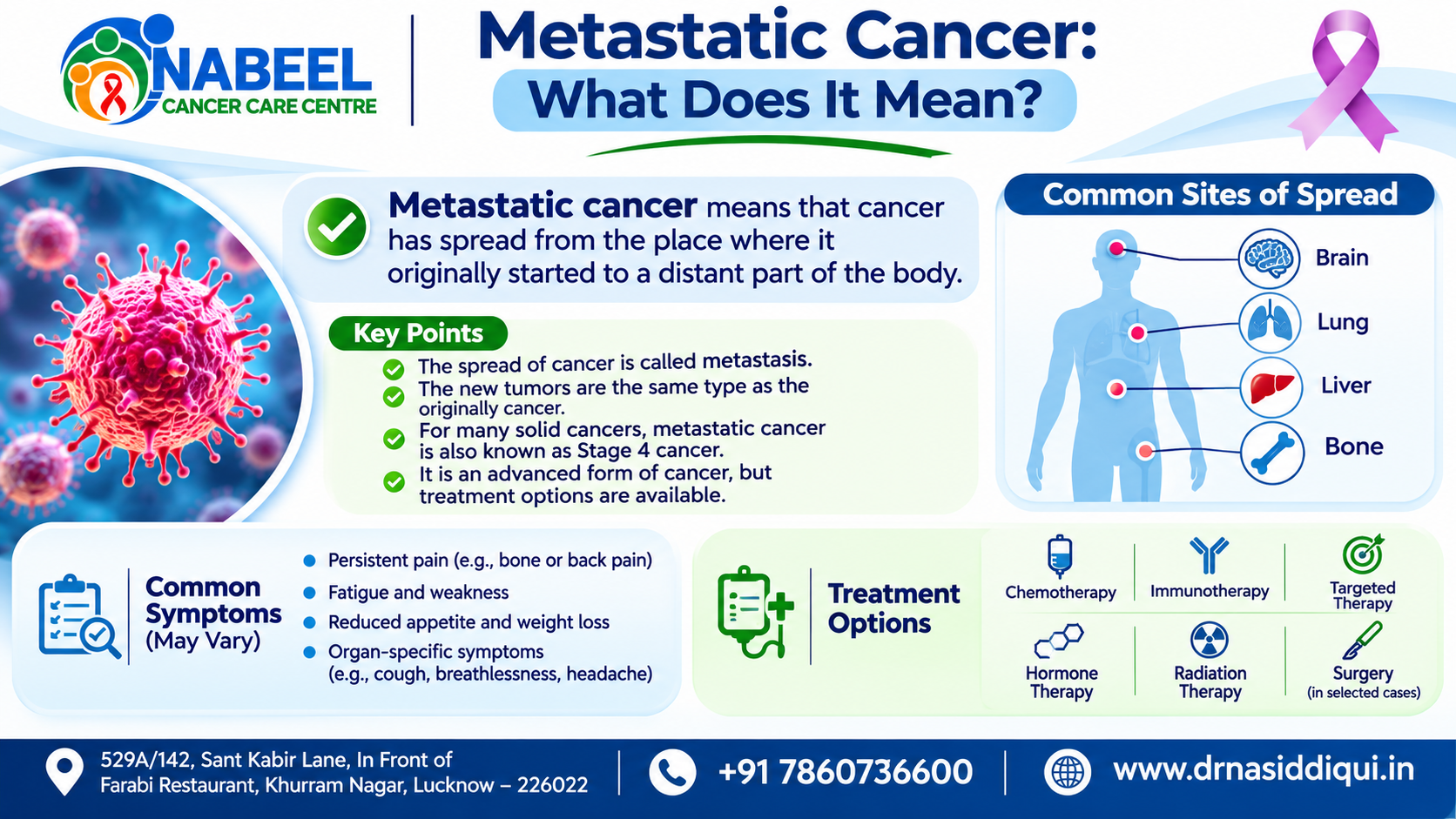
Metastatic cancer means that cancer has spread from the place where it originally started to a distant part of the body. The process of cancer spreading is called metastasis. For many solid cancers, metastatic disease is also described as Stage 4 cancer.
However, metastatic cancer is not one single disease. For example, metastatic breast cancer behaves differently from metastatic lung, colorectal, prostate or kidney cancer.
Therefore, treatment depends on much more than the word “metastatic.”
Doctors also consider the original cancer type, pathology, sites of spread, molecular characteristics, previous treatment and the patient’s overall health.
Patients seeking detailed treatment information can visit Metastatic Cancer Treatment in Lucknow – Dr. N. A. Siddiqui.
What Is Metastasis?
Metastasis is the process by which cancer cells move from the original, or primary, tumor to another part of the body.
Cancer cells may invade nearby tissue and enter blood vessels or lymphatic vessels. They can then travel to another part of the body, leave the circulation and begin growing there.
Importantly, the new tumor remains the same type of cancer as the original tumor.
For example, breast cancer that spreads to the lung is called metastatic breast cancer. It does not become lung cancer.
Similarly, colon cancer that spreads to the liver remains metastatic colon cancer.
This distinction is extremely important because doctors usually select treatment according to the primary cancer and its biology, rather than simply treating the organ where the metastasis is found.
Is Metastatic Cancer the Same as Stage 4 Cancer?
For many solid tumors, metastatic cancer is classified as Stage 4 or Stage IV.
However, staging systems differ between cancer types. In addition, blood cancers and some other malignancies may use different classification systems.
Therefore, the terms metastatic cancer and Stage 4 cancer are closely related, but they should not automatically be treated as identical across every cancer.
If you want a detailed explanation of Stage IV disease, visit Stage 4 Cancer Treatment in Lucknow.
Does Metastatic Cancer Mean Cancer Is Everywhere?
No.
Metastatic disease means cancer has spread to a distant location. However, the amount of spread can vary considerably.
For example, one patient may have only a small number of metastatic lesions. In contrast, another patient may have cancer involving several organs.
Consequently, two people with the same primary cancer can have very different disease burdens, symptoms, treatment options and outcomes.
This is why treatment should be personalized rather than based only on the word “metastatic.”
Where Can Cancer Spread?
Cancer can spread to almost any part of the body. However, different cancer types have characteristic patterns of spread.
For example, breast cancer often spreads to bone, liver, lung or brain. Prostate cancer frequently spreads to bone, while colorectal cancer commonly spreads to the liver or lung.
Likewise, lung cancer may spread to the brain, bone, liver or adrenal glands.
NCI notes that bone, liver and lung are among the most common sites of distant cancer spread overall.
Nevertheless, these are general patterns. An individual patient’s scans are required to determine where the cancer has actually spread.
How Does Cancer Spread?
Cancer spread is a complex biological process.
First, cancer cells can invade nearby tissue. Next, some cells may enter the bloodstream or lymphatic system. After travelling through the body, a small number of these cells may settle in another organ.
If the environment is suitable, they may begin growing and eventually form another tumor.
However, most cancer cells that enter circulation do not successfully form metastases. Metastasis requires several biological steps to occur successfully.
As a result, cancer spread is influenced by both the cancer cells themselves and the environment within other tissues.
What Are the Symptoms of Metastatic Cancer?
There is no single symptom that proves cancer has spread.
In fact, some metastatic cancers are discovered on imaging before they cause noticeable symptoms.
When symptoms occur, they usually depend on the location and size of the metastatic tumors.
For example, bone metastases may cause persistent bone or back pain. Liver involvement may cause abdominal discomfort, swelling or jaundice in selected patients.
Likewise, lung involvement may cause cough or breathlessness, while brain metastases may produce headaches, weakness, seizures, vomiting or balance problems.
General symptoms may include fatigue, reduced appetite, unexplained weight loss or weakness.
However, these symptoms can also have many non-cancerous causes. Therefore, imaging and appropriate diagnostic tests are required before metastasis can be confirmed.
How Is Metastatic Cancer Diagnosed?
Diagnosis usually begins with understanding the original cancer.
If cancer has already been confirmed, doctors may review the previous biopsy, pathology and imaging.
Additional investigations may include CT, MRI, PET-CT in selected situations, blood tests and other disease-specific imaging.
Meanwhile, pathology remains extremely important because treatment depends heavily on the exact cancer type.
For a broader explanation of diagnostic investigations, visit Cancer Tests & Diagnosis in Lucknow.
Is a Biopsy Always Needed?
A biopsy is often important when cancer is first diagnosed because it provides tissue for pathological examination.
It can identify the cancer type, subtype and sometimes important treatment-related biomarkers.
However, another biopsy is not automatically required every time metastatic disease is found.
For example, if a patient already has a confirmed diagnosis and imaging clearly fits the expected pattern of disease spread, existing tissue may sometimes provide enough information.
In contrast, repeat biopsy may be useful when the diagnosis is uncertain, the previous tissue sample is inadequate or additional molecular testing is required.
For more information, visit Biopsy for Cancer in Lucknow.
Why Is Biomarker Testing Important?
Modern metastatic-cancer treatment increasingly depends on tumor biology.
Depending on the cancer, doctors may evaluate genes, proteins or other biomarkers that can influence treatment selection.
For example, selected cancers may be tested for abnormalities involving EGFR, ALK, ROS1, KRAS, BRAF, HER2, BRCA, PD-L1 or MSI/MMR.
However, not every patient needs all of these tests.
Instead, the appropriate biomarkers depend on the primary cancer, stage, pathology and available treatment options.
Therefore, molecular testing should be selected and interpreted in the context of the patient’s complete diagnosis.
Can Metastatic Cancer Be Treated?
Yes.
There are treatments for most types of metastatic cancer. Often, the goal is to stop or slow cancer growth, reduce symptoms and maintain quality of life. Some patients can live for years with metastatic disease that remains well controlled.
However, treatment goals vary.
For many metastatic solid cancers, treatment focuses on long-term control rather than cure.
Nevertheless, selected situations may behave differently. Some cancers are especially sensitive to treatment, while patients with a limited number of metastases may sometimes be considered for more aggressive local treatment.
Therefore, the realistic treatment goal should always be discussed individually with the treating oncologist.
What Treatments Are Used?
Modern metastatic-cancer treatment may involve chemotherapy, immunotherapy, targeted therapy, hormone therapy, radiation, selected surgery and supportive care.
Which option is appropriate depends on the original cancer and its biological characteristics.
Chemotherapy
Chemotherapy remains an important systemic treatment for many advanced cancers.
Because chemotherapy travels through the bloodstream, it can reach cancer cells in different parts of the body.
However, chemotherapy is not one universal treatment. Breast cancer, lung cancer, colorectal cancer and ovarian cancer all use different chemotherapy regimens.
For more information, visit Chemotherapy in Lucknow – Dr. N. A. Siddiqui.
Immunotherapy
Immunotherapy helps the immune system recognize or attack cancer more effectively.
It has become an important option for selected patients with several advanced cancers.
However, it does not work for every cancer or every patient.
Therefore, tumor type, biomarker results, previous treatment and the patient’s general condition need to be reviewed before immunotherapy is selected.
Read more at Immunotherapy for Cancer in Lucknow.
Targeted Therapy
Targeted therapy acts against specific molecular abnormalities that cancer cells use to grow or survive.
For example, selected lung cancers may have actionable EGFR, ALK or other molecular changes.
Similarly, treatment-relevant biomarkers may be identified in breast, colorectal, ovarian and other cancers.
Therefore, targeted treatment can sometimes provide major benefit when the correct molecular target is present.
For more information, visit Targeted Therapy in Lucknow – Dr. N. A. Siddiqui.
Hormone Therapy
Some cancers depend on hormonal signals for growth.
Consequently, hormone therapy may be especially important in selected advanced breast cancers and prostate cancers.
In addition, hormonal treatment may sometimes be combined with targeted therapy or other systemic treatments.
Read more at Hormone Therapy for Cancer in Lucknow.
Radiation Therapy
Although metastatic disease is systemic, radiation can still be useful for specific metastatic sites.
For example, it may help control painful bone metastases, selected brain metastases, tumor-related bleeding or pressure on surrounding tissues.
Therefore, local treatment can still be an important part of advanced cancer care.
Can Metastatic Cancer Be Operated On?
Sometimes.
A metastatic diagnosis does not automatically mean surgery can never be used.
However, surgery is usually considered only in selected circumstances.
For example, surgery may help treat an obstruction, control bleeding or manage another complication.
In carefully selected patients with limited metastatic disease, surgery or another local treatment may also form part of a more aggressive treatment strategy.
Therefore, surgical decisions require individualized multidisciplinary assessment.
What Is Oligometastatic Cancer?
Oligometastatic cancer generally refers to a situation in which only a limited number of metastatic sites are present.
In selected cases, doctors may combine systemic therapy with focused local treatment such as surgery or stereotactic radiation.
However, this approach does not apply to everyone with a small number of lesions.
The primary cancer type, location of metastases, disease biology and overall health all matter.
How Is Treatment Chosen?
Treatment planning begins with the exact diagnosis.
Doctors may review pathology, imaging, previous treatment, organ function and general health.
In addition, molecular or biomarker testing can sometimes identify additional treatment options.
As a result, two patients with apparently similar metastatic cancers may receive different therapies because their tumors have different biological features.
This individualized approach is increasingly important in modern oncology.
How Do Doctors Know Whether Treatment Is Working?
Treatment response is usually assessed at planned intervals.
Doctors may evaluate symptoms, physical findings, blood tests and imaging such as CT or MRI.
PET-CT may also be useful in selected situations.
Depending on the results, cancer may be described as responding, stable or progressive.
If the disease progresses, the oncology team may consider another treatment strategy.
What Happens If the First Treatment Stops Working?
One treatment stopping working does not always mean treatment options are over.
Depending on the cancer, another option may include a different chemotherapy regimen, targeted therapy, immunotherapy, hormone therapy, radiation or another systemic treatment.
Furthermore, repeat molecular testing may occasionally identify a new actionable alteration.
Therefore, disease progression often requires reassessment rather than assuming that nothing more can be done.
Is Metastatic Cancer the Same as Terminal Cancer?
No.
Metastatic cancer and terminal cancer are not automatically the same thing.
Advanced cancer is a broad term. Some advanced cancers may be controlled for many years, while end-stage or terminal cancer generally refers to disease that can no longer be controlled with treatment.
Therefore, patients should not assume that a metastatic diagnosis automatically means they are at the end of life.
The prognosis depends on the exact cancer and its response to treatment.
Can Someone Live for Years With Metastatic Cancer?
Yes, some patients can.
However, survival varies widely.
Outcome depends on the primary cancer, tumor biology, location and amount of spread, available treatments, overall health and response to therapy.
Moreover, modern targeted medicines and immunotherapies have changed treatment expectations for selected cancers.
Therefore, online survival statistics cannot accurately predict the outcome of one individual patient.
Palliative Care and Metastatic Cancer
Palliative care is an important part of advanced cancer treatment.
However, it does not automatically mean that cancer-directed treatment has stopped.
Supportive and palliative care may be given alongside chemotherapy, immunotherapy, targeted therapy or hormone therapy.
It can help manage pain, nausea, fatigue, appetite problems, breathlessness and other symptoms.
NCI notes that palliative care can be provided at any point during metastatic-cancer treatment.
For detailed information, visit Palliative Cancer Care in Lucknow.
Should You Get a Second Opinion?
A second oncology opinion may be useful when metastatic cancer has recently been diagnosed, treatment options are complex or the cancer has progressed.
It may also help when biomarker testing has not been discussed or when a major change in treatment is being considered.
A second opinion does not necessarily mean the original oncologist is wrong.
Instead, it provides another specialist review of the pathology, imaging and available treatment strategy.
For more information, visit Cancer Second Opinion in Lucknow.
Metastatic Cancer Treatment in Lucknow – Dr. N. A. Siddiqui
Dr. N. A. Siddiqui is a Consultant Medical Oncologist & Hematologist in Lucknow.
His qualifications include MBBS, MD (Medicine) and DNB (Medical Oncology).
For patients with advanced or metastatic cancer, evaluation may involve review of pathology, imaging, sites of spread, previous therapies, biomarker reports, organ function, symptoms and overall health.
Based on these findings, treatment planning may involve chemotherapy, immunotherapy, targeted therapy, hormone therapy and supportive oncology care.
For dedicated treatment information, visit Metastatic Cancer Treatment in Lucknow – Dr. N. A. Siddiqui.
Patients with Stage IV disease can also visit Stage 4 Cancer Treatment in Lucknow.
For broader oncology consultation, visit Cancer Doctor in Lucknow – Dr. N. A. Siddiqui.
Nabeel Cancer Care Centre
529A/142, Sant Kabir Lane, In Front of Farabi Restaurant, Khurram Nagar, Lucknow – 226022
Appointment: +91 7860736600
Website: www.drnasiddiqui.in
Frequently Asked Questions
What does metastatic cancer mean?
Metastatic cancer means cancer has spread from the place where it originally started to a distant part of the body.
Is metastatic cancer always Stage 4?
For many solid cancers, metastatic disease is classified as Stage 4. However, staging systems vary between cancer types.
Is metastatic cancer curable?
Many metastatic solid cancers are treated with the goal of long-term control rather than cure. However, selected cancers and selected patients may have different treatment possibilities.
Can metastatic cancer be treated?
Yes. Treatment may include chemotherapy, immunotherapy, targeted therapy, hormone therapy, radiation or other individualized approaches.
Does metastatic cancer mean cancer is everywhere?
No. The disease may involve only one distant site or several sites.
Can metastatic cancer go into remission?
Some metastatic cancers can respond strongly to treatment. However, the meaning and duration of remission vary by cancer type.
Can someone live for years with metastatic cancer?
Yes. Some patients live for years with well-controlled metastatic cancer, although outcomes differ greatly between individuals.
Is metastatic cancer terminal?
Not automatically. Some metastatic cancers can be controlled for prolonged periods.
Is biopsy necessary?
Biopsy is important for confirming cancer type and biology. However, repeat biopsy is not required in every patient with known metastatic disease.
Why is biomarker testing important?
Biomarker testing may identify tumor characteristics that influence targeted therapy, immunotherapy or other treatment decisions.
Does palliative care mean cancer treatment has stopped?
No. Palliative care can be provided alongside active treatment to control symptoms and improve quality of life.
Conclusion
Metastatic cancer means that cancer has spread from its original location to a distant part of the body.
However, the diagnosis does not tell the entire story.
Treatment depends on the original cancer type, pathology, sites of spread, molecular characteristics, previous treatment and general health.
Modern metastatic-cancer treatment may involve chemotherapy, immunotherapy, targeted therapy, hormone therapy, radiation, selected surgery and supportive care.
Therefore, patients should not assume that metastatic disease means nothing more can be done.
Instead, the next step is to understand the exact cancer diagnosis, disease extent, tumor biology and available treatment options.
If you are seeking metastatic cancer treatment or a cancer specialist in Lucknow, Dr. N. A. Siddiqui provides individualized medical-oncology evaluation and treatment planning for patients with advanced and metastatic cancer.
Medical Disclaimer: This article is for general educational purposes only. It does not provide an individual diagnosis, prognosis or treatment recommendation. Treatment differs according to cancer type, pathology, molecular features, previous therapy and individual health.