

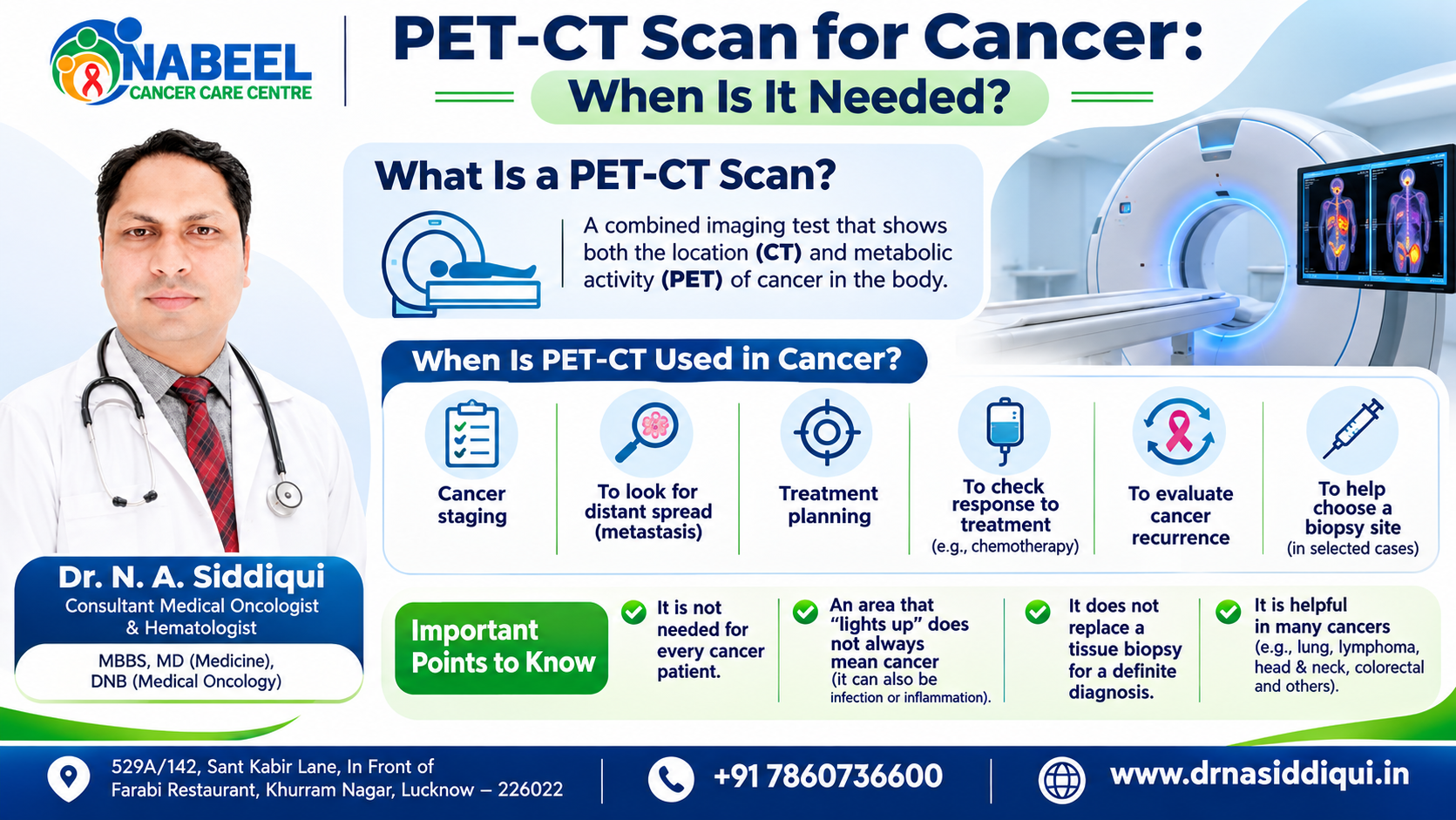
PET-CT Scan for Cancer: When Is It Needed?
A PET-CT scan is an important imaging test used in the evaluation of several types of cancer. However, it is not required for every patient or every cancer diagnosis.
Patients commonly ask questions such as:
- Why has my doctor advised a PET-CT?
- Does PET-CT confirm cancer?
- Can it show whether cancer has spread?
- Is PET-CT required before chemotherapy?
- Can it tell whether cancer treatment is working?
- Does every cancer patient need a PET scan?
The answer depends on the type of cancer, stage, symptoms, previous treatment and the clinical question doctors are trying to answer.
A PET-CT combines two different imaging techniques. The PET component shows areas of increased metabolic activity, while the CT component shows detailed anatomical structures.
Therefore, combining the two can help doctors understand both where an abnormal area is located and how metabolically active it appears.
For a broader overview of cancer investigations, visit Cancer Tests & Diagnosis in Lucknow.
What Is a PET-CT Scan?
PET-CT combines:
PET – Positron Emission Tomography
and
CT – Computed Tomography
Both scans are performed using the same combined scanner.
The CT part provides detailed images of structures inside the body. Meanwhile, the PET part provides information about metabolic activity in tissues.
As a result, doctors can compare abnormal metabolic activity with the exact anatomical location shown on CT.
This combined information can be useful for:
- Cancer staging
- Detecting possible metastatic disease
- Treatment planning
- Assessing treatment response
- Evaluating suspected recurrence
- Identifying an appropriate biopsy site in selected cases
However, a PET-CT result must always be interpreted together with the patient’s history, pathology and other investigations.
How Does a PET Scan Work?
A PET scan uses a small amount of radioactive material called a radiotracer.
For many cancer PET scans, a radioactive form of glucose known as FDG is used.
After the tracer is injected, it circulates through the body.
Many cancer cells use glucose at a higher rate than surrounding normal tissues. Consequently, they may take up more FDG and appear as areas of increased activity on the scan.
However, increased FDG uptake is not specific to cancer.
For example, infection and inflammation can also show increased activity.
Therefore, an area that “lights up” on PET does not automatically mean cancer is present.
PET Scan vs CT Scan: What Is the Difference?
A CT scan mainly shows anatomy and structure.
For example, CT can show:
- Tumor size
- Tumor location
- Enlarged lymph nodes
- Organ abnormalities
- Possible metastatic lesions
In contrast, PET provides information about metabolic activity.
Therefore, PET may help show whether particular tissue is unusually active.
When both are combined, doctors can match metabolic findings with anatomical structures.
As a result, PET-CT may provide more useful information than either scan alone in selected cancers.
Nevertheless, PET-CT does not replace CT, MRI or other imaging in every situation.
When Is PET-CT Needed for Cancer?
There are several situations in which PET-CT may be useful.
The most common reasons include:
- Helping with cancer staging
- Looking for distant spread
- Evaluating selected suspicious abnormalities
- Planning treatment
- Checking response to treatment
- Investigating possible cancer recurrence
- Helping identify a biopsy target in selected situations
However, the exact indication depends on the cancer type.
PET-CT for Cancer Staging
One of the most important uses of PET-CT is cancer staging.
Staging helps doctors determine:
- Where the cancer started
- How large or extensive it is
- Whether lymph nodes are involved
- Whether the disease has spread to distant organs
Therefore, PET-CT can sometimes change the stage originally suspected from other tests.
For example, a patient may appear to have localized disease on initial imaging. However, PET-CT may reveal an additional suspicious distant site that requires further evaluation.
Accurate staging matters because the treatment for localized cancer may be very different from treatment for metastatic disease.
For more information about staging, read Cancer Tests & Diagnosis in Lucknow.
Is PET-CT Used to Detect Metastatic Cancer?
Yes, in selected cancer types.
PET-CT can help doctors look for areas of possible distant spread.
Depending on the primary cancer, metastatic disease may involve:
- Bone
- Liver
- Lung
- Lymph nodes
- Other organs
However, PET-CT is not equally useful for every cancer.
Moreover, some metastatic lesions may be better evaluated using CT, MRI or another disease-specific imaging test.
Therefore, the correct imaging strategy depends on the exact cancer.
Patients with confirmed distant spread can learn more at Metastatic Cancer Treatment in Lucknow.
PET-CT and Stage 4 Cancer
For many solid cancers, Stage 4 means that the cancer has spread to a distant part of the body.
PET-CT may sometimes help detect or evaluate these metastatic sites.
However, PET-CT alone does not decide the entire treatment plan.
Doctors must also consider:
- Biopsy results
- Histological subtype
- Tumor grade
- Biomarkers
- Molecular findings
- Previous treatment
- General health
Therefore, imaging is only one part of modern cancer assessment.
For detailed information about advanced cancer, visit Stage 4 Cancer Treatment in Lucknow.
Does PET-CT Confirm Cancer?
Not always.
This is one of the most important limitations patients should understand.
An abnormal PET scan may indicate increased metabolic activity. However, increased activity can also occur because of:
- Infection
- Inflammation
- Healing after surgery
- Recent radiation
- Other non-cancerous conditions
Consequently, PET-CT cannot always determine whether an abnormal area is definitely cancer.
If a suspicious lesion needs confirmation, doctors may recommend a biopsy.
For more information about tissue diagnosis, visit Biopsy for Cancer in Lucknow.
Can a PET-CT Replace Biopsy?
Usually, no.
PET-CT can show where an abnormality is and how active it appears.
However, biopsy can provide information about:
- Cancer type
- Tumor subtype
- Tumor grade
- Receptors
- Biomarkers
- Molecular features
Therefore, PET-CT and biopsy answer different questions.
For many solid cancers, tissue examination remains essential before systemic cancer treatment is selected.
In selected situations, PET-CT may actually help doctors choose the most appropriate area to biopsy.
Is PET-CT Needed Before Every Cancer Treatment?
No.
A PET-CT should not be considered an automatic test before chemotherapy, immunotherapy or surgery.
Instead, imaging should be selected according to:
- Cancer type
- Cancer stage
- Existing scans
- Treatment plan
- Clinical guidelines
- Symptoms
For example, a CT or MRI may provide all the information needed in certain cancers.
In contrast, PET-CT may add important staging information in others.
Therefore, the decision should be individualized.
Which Cancers Commonly Use PET-CT?
PET-CT has an established role in several cancers, although its exact use varies by disease and treatment setting.
Examples may include selected cases of:
- Lung cancer
- Lymphoma
- Head and neck cancer
- Esophageal cancer
- Colorectal cancer
- Melanoma
- Cervical cancer
- Other malignancies
However, this does not mean PET-CT is required at every stage of these cancers.
Furthermore, certain tumors show relatively low FDG uptake. As a result, another imaging test may sometimes be more informative.
PET-CT in Lung Cancer
PET-CT can be particularly useful in selected patients with lung cancer.
It may help assess:
- Primary tumor activity
- Mediastinal lymph nodes
- Possible distant spread
Therefore, PET-CT may influence staging and treatment planning.
However, suspicious PET-positive lymph nodes or distant lesions may sometimes still require tissue confirmation if the result would change treatment.
PET-CT in Lymphoma
PET-CT has an important role in several types of lymphoma.
Depending on the exact lymphoma, it may be used for:
- Initial staging
- Response assessment
- End-of-treatment evaluation
However, interpretation should follow lymphoma-specific criteria.
Therefore, patients should not judge treatment response simply by comparing the brightness of two scan images themselves.
PET-CT in Breast Cancer
PET-CT is not automatically required for every newly diagnosed breast cancer.
In earlier-stage disease, other tests such as mammography, ultrasound, MRI or conventional staging scans may be more appropriate depending on the clinical situation.
However, PET-CT may be useful in selected patients when more extensive disease is suspected.
For disease-specific oncology information, visit Breast Cancer Doctor in Lucknow – Dr. N. A. Siddiqui.
PET-CT in Colorectal Cancer
In colorectal cancer, CT remains a major staging investigation.
However, PET-CT may be useful in selected situations, particularly when doctors need additional information regarding possible metastatic or recurrent disease.
Therefore, PET-CT should be used for a specific clinical question rather than automatically ordered for every patient.
PET Imaging in Prostate Cancer
Prostate cancer imaging can differ from conventional FDG PET imaging.
For selected prostate-cancer patients, PSMA PET-based imaging may be useful because it targets prostate-specific membrane antigen rather than relying solely on glucose metabolism.
Therefore, the term “PET scan” can refer to different tracers designed for different clinical purposes.
The appropriate tracer depends on the cancer and treatment question.
Can PET-CT Show Whether Chemotherapy Is Working?
Yes, in selected cancers.
PET-CT can sometimes help assess whether metabolic activity has decreased after treatment.
This may provide useful information about treatment response.
However, response assessment differs by cancer type.
Furthermore, imaging performed too soon after treatment may be difficult to interpret because inflammation or healing can also produce increased uptake.
Therefore, the timing of PET-CT should be decided by the oncology team.
PET-CT After Chemotherapy
After chemotherapy, doctors may use imaging to answer questions such as:
- Has the tumor decreased?
- Has metabolic activity reduced?
- Is the disease stable?
- Has the cancer progressed?
- Are there new suspicious areas?
However, PET-CT is not required after every chemotherapy cycle.
Instead, scans are generally performed at clinically appropriate intervals.
The exact timing depends on:
- Cancer type
- Treatment regimen
- Stage
- Symptoms
- Previous scan findings
Therefore, patients should not arrange frequent scans independently simply to “check the cancer.”
PET-CT After Radiation Therapy
Radiation treatment can cause inflammation in the treated area.
As a result, PET uptake may remain increased for a period after radiation.
Therefore, scans performed too soon after treatment can sometimes be difficult to interpret.
The oncology team will consider treatment timing when deciding when follow-up imaging is appropriate.
PET-CT for Cancer Recurrence
PET-CT may be useful in selected patients when doctors suspect that cancer has returned.
Suspicion may arise because of:
- New symptoms
- Rising tumor markers in selected cancers
- Abnormal CT or MRI
- Previous cancer history
PET-CT may help identify suspicious areas elsewhere in the body.
However, an abnormal PET finding still needs to be interpreted carefully.
In some situations, biopsy may be needed before a major treatment decision is made.
Can PET-CT Find Very Small Cancers?
Not always.
PET imaging has limitations in detecting very small tumors.
In addition, some slowly growing cancers may have low metabolic activity and may not show strong FDG uptake.
Therefore, a normal PET-CT does not guarantee that microscopic cancer is absent.
Likewise, a small tumor may sometimes be better identified by CT, MRI, mammography or another specialized test.
As a result, PET-CT should not be treated as a universal “whole-body cancer detector.”
Does Every Cancer Show Up on PET-CT?
No.
Some cancers show high uptake on FDG PET.
However, other tumors may be less metabolically active.
Furthermore, tumor size, blood glucose, treatment effects and several technical factors may influence the scan.
Therefore, a negative PET scan does not rule out every cancer.
The test must be interpreted according to the suspected disease.
What Does “FDG-Avid” Mean?
Patients sometimes see the term FDG-avid in their report.
It means that an area has taken up more FDG tracer.
However, FDG uptake alone does not prove that the area contains cancer.
For example, infection and inflammation can also be FDG-avid.
Therefore, radiologists interpret the uptake pattern alongside CT findings, location and clinical history.
What Does SUV Mean on a PET Scan?
PET reports may include a number called the SUV, or standardized uptake value.
SUV provides a semi-quantitative estimate of tracer uptake in an area.
However, there is no single SUV value that proves an abnormality is cancer.
SUV can be affected by:
- Scanner technique
- Timing
- Blood glucose
- Lesion size
- Inflammation
- Tumor biology
Therefore, patients should not diagnose themselves based on an SUV number alone.
How Do You Prepare for a PET-CT Scan?
Preparation depends on the tracer and imaging centre.
For standard FDG PET imaging, patients are commonly given specific instructions regarding food, sugary drinks, physical activity and medicines before the scan.
Importantly, follow the instructions provided by the imaging centre because preparation can affect scan quality.
Patients should inform the team if they:
- Have diabetes
- Are pregnant or may be pregnant
- Are breastfeeding
- Take regular medicines
- Have kidney problems
- Have allergies to contrast material
- Recently had surgery, radiation or another treatment
People with diabetes may require special scheduling or glucose-management instructions.
Therefore, do not change diabetes medicine or insulin without medical guidance.
What Happens During PET-CT?
Although protocols differ, the general process often involves several stages.
Radiotracer Injection
First, a small amount of radioactive tracer is injected into a vein.
Uptake Period
Next, the patient rests while the tracer distributes through the body.
Movement and muscle activity may affect uptake. Therefore, patients are usually asked to remain relaxed.
Scan
Afterwards, the patient lies on a table that moves through the PET-CT scanner.
It is important to remain still to reduce image blurring.
Image Review
Finally, the images are reconstructed and interpreted by a trained imaging specialist.
The report is then reviewed together with the patient’s other cancer records.
Is PET-CT Painful?
The scan itself is generally not painful.
The main discomfort usually comes from the intravenous injection.
However, lying still can be uncomfortable for some patients.
If you have severe pain, claustrophobia or difficulty remaining flat, inform the imaging team before the procedure.
Is PET-CT Safe?
PET-CT uses a radioactive tracer and CT uses ionizing radiation.
Therefore, the test involves radiation exposure.
However, when PET-CT is medically indicated, doctors consider whether the expected diagnostic benefit outweighs the radiation risk.
The test should not be repeated unnecessarily.
In addition, patients who are pregnant, could be pregnant or are breastfeeding should tell their healthcare team before the scan.
What About CT Contrast Dye?
Some PET-CT examinations may also use intravenous CT contrast.
Contrast can improve anatomical detail.
However, some patients may experience allergic reactions to contrast material.
In addition, kidney function may need consideration in people with existing kidney disease.
Therefore, tell the imaging team about:
- Previous contrast reactions
- Kidney problems
- Relevant medicines
- Other significant medical conditions
Does PET-CT Have Side Effects?
The PET radiotracer is generally well tolerated.
However, mild discomfort or swelling can occur at the injection site.
If contrast is used for the CT component, contrast-related reactions are also possible.
Most reactions are mild. Nevertheless, serious reactions can rarely occur.
Therefore, report any previous contrast allergy before the test.
How Long Does a PET-CT Take?
The actual scanning time may be shorter than the total appointment.
This is because patients usually need an uptake period after tracer injection before imaging begins.
Therefore, the complete visit can take considerably longer than the scan itself.
Your imaging centre can provide exact timing instructions for your specific examination.
When Will PET-CT Results Be Available?
Result timing differs between centres.
The scan must first be reviewed by a radiologist or nuclear-medicine specialist.
Afterwards, the report should be interpreted in the context of:
- Biopsy
- Pathology
- Previous imaging
- Treatment history
- Symptoms
Therefore, patients should avoid making treatment decisions based only on isolated wording in the PET report.
What Happens If PET-CT Shows a Suspicious Area?
A suspicious area does not automatically mean metastatic cancer.
Depending on the situation, the next step may include:
- Review of previous scans
- Targeted CT or MRI
- Clinical examination
- Biopsy
- Follow-up imaging
- Multidisciplinary review
For example, if PET shows a single unexpected lesion that would completely change the treatment plan, tissue confirmation may sometimes be especially valuable.
Therefore, the result should be reviewed by the treating oncology team.
Can PET-CT Replace All Other Cancer Tests?
No.
Cancer diagnosis and treatment planning may require several different types of information.
These can include:
- Biopsy
- Histopathology
- Blood tests
- CT
- MRI
- PET-CT
- Endoscopy
- Molecular testing
- Biomarker testing
Each test answers a different clinical question.
Therefore, PET-CT should be considered one part of the diagnostic process rather than a replacement for every other investigation.
Should Healthy People Get PET-CT for Cancer Screening?
PET-CT is generally not used as routine whole-body cancer screening for healthy people without a specific clinical indication.
An abnormal PET finding can sometimes reflect infection or inflammation rather than cancer.
Furthermore, PET-CT involves radiation exposure.
Therefore, cancer screening should follow evidence-based recommendations for specific cancers rather than routine PET scanning.
PET-CT and Biopsy: Which Comes First?
There is no universal sequence.
Sometimes biopsy is performed first to confirm the cancer diagnosis.
In contrast, PET-CT may occasionally be performed before biopsy when doctors need better information about disease extent or the most useful site to sample.
Therefore, the sequence depends on the clinical situation.
For more information about tissue sampling, visit Biopsy for Cancer in Lucknow.
PET-CT and Cancer Stage vs Cancer Grade
PET-CT mainly contributes information about the location and extent of disease.
Therefore, it may help with staging.
However, PET-CT cannot determine microscopic tumor grade.
Tumor grade is generally assessed by examining tissue under a microscope.
Therefore:
PET-CT helps with cancer staging.
Biopsy and pathology help determine cancer type and grade.
This distinction is important when interpreting cancer reports.
When Is a Second Opinion Useful?
Another oncology review may be useful when:
- PET findings are difficult to understand
- The scan suggests metastatic disease
- Imaging and biopsy do not match
- Treatment would change substantially because of a scan finding
- Cancer appears to have progressed
- Multiple treatment options are available
Importantly, bring the actual PET-CT images/CD along with the written report when possible.
For a medical-oncology review, visit Cancer Second Opinion in Lucknow.
Questions to Ask After a PET-CT Scan
Useful questions include:
- Why was PET-CT needed in my case?
- What did the scan show?
- Are the findings definitely cancer?
- Has my cancer stage changed?
- Is there evidence of distant spread?
- Do any findings require biopsy?
- Will this result change my treatment?
- Do I need another CT or MRI?
- When should the next scan be done?
- How will treatment response be monitored?
Therefore, discussing the report with the treating oncologist is usually more useful than trying to interpret individual terms online.
PET-CT Scan and Cancer Evaluation in Lucknow – Dr. N. A. Siddiqui
Dr. N. A. Siddiqui is a Consultant Medical Oncologist & Hematologist in Lucknow.
Qualifications:
- MBBS
- MD (Medicine)
- DNB (Medical Oncology)
Patients who already have PET-CT, CT, MRI or biopsy reports may require oncology review to determine what those findings mean for diagnosis, staging and treatment planning.
An oncology review may include:
- Biopsy and pathology
- PET-CT findings
- CT/MRI findings
- Cancer stage
- Tumor grade
- Biomarkers
- Molecular reports
- Previous treatment
- Treatment response
- General health
For a complete overview of cancer investigations, visit Cancer Tests & Diagnosis in Lucknow.
If imaging suggests distant spread, see Metastatic Cancer Treatment in Lucknow.
For Stage IV disease, visit Stage 4 Cancer Treatment in Lucknow.
For broader oncology consultation, visit Cancer Doctor in Lucknow – Dr. N. A. Siddiqui.
Nabeel Cancer Care Centre
529A/142, Sant Kabir Lane, In Front of Farabi Restaurant, Khurram Nagar, Lucknow – 226022
Appointment: +91 7860736600
Website: www.drnasiddiqui.in
Frequently Asked Questions
What is a PET-CT scan for cancer?
PET-CT combines metabolic information from PET with detailed anatomical information from CT.
Does a PET-CT confirm cancer?
Not always. Infection and inflammation can also produce increased tracer uptake. Therefore, biopsy may still be needed.
Is PET-CT required for every cancer patient?
No. The need for PET-CT depends on the cancer type, stage and clinical question.
Can PET-CT show whether cancer has spread?
Yes, PET-CT can help identify possible metastatic disease in selected cancers. However, other imaging may be more appropriate in some situations.
Can PET-CT detect Stage 4 cancer?
It can help detect distant disease in selected cancers. Nevertheless, Stage 4 diagnosis is based on the complete clinical and diagnostic picture.
Can PET-CT replace biopsy?
Usually no. Imaging shows abnormal areas, whereas biopsy provides tissue for diagnosis, grading and biomarkers.
Can infection show up on a PET scan?
Yes. Infection and inflammation can show increased FDG uptake and may resemble cancer on PET imaging.
Does every cancer light up on PET?
No. Some cancers have low FDG uptake, and very small lesions may not be detected.
What does FDG-avid mean?
It means the area has increased uptake of the FDG tracer. However, this finding does not by itself prove cancer.
Does a high SUV mean cancer?
Not necessarily. SUV is only one part of PET interpretation and can also be affected by inflammation and other factors.
Can PET-CT check whether chemotherapy is working?
Yes, in selected cancers. However, treatment-response imaging depends on the disease and treatment regimen.
Is PET-CT used after cancer treatment?
It may be used in selected situations to assess treatment response or suspected recurrence.
Is PET-CT safe?
PET-CT involves radiation exposure. Therefore, it should be performed when clinically appropriate rather than unnecessarily repeated.
Can I have PET-CT during pregnancy?
Pregnant or possibly pregnant patients should inform the healthcare team before PET-CT so the need for imaging and available alternatives can be assessed.
Is PET-CT a routine cancer screening test?
No. PET-CT is not routinely recommended as a general whole-body cancer-screening test for healthy people without a specific indication.
Conclusion
A PET-CT scan for cancer can provide valuable information about both the location and metabolic activity of abnormal tissue.
Depending on the cancer, doctors may use it for:
- Staging
- Evaluating possible metastatic disease
- Planning treatment
- Assessing treatment response
- Investigating suspected recurrence
- Selecting a biopsy target in certain situations
However, PET-CT is not required for every cancer patient.
Furthermore, increased PET activity does not automatically mean cancer because infection, inflammation and treatment-related changes can also produce abnormal uptake.
Therefore, PET-CT results should always be interpreted together with biopsy findings, pathology, other imaging and the patient’s clinical history.
Most importantly, do not repeat PET scans unnecessarily or make treatment decisions based solely on one PET report.
If you already have a PET-CT report, an oncology consultation can help determine what the findings mean for your cancer stage and treatment plan.
Medical Disclaimer: This article is for general educational purposes only. The need for PET-CT, scan preparation, contrast use, timing and interpretation vary according to cancer type and individual clinical circumstances.