

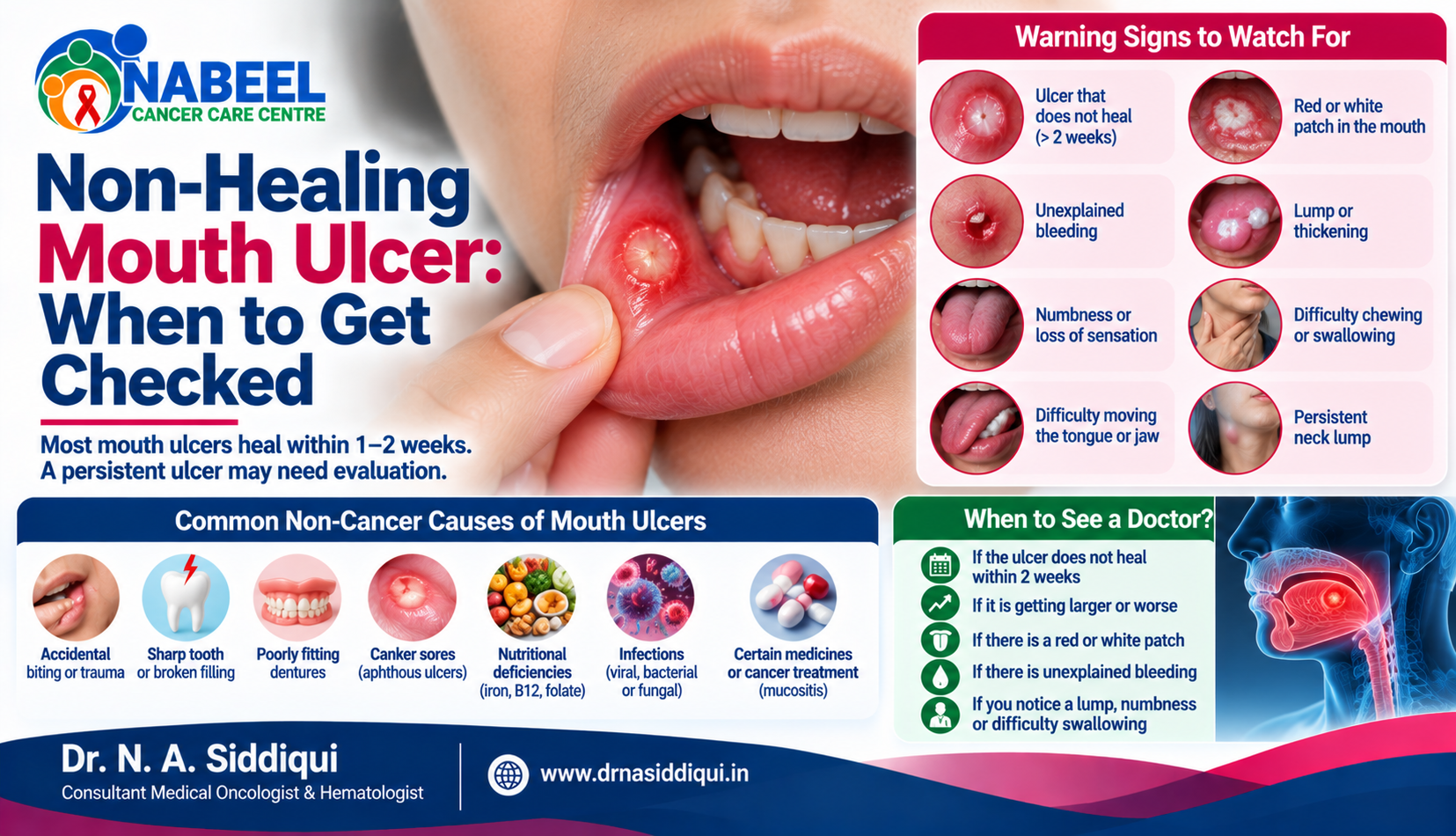
Non-Healing Mouth Ulcer: When to Get Checked
Mouth ulcers are extremely common.
Most are caused by minor problems such as accidental biting, irritation from a sharp tooth, stress or common canker sores. In most cases, these ulcers improve and heal on their own.
However, a mouth ulcer that does not heal should not be repeatedly ignored.
A persistent sore inside the mouth can occasionally be an early warning sign of oral or mouth cancer, particularly when it occurs with a red or white patch, unexplained bleeding, a lump, numbness, difficulty swallowing or a neck swelling.
Therefore, an important question is:
How long should you wait before getting a mouth ulcer checked?
Most common canker sores heal within approximately 1–2 weeks. Consequently, if an ulcer is still present after about two weeks, is getting larger or looks unusual, arranging a dental or medical examination is sensible. An ulcer that remains for three weeks clearly needs evaluation.
For a broader overview of possible cancer warning symptoms, read Early Signs of Cancer.
What Is a Mouth Ulcer?
A mouth ulcer is an open sore or break in the lining of the mouth.
It may appear on the:
- Tongue
- Inner cheek
- Inner lip
- Gums
- Floor of the mouth
- Roof of the mouth
- Area behind the teeth
A common aphthous ulcer, also called a canker sore, is often round or oval with a white or yellow centre and a red border.
Usually, these ulcers are painful, particularly while eating, drinking or speaking.
Nevertheless, not every oral ulcer follows the same pattern. Some persistent oral lesions may be relatively painless, which is why the absence of pain should not automatically provide reassurance.
How Long Does a Normal Mouth Ulcer Take to Heal?
Many minor mouth ulcers improve within a few days and heal within approximately one to two weeks.
For example, an ulcer caused by accidentally biting your cheek may gradually improve once the injured area is no longer being irritated.
Likewise, a typical canker sore often resolves without specific treatment.
However, an ulcer deserves closer attention when it:
- Does not start improving
- Remains present after about two weeks
- Gets larger
- Becomes harder
- Bleeds without obvious trauma
- Keeps returning in exactly the same place
- Develops alongside another suspicious mouth change
Therefore, duration and progression matter.
Does a Non-Healing Mouth Ulcer Mean Cancer?
No.
A persistent mouth ulcer does not automatically mean oral cancer.
In fact, many non-cancerous problems can cause ulcers.
However, a sore that does not heal is a recognized warning sign of oral cavity cancer. Therefore, persistent ulcers should be examined rather than diagnosed by appearance alone.
The Oral Cancer Doctor in Lucknow page explains other symptoms, diagnostic methods and treatment options for confirmed oral cancer.
Common Non-Cancer Causes of Mouth Ulcers
Several conditions can produce mouth ulcers.
1. Accidental Biting or Trauma
One of the simplest causes is injury.
For example, you may develop an ulcer after:
- Biting your cheek
- Biting your tongue
- Eating hard food
- Burning the mouth with hot food
- Dental treatment
- Sports injury
Usually, the ulcer heals once the tissue has time to recover.
However, repeated trauma can prevent healing.
2. Sharp Tooth or Broken Filling
A sharp tooth, broken filling or rough dental edge may continuously rub against the same part of the tongue or cheek.
As a result, the area may repeatedly ulcerate.
Therefore, if a sore occurs directly next to a sharp tooth, a dental examination may identify an obvious mechanical cause.
Nevertheless, if the ulcer remains after the irritation has been corrected, further assessment may still be necessary.
3. Poorly Fitting Dentures
Dentures can sometimes rub against oral tissue.
Consequently, repeated pressure may produce painful ulcers.
However, dentures that suddenly become uncomfortable can also occur with changes inside the mouth.
Therefore, a persistent ulcer beneath a denture should not simply be blamed on the denture without examination.
4. Canker Sores
Canker sores are common benign ulcers.
They may be associated with triggers such as:
- Minor trauma
- Emotional stress
- Hormonal changes
- Certain nutritional deficiencies
- Some systemic diseases
Typically, they are painful and heal without causing permanent damage.
However, severe, unusually large or repeatedly recurring ulcers may require medical evaluation.
5. Nutritional Deficiencies
Deficiencies involving nutrients such as:
- Iron
- Vitamin B12
- Folate
can sometimes be associated with recurrent oral ulcers.
Therefore, patients with repeated ulcers may occasionally need blood investigations depending on their clinical history.
6. Infections
Certain viral, bacterial or fungal infections can affect the mouth.
For example, some infections can produce ulcers, white patches, soreness or inflammation.
Nevertheless, persistent lesions should be properly diagnosed rather than repeatedly treated with random antibiotics or antifungal medicines.
7. Medicines and Medical Treatments
Some medicines can contribute to oral ulceration.
In addition, cancer treatments such as chemotherapy and radiation to the head and neck may cause oral mucositis, which can produce painful ulcer-like sores.
Therefore, cancer patients who develop mouth ulcers during treatment should inform their oncology team.
When Could a Mouth Ulcer Be Oral Cancer?
No appearance can confirm cancer without appropriate examination and, when required, biopsy.
However, certain characteristics may increase concern.
These include:
- Ulcer that does not heal
- Hardness around the ulcer
- Irregular or raised edges
- Unexplained bleeding
- Persistent red patch
- Persistent white patch
- Lump or thickening
- Numbness
- Difficulty moving the tongue
- Difficulty chewing
- Difficulty swallowing
- Persistent mouth pain
- Unexplained neck lump
- Unexplained weight loss
If these features are present, prompt evaluation becomes more important.
1. Mouth Ulcer Lasting More Than Two Weeks
Time is one of the most useful warning clues.
Most simple ulcers should show clear healing within approximately one to two weeks.
Therefore, if an ulcer remains unchanged after about two weeks, becomes worse or keeps enlarging, arrange an examination.
Furthermore, an ulcer persisting around three weeks should definitely not be ignored.
This does not mean the ulcer is cancer.
Instead, it means the cause needs to be identified.
2. Hardness Around the Ulcer
A traumatic or aphthous ulcer may be tender but relatively soft around the surrounding tissue.
In contrast, a suspicious lesion may sometimes feel firm or hardened.
Doctors call this induration.
However, touch alone is not enough to diagnose cancer.
Therefore, a persistent hard lesion requires proper examination.
3. Red or White Patch in the Mouth
Persistent red and white patches can occur for different reasons.
Some are benign.
However, certain persistent patches can represent precancerous changes or cancer.
They may occur on the:
- Tongue
- Inner cheek
- Gums
- Floor of the mouth
- Palate
Consequently, a red or white patch that does not disappear should be examined.
4. Unexplained Bleeding
An ulcer may occasionally bleed after being irritated by food or a toothbrush.
However, repeated spontaneous bleeding is different.
If a mouth lesion bleeds without a clear reason, particularly when it is persistent, further evaluation is appropriate.
5. Numbness of the Lip or Mouth
Persistent numbness, altered sensation or tingling in part of the mouth can have several causes.
Nevertheless, unexplained numbness associated with an oral lesion should be medically evaluated.
6. Difficulty Chewing or Swallowing
Difficulty chewing or swallowing may arise from dental problems, infections or other conditions.
However, persistent difficulty can also occur with cancers involving the mouth or throat.
Therefore, progressive swallowing difficulty should not be ignored.
7. Difficulty Moving the Tongue or Jaw
An oral lesion that affects tongue or jaw movement deserves prompt assessment.
For example, a person may notice:
- Reduced tongue movement
- Pain while moving the tongue
- Difficulty opening the mouth
- Difficulty chewing
These symptoms do not automatically indicate cancer.
Nevertheless, persistence makes further investigation important.
8. Lump in the Mouth or Neck
A lump inside the mouth may represent several benign conditions.
Similarly, enlarged neck lymph nodes frequently occur with infections.
However, a persistent unexplained neck lump can occasionally be associated with head-and-neck cancer.
Therefore, a mouth ulcer together with a persistent neck lump warrants evaluation.
9. Persistent Ear Pain
The mouth and throat share nerve pathways with the ear.
Consequently, disease in the oral cavity or throat can occasionally be perceived as ear pain even when the ear itself appears normal.
Persistent one-sided ear pain associated with a mouth or throat lesion should therefore be evaluated.
10. Unexplained Weight Loss
Weight loss has many causes.
However, persistent mouth symptoms accompanied by unexplained weight loss, reduced appetite or difficulty swallowing require medical attention.
For information about other cancer-warning symptoms, visit Early Signs of Cancer.
Where Can Oral Cancer Develop?
Oral cancer can develop in several parts of the mouth, including:
- Tongue
- Inner cheek
- Lips
- Gums
- Floor of the mouth
- Roof of the mouth
- Areas behind the molar teeth
Therefore, oral cancer does not always begin on the tongue.
Any persistent unexplained lesion inside the oral cavity should be assessed according to its location and appearance.
Mouth Ulcer on the Tongue: When Should You Worry?
Tongue ulcers are very common.
For example, accidentally biting the tongue or rubbing it against a sharp tooth can create a painful sore.
However, a tongue ulcer should be examined if it:
- Does not heal
- Continues beyond approximately two weeks
- Feels hard
- Becomes larger
- Bleeds repeatedly
- Causes numbness
- Affects tongue movement
- Is associated with a neck lump
A persistent lesion along the side or underside of the tongue is particularly important to have assessed because these are areas where oral cancer can occur.
Who Is at Higher Risk of Oral Cancer?
Several factors can increase oral-cancer risk.
Tobacco
Tobacco is one of the most important risk factors.
This includes:
- Cigarettes
- Bidis
- Cigars
- Chewing tobacco
- Khaini
- Gutkha
- Other smokeless tobacco products
Therefore, a persistent oral lesion in someone who uses tobacco requires particular attention.
Gutkha, Pan Masala and Areca Nut
Areca nut and betel-quid products are important oral-health risks.
Even products without tobacco are not automatically harmless.
Consequently, regular chewing of areca nut or related products can increase oral-cancer risk.
Alcohol
Heavy alcohol consumption increases oral and throat cancer risk.
Moreover, tobacco and heavy alcohol use together can increase risk substantially more than either exposure alone.
HPV
Certain human papillomavirus infections are strongly associated with some cancers of the oropharynx.
However, HPV-associated cancers more commonly involve areas such as the tonsils and base of the tongue rather than every type of oral cavity cancer.
Can Oral Cancer Occur Without Tobacco Use?
Yes.
Although tobacco is a major risk factor, oral cancer can occur in people who have never used tobacco.
Therefore, a persistent ulcer should not be dismissed solely because a patient:
- Does not smoke
- Does not chew tobacco
- Is relatively young
- Does not drink alcohol
Risk factors influence probability, but they do not provide a diagnosis.
Can a Mouth Ulcer Be Painless and Still Be Serious?
Yes.
Pain is not a reliable way to distinguish cancer from a benign lesion.
Some common ulcers are extremely painful, while some serious oral lesions may initially cause little discomfort.
Therefore, do not wait for a persistent mouth lesion to become painful before seeking evaluation.
How Is a Non-Healing Mouth Ulcer Examined?
The first step is usually a careful clinical examination.
A doctor or dentist may examine:
- Location of the ulcer
- Size
- Edges
- Surface
- Surrounding tissue
- Tongue
- Gums
- Inner cheeks
- Floor of the mouth
- Neck lymph nodes
In addition, they may ask about:
- Duration
- Tobacco use
- Gutkha or areca-nut use
- Alcohol consumption
- Trauma
- Dental problems
- Previous ulcers
- Weight loss
- Swallowing problems
Based on these findings, further Cancer Tests & Diagnosis may be recommended.
Does Every Mouth Ulcer Need a Biopsy?
No.
Most ordinary mouth ulcers do not need biopsy.
For example, a small typical canker sore that heals normally usually requires no tissue diagnosis.
However, biopsy may be recommended when a lesion is:
- Persistent
- Suspicious on examination
- Hard
- Irregular
- Unexplained
- Growing
- Associated with other warning signs
A Biopsy for Cancer provides tissue that can be examined by a pathologist.
Consequently, biopsy can determine whether a lesion is:
- Benign
- Precancerous
- Cancerous
- Related to another condition
Can a Doctor Diagnose Oral Cancer Just by Looking?
Not definitively.
An experienced clinician may identify a lesion that appears suspicious.
However, appearance alone generally cannot establish the exact diagnosis.
Therefore, when cancer is suspected, biopsy and histopathological examination are usually important for confirmation.
This also helps determine the exact cancer type.
What Happens If Oral Cancer Is Confirmed?
If biopsy confirms oral cancer, the next step is to determine the extent of disease and plan treatment.
Depending on the case, evaluation may include:
- Clinical examination
- CT scan
- MRI
- PET-CT in selected cases
- Neck lymph-node assessment
- Other staging investigations
Treatment may involve:
- Surgery
- Radiation therapy
- Chemotherapy
- Targeted therapy
- Immunotherapy
- A combination of treatments
Importantly, treatment depends on the tumor location, stage, lymph-node involvement, pathology and patient’s overall condition.
For detailed information, visit Oral Cancer Doctor in Lucknow – Dr. N. A. Siddiqui.
Should You Keep Applying Mouth Ulcer Gel and Wait?
For an ordinary short-lived ulcer, symptomatic treatments may help reduce discomfort.
However, repeatedly using gels, mouthwashes or home remedies for a lesion that is not healing can delay diagnosis.
Therefore, if an ulcer persists, the priority should shift from symptom relief to determining the underlying cause.
Similarly, repeated courses of antibiotics should not replace proper examination when the lesion remains unexplained.
What Can You Do While Waiting for an Appointment?
While waiting for medical or dental evaluation:
- Keep the mouth clean
- Use a soft toothbrush
- Avoid tobacco
- Avoid gutkha and areca nut
- Avoid alcohol
- Avoid very spicy foods
- Avoid sharp or crunchy foods irritating the ulcer
- Avoid repeatedly touching the lesion
- Maintain adequate fluid intake
However, these measures are only supportive.
They should not be used to delay assessment of a persistent lesion.
When Should You Seek More Urgent Medical Care?
Most mouth ulcers do not require emergency treatment.
Nevertheless, seek urgent medical care if you develop:
- Heavy bleeding that does not stop
- Severe mouth or throat swelling
- Difficulty breathing
- Severe difficulty swallowing liquids
- Significant dehydration
- Rapidly worsening facial or neck swelling
- Severe infection symptoms
These symptoms require assessment regardless of whether cancer is suspected.
Dr. N. A. Siddiqui – Oral Cancer Evaluation and Treatment in Lucknow
Dr. N. A. Siddiqui is a Consultant Medical Oncologist & Hematologist in Lucknow.
His qualifications include:
- MBBS
- MD (Medicine)
- DNB (Medical Oncology)
Patients with a suspicious oral lesion or a confirmed oral-cancer biopsy may need coordinated evaluation involving dental, surgical, radiation and medical-oncology specialists depending on the diagnosis.
If oral cancer is confirmed, medical-oncology treatment may include chemotherapy, targeted treatment or immunotherapy in selected situations.
For detailed information, visit Oral Cancer Doctor in Lucknow.
Additionally, patients with a confirmed cancer diagnosis who require broader oncology consultation can visit Cancer Doctor in Lucknow – Dr. N. A. Siddiqui.
Frequently Asked Questions
How long is too long for a mouth ulcer?
Many common ulcers heal within approximately one to two weeks. Therefore, an ulcer that is not healing after about two weeks should be assessed, especially if it is worsening or has suspicious features. An ulcer lasting three weeks clearly needs medical or dental evaluation.
Does every non-healing mouth ulcer mean cancer?
No. Trauma, dental irritation, infections and several benign conditions can cause persistent ulcers. However, oral cancer is one important possibility that needs to be excluded.
What does an oral cancer ulcer look like?
There is no single appearance that confirms cancer. However, a persistent ulcer may sometimes have irregular edges, surrounding hardness, unexplained bleeding or associated red or white patches.
Is a painful mouth ulcer more likely to be cancer?
Not necessarily. Most common canker sores can be very painful. Conversely, some oral cancers may initially cause little or no pain.
Can a sharp tooth cause a non-healing ulcer?
Yes. Continuous rubbing from a sharp tooth can prevent an ulcer from healing. However, if the lesion persists after the source of irritation is corrected, further evaluation is appropriate.
Can gutkha cause oral cancer?
Gutkha and other smokeless-tobacco or areca-nut products are associated with oral-cancer risk. Therefore, persistent oral changes in regular users should not be ignored.
Can oral cancer occur in a non-smoker?
Yes. Tobacco increases risk, but oral cancer can occur in people who have never smoked or chewed tobacco.
Is a white patch in the mouth cancer?
Not necessarily. White patches have several possible causes. Nevertheless, a persistent unexplained white or red patch should be examined.
Does every oral lesion require a biopsy?
No. Typical ulcers that heal normally generally do not need biopsy. However, suspicious or persistent lesions may require tissue sampling.
Which doctor should I consult for a non-healing mouth ulcer?
A dentist, oral specialist or ENT doctor may provide the initial assessment. If cancer is suspected or confirmed, further evaluation by the appropriate head-and-neck cancer team and oncologist may be required.
Conclusion
Most mouth ulcers are harmless and heal naturally.
However, a mouth ulcer that fails to heal should not be repeatedly ignored.
Arrange an examination particularly when the ulcer:
- Persists beyond about two weeks
- Continues to grow
- Feels hard
- Bleeds repeatedly
- Occurs with a red or white patch
- Causes numbness
- Interferes with tongue movement
- Causes difficulty swallowing
- Occurs with a persistent neck lump
Most importantly, a persistent mouth ulcer does not automatically mean cancer.
Instead, medical evaluation is necessary to determine why it is not healing.
If the lesion appears suspicious, biopsy can provide a definite tissue diagnosis. Then, if oral cancer is confirmed, accurate staging can guide the most appropriate treatment.
Early evaluation is particularly important for people who smoke, chew tobacco, use gutkha, khaini or areca-nut products.
Medical Disclaimer: This article is for general educational purposes only and does not replace examination, diagnosis, biopsy recommendations or individualized treatment advice from a qualified healthcare professional.