

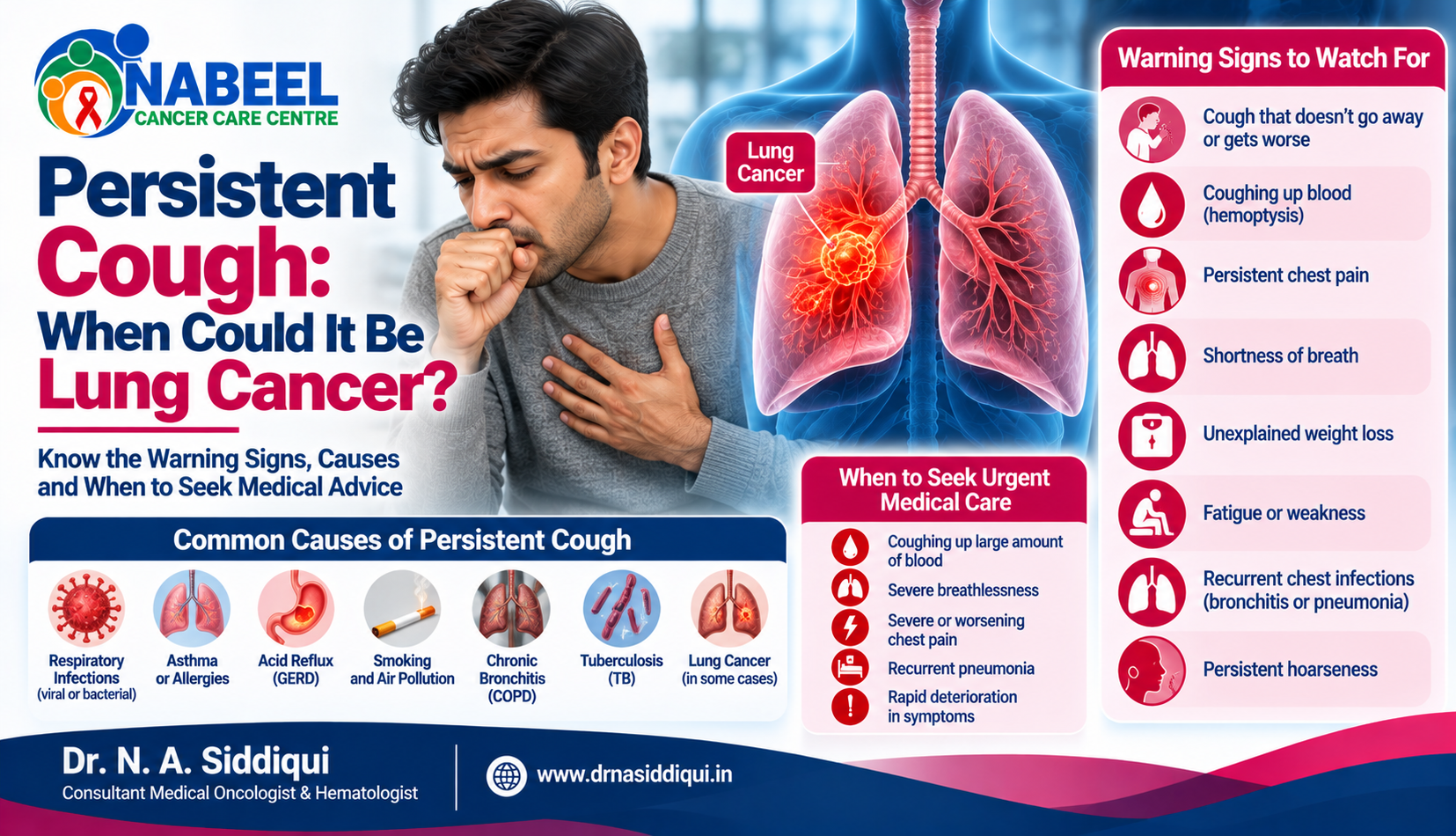
Persistent Cough: When Could It Be Lung Cancer?
A cough is one of the most common health symptoms. In most cases, it is caused by a respiratory infection, allergy, asthma, acid reflux, air pollution or another non-cancerous condition.
However, a cough that does not go away, becomes progressively worse or changes from your usual cough should not be repeatedly ignored.
Although most persistent coughs are not caused by cancer, a long-lasting or worsening cough can sometimes be one of the early signs of cancer, particularly when it occurs with coughing up blood, chest pain, breathlessness, unexplained weight loss or recurrent chest infections.
Therefore, the important question is not simply whether you are coughing. Instead, you need to consider how long the cough has lasted, whether it is changing and whether other warning symptoms are present.
How Long Is a Cough Considered Persistent?
Coughs can last for different periods depending on their cause. For example, a cough following a viral respiratory infection may continue even after fever and other symptoms have improved.
Nevertheless, a cough deserves medical evaluation when it continues for several weeks, does not improve as expected or gradually becomes worse.
In addition, doctors pay particular attention when a cough:
- Continues for several weeks
- Gets progressively worse
- Changes from your usual cough
- Produces blood
- Causes persistent chest discomfort
- Occurs with unexplained breathlessness
- Occurs with unexplained weight loss
Importantly, there is no single number of days that can diagnose lung cancer. Instead, doctors consider the entire symptom pattern and the patient’s individual risk factors.
Does a Persistent Cough Mean Lung Cancer?
Usually, no.
Many non-cancerous conditions are much more common causes of persistent coughing. For instance, viral infections, asthma, allergies, postnasal drip and acid reflux can all lead to a cough that lasts longer than expected.
Similarly, chronic bronchitis, COPD, smoking-related airway irritation, air pollution, tuberculosis and certain medicines can also cause chronic coughing.
Therefore, a persistent cough should be considered a symptom rather than a diagnosis.
However, lung cancer becomes one of the conditions doctors may need to exclude when the cough remains unexplained, continues to worsen or occurs with additional warning signs.
Consequently, if imaging shows a suspicious lung abnormality, further evaluation through a Lung Cancer Doctor in Lucknow may be appropriate.
What Does a Lung Cancer Cough Feel Like?
There is no unique type of cough that confirms lung cancer.
For example, a lung-cancer-related cough may be dry in one patient but productive in another. Likewise, it may initially be mild and gradually become more frequent.
More importantly, some people notice a change in a cough they have had for years.
A person who smokes, for instance, may already have a regular morning cough. However, if that cough becomes deeper, more frequent, painful or associated with blood, the change should not be ignored.
Therefore, doctors are often more interested in a change in the pattern of coughing than in the sound of the cough itself.
Warning Signs That Should Not Be Ignored
A persistent cough deserves greater attention when other symptoms occur at the same time.
1. Coughing Up Blood
Coughing up blood is medically known as hemoptysis.
Blood may appear as small red streaks in mucus, rust-colored sputum or bright-red blood.
Although respiratory infections and other non-cancerous conditions can cause blood in sputum, lung cancer is also a possible cause.
Therefore, repeated or unexplained coughing up of blood should be medically evaluated.
Moreover, if a person coughs up a large amount of blood or develops severe breathing difficulty, urgent medical attention may be required.
2. Persistent Chest Pain
Chest discomfort can result from several common conditions.
For example, muscle strain, acid reflux, infection and inflammation can all cause chest pain.
However, lung cancer can occasionally cause persistent chest discomfort, particularly when pain worsens during coughing, laughing or deep breathing.
Therefore, persistent unexplained chest pain combined with a long-lasting cough should be assessed rather than repeatedly treated at home.
3. Shortness of Breath
Breathlessness has many possible causes.
For instance, asthma, COPD, anemia, heart disease and respiratory infections can all make breathing difficult.
However, lung cancer can also cause breathlessness if a tumor narrows an airway, affects lung tissue or leads to fluid around the lung.
Consequently, breathlessness that persists or progressively worsens should be medically evaluated.
Furthermore, sudden severe breathing difficulty should receive urgent medical attention regardless of the cause.
4. Unexplained Weight Loss
Weight loss associated with dietary changes or exercise is expected.
In contrast, losing weight without trying may require investigation.
Cancer is not the only possible cause. Nevertheless, a persistent cough combined with unexplained weight loss, reduced appetite or fatigue deserves medical attention.
For broader information about warning symptoms, read Early Signs of Cancer.
5. Persistent Fatigue
Everyone feels tired occasionally.
However, fatigue that continues despite adequate rest can sometimes indicate an underlying medical problem.
For example, anemia, thyroid disorders, infection and nutritional deficiencies commonly cause fatigue.
Nevertheless, persistent fatigue becomes more concerning when it occurs together with chronic cough, weight loss, breathlessness, chest pain or recurrent infections.
6. Recurrent Chest Infections
Bronchitis and pneumonia are common illnesses.
However, infections that repeatedly occur in the same part of the lung or do not resolve as expected may prompt further investigation.
In some cases, an abnormality in an airway can interfere with normal drainage and increase the risk of repeated infection.
Therefore, recurrent pneumonia should not automatically be assumed to be a series of unrelated infections.
7. New Wheezing
Wheezing is most commonly associated with asthma and other airway disorders.
Still, new or unexplained persistent wheezing can sometimes require further investigation.
Especially when wheezing occurs with a persistent cough, chest pain or unexplained weight loss, medical assessment may be appropriate.
8. Persistent Hoarseness
Hoarseness is often caused by infection, voice strain or acid reflux.
However, a voice change that continues without an obvious explanation may occasionally occur with lung or head-and-neck cancers.
Therefore, persistent hoarseness should be evaluated rather than repeatedly ignored.
Who Is at Higher Risk of Lung Cancer?
Several factors can increase the risk of developing lung cancer.
Smoking
Smoking is the most important known risk factor for lung cancer.
Generally, risk increases with both the amount smoked and the duration of smoking.
However, stopping smoking is beneficial at any age because the risk gradually decreases after quitting.
Secondhand Smoke
People who do not smoke themselves may still be exposed to cigarette smoke from others.
As a result, long-term secondhand-smoke exposure can also increase lung-cancer risk.
Occupational Exposure
Certain workplace exposures may contribute to risk.
For example, asbestos, silica, radon and some industrial substances are associated with increased lung-cancer risk.
Therefore, occupational history can be important when a doctor evaluates unexplained persistent respiratory symptoms.
Air Pollution
Long-term exposure to air pollution may also contribute to lung-cancer risk.
Nevertheless, exposure does not mean that someone will definitely develop cancer.
Family and Genetic Factors
Some people may have increased susceptibility because of family or genetic factors.
However, having a family history of lung cancer does not mean lung cancer is inevitable.
Can Non-Smokers Develop Lung Cancer?
Yes.
Although smoking is the major risk factor, lung cancer can also develop in people who have never smoked.
For example, secondhand smoke, radon, air pollution, occupational exposures and certain genetic factors may contribute.
Therefore, a concerning persistent cough should not be dismissed simply because someone has never smoked.
How Is a Persistent Cough Investigated?
The diagnostic process depends on the patient’s symptoms, medical history and risk factors.
First, the doctor may ask several questions.
These may include:
- How long has the cough been present?
- Is it improving or worsening?
- Is it dry or productive?
- Is there blood in sputum?
- Is there chest pain?
- Is there breathlessness?
- Has there been unexplained weight loss?
- Is there a smoking history?
- Are chest infections recurring?
Next, a physical examination may be performed.
Depending on the findings, additional cancer tests and diagnostic investigations may be recommended.
Chest X-Ray
A chest X-ray may be one of the first imaging tests used when persistent respiratory symptoms require investigation.
For example, it may identify infection, certain masses, fluid collections or other lung abnormalities.
However, a normal chest X-ray cannot rule out every lung cancer.
Therefore, if symptoms remain concerning, more detailed imaging may be required.
CT Scan of the Chest
A CT scan provides more detailed cross-sectional images of the lungs.
As a result, CT can detect smaller or more subtle abnormalities that may not be obvious on a standard chest X-ray.
A CT scan may identify:
- Lung nodules
- Lung masses
- Enlarged lymph nodes
- Pleural abnormalities
- Other chest disease
If a suspicious lesion is identified, doctors may recommend further testing.
You can read more about the diagnostic process at Cancer Tests & Diagnosis in Lucknow.
Does a Lung Nodule Mean Cancer?
No.
Lung nodules are relatively common and can develop for several reasons.
For example, previous infection, inflammation, scarring and benign growths can all produce nodules.
However, some nodules represent cancer.
Therefore, doctors consider the nodule’s size, shape, border, growth over time, CT characteristics and the patient’s risk factors.
In some cases, follow-up imaging may be all that is required. In other cases, additional investigation may be recommended.
PET-CT and Lung Cancer
PET-CT may be useful in selected patients after a suspicious lung abnormality has already been identified.
For instance, it may help evaluate suspicious lymph nodes or determine whether cancer has spread to another part of the body.
However, PET-CT is not automatically required for every persistent cough.
Instead, its use depends on the results of earlier investigations and the suspected diagnosis.
How Is Lung Cancer Confirmed?
Imaging can suggest cancer, but it usually cannot determine the exact cancer type on its own.
Therefore, tissue may need to be obtained for pathological examination.
A biopsy for cancer allows a pathologist to examine the cells or tissue under a microscope.
Depending on the location of the abnormality, tissue may be obtained through:
- Bronchoscopy
- CT-guided biopsy
- Needle biopsy
- Lymph-node sampling
- Other appropriate procedures
Once the pathology result is available, doctors can determine what type of lung cancer is present.
Small Cell vs Non-Small Cell Lung Cancer
Lung cancers are broadly divided into two major groups.
Non-Small Cell Lung Cancer
Non-small-cell lung cancer, or NSCLC, is the most common broad group.
It includes adenocarcinoma, squamous-cell carcinoma and other subtypes.
Small Cell Lung Cancer
Small-cell lung cancer generally behaves more aggressively and is treated differently.
Therefore, confirming the exact pathology is essential before starting treatment.
Why Is Biomarker Testing Important?
Modern lung-cancer treatment increasingly depends on tumor biology.
For selected non-small-cell lung cancers, doctors may test for molecular alterations involving:
- EGFR
- ALK
- ROS1
- BRAF
- KRAS
- MET
- RET
- NTRK
- Other clinically relevant biomarkers
Additionally, PD-L1 testing may help determine whether immunotherapy could be appropriate.
This approach is part of Precision Oncology.
As a result, two patients with apparently similar lung cancers may receive different treatments because their tumors have different molecular characteristics.
Can Lung Cancer Be Treated?
Yes.
Treatment depends on the cancer type, stage, molecular profile, tumor location and patient’s overall health.
Depending on these factors, treatment may include:
- Surgery
- Radiation therapy
- Chemotherapy
- Targeted therapy
- Immunotherapy
- Combinations of treatments
For example, some early-stage lung cancers can be treated with curative intent.
Meanwhile, advanced lung cancers may be treated with systemic therapies such as targeted therapy, immunotherapy or chemotherapy depending on tumor characteristics.
For detailed information, visit Lung Cancer Doctor in Lucknow – Dr. N. A. Siddiqui.
Lung Cancer Screening vs Diagnostic Testing
Screening and diagnosis are not the same.
Screening is intended for selected people at increased risk who do not have symptoms.
In contrast, diagnostic testing is performed because symptoms or abnormal findings are already present.
Therefore, someone with persistent cough, coughing up blood or unexplained chest pain should undergo an appropriate diagnostic evaluation rather than relying only on a screening test.
When Should You See a Doctor?
Consider medical evaluation when a cough:
- Persists for several weeks
- Continues to worsen
- Changes from your normal cough
- Produces blood
- Occurs with chest pain
- Causes increasing breathlessness
- Occurs with unexplained weight loss
- Is associated with significant fatigue
- Occurs with repeated chest infections
Furthermore, urgent medical evaluation may be needed for significant coughing up of blood, severe breathing difficulty, severe chest pain, fainting or rapidly worsening symptoms.
The purpose is not to assume cancer.
Instead, the goal is to determine why the cough is persisting.
Dr. N. A. Siddiqui – Lung Cancer Doctor in Lucknow
Dr. N. A. Siddiqui is a Consultant Medical Oncologist & Hematologist in Lucknow.
His qualifications include:
- MBBS
- MD (Medicine)
- DNB (Medical Oncology)
- MRCP (UK)
- PDCR
- Certificate in Immuno-Oncology
- ESMO Certified Medical Oncologist
Patients with a suspicious lung mass or confirmed lung cancer may require assessment of pathology, cancer subtype, stage, molecular biomarkers, PD-L1 and previous treatments.
Based on these findings, treatment may involve chemotherapy, targeted therapy, immunotherapy, radiation therapy or multidisciplinary care.
For lung-cancer-specific treatment information, visit Lung Cancer Doctor in Lucknow.
Additionally, patients seeking broader oncology consultation can visit Cancer Doctor in Lucknow – Dr. N. A. Siddiqui.
Frequently Asked Questions
How long should a cough last before I worry about lung cancer?
There is no specific duration that proves cancer. However, a cough lasting several weeks, getting worse or occurring with other warning symptoms deserves evaluation.
Does every persistent cough mean lung cancer?
No. In fact, infections, allergies, asthma, reflux and chronic airway disorders are much more common causes.
What type of cough occurs with lung cancer?
There is no unique lung-cancer cough. Instead, doctors look for persistence, worsening symptoms or a change from the person’s usual cough.
Is coughing up blood always cancer?
No. However, unexplained or recurrent coughing up of blood should be medically evaluated.
Can lung cancer occur without coughing?
Yes. For example, some early lung cancers may cause no noticeable cough.
Can a chest X-ray rule out lung cancer?
Not completely. Therefore, CT or additional testing may be recommended when symptoms remain concerning.
Can non-smokers develop lung cancer?
Yes. Although smoking is the major risk factor, lung cancer also occurs in never-smokers.
Does recurrent pneumonia mean lung cancer?
Usually not. Nevertheless, repeated infection in the same region or pneumonia that does not resolve may prompt further investigation.
Is early lung cancer treatable?
Yes. In some cases, early-stage lung cancer can be treated with curative intent.
Does every lung cancer patient need chemotherapy?
No. Depending on stage and tumor biology, treatment may involve surgery, radiation, targeted therapy, immunotherapy, chemotherapy or combinations.
Conclusion
A persistent cough does not automatically mean lung cancer.
In fact, most long-lasting coughs are caused by non-cancerous conditions.
However, a cough deserves further evaluation when it does not improve, progressively worsens, changes from your usual cough or occurs with blood in sputum, chest pain, breathlessness, unexplained weight loss or recurrent infections.
Therefore, rather than trying to determine the diagnosis from the cough itself, the best approach is to investigate why the symptom is continuing.
If imaging identifies a suspicious lung abnormality, then additional testing such as biopsy can determine whether cancer is present.
Finally, if lung cancer is confirmed, treatment should be individualized according to pathology, stage, molecular characteristics and the patient’s overall health.
Medical Disclaimer: This article is for general educational purposes and does not replace medical examination, diagnostic testing or individualized treatment recommendations.