

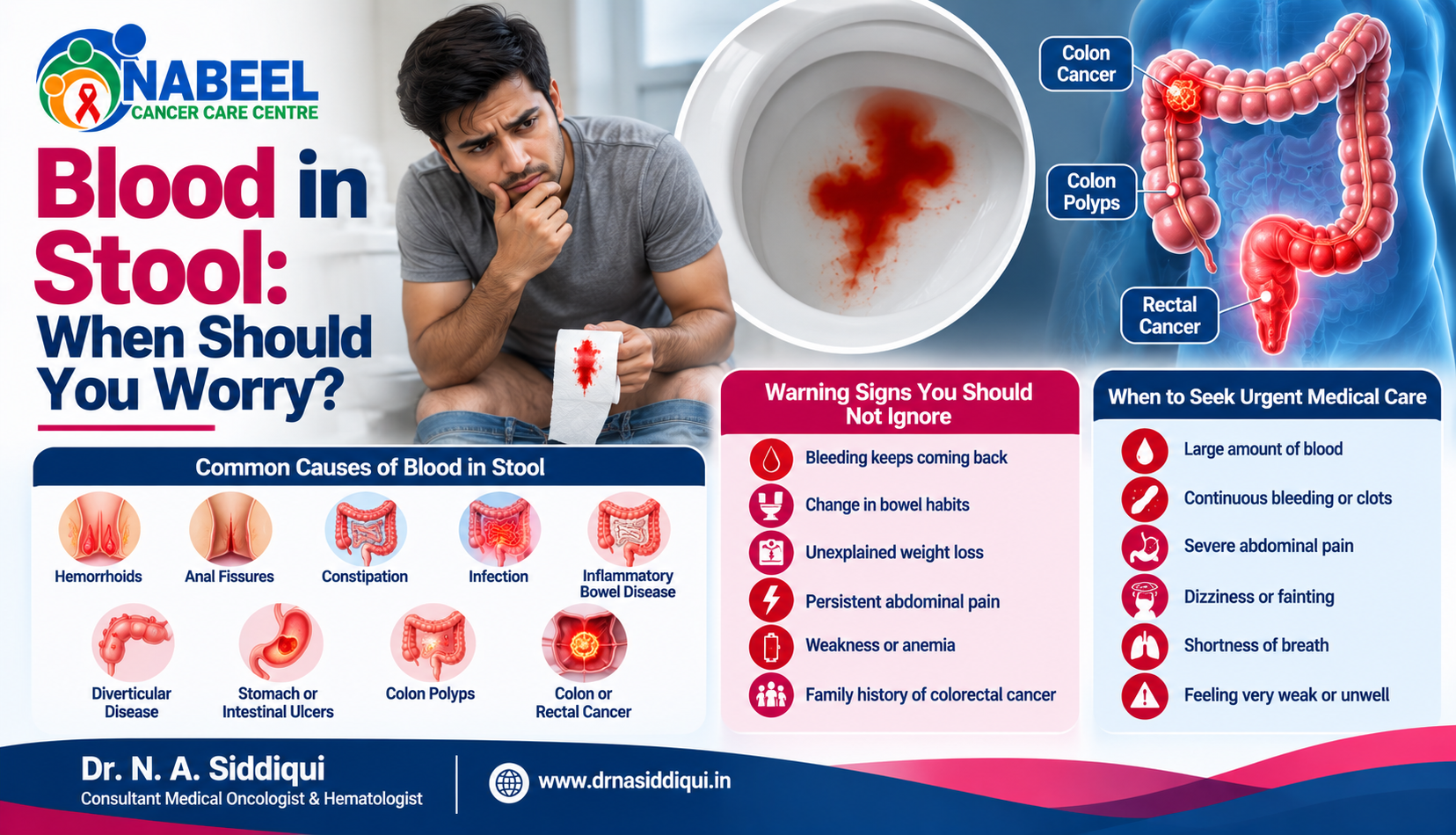
Blood in Stool: When Should You Worry?
Seeing blood in your stool can be alarming.
For many people, the first thought is: “Could this be cancer?”
The reassuring fact is that blood in stool has many possible causes, and most are not cancer. Hemorrhoids, anal fissures, constipation, infections, inflammatory bowel disease and ulcers can all cause gastrointestinal bleeding.
However, blood in or on the stool should not repeatedly be ignored, particularly when the bleeding is unexplained, persistent, recurrent or accompanied by other symptoms such as a change in bowel habits, abdominal pain, unexplained weight loss or anemia.
Blood in stool is also one of the possible warning signs of colon and rectal cancer.
The CDC lists blood in or on the stool, persistent bowel changes, abdominal pain, unexplained weight loss and iron-deficiency anemia among possible colorectal-cancer symptoms.
The important message is:
Do not panic—but do not assume that every episode of bleeding is “just piles” without appropriate evaluation.
What Does Blood in Stool Look Like?
Blood from the digestive tract does not always look the same.
Its appearance may provide clues about where the bleeding is coming from, although color alone cannot establish the diagnosis.
Bright Red Blood in Stool
Bright red blood may appear:
- On toilet paper
- On the outside of stool
- As drops in the toilet
- Mixed with stool
Small amounts of bright red blood often arise from the lower digestive tract, including the anus or rectum.
Common causes include hemorrhoids and anal fissures, but polyps, inflammatory conditions and colorectal cancer can also cause bright red bleeding.
The American Cancer Society notes that bright red blood often suggests bleeding from the lower gastrointestinal tract.
Dark Red or Maroon Blood
Dark red or maroon-colored stool may indicate bleeding from further inside the gastrointestinal tract.
The exact source cannot be determined simply by looking at the color.
Medical assessment may be required, especially if bleeding is recurrent or significant.
Black or Tarry Stool
Black, sticky or tar-like stool can sometimes indicate bleeding from higher in the gastrointestinal tract, such as the stomach or upper intestine.
Certain medicines and supplements—especially iron—can also darken stool.
Therefore, black stool should be interpreted according to the person’s medicines, symptoms and medical history.
Sudden black tarry stool, particularly with weakness, dizziness or vomiting blood, can require urgent medical attention.
Does Blood in Stool Mean Cancer?
No.
Blood in stool does not automatically mean cancer.
The American Cancer Society lists several non-cancerous causes, including:
- Hemorrhoids
- Constipation
- Anal fissures
- Gastrointestinal infection
- Diverticular disease
- Peptic ulcers
- Crohn’s disease
- Ulcerative colitis
- Certain medicines
Colon and rectal polyps, colorectal cancer and anal cancer are also possible causes.
The problem is that blood caused by cancer does not have a unique appearance.
Blood from a hemorrhoid and blood from a colorectal tumor can sometimes look similar.
This is why appearance alone cannot determine the cause.
If bleeding is unexplained, the safest approach is proper medical evaluation rather than self-diagnosis.
For a broader overview of cancer symptoms, read Early Signs of Cancer.
When Should You Worry About Blood in Stool?
Blood in stool deserves greater attention when it is associated with one or more additional warning features.
1. The Bleeding Keeps Coming Back
One isolated episode after severe constipation may have a relatively simple explanation.
Repeated bleeding over several days or weeks deserves evaluation.
Bleeding caused by gastrointestinal disease can sometimes stop temporarily and then return.
Therefore, the fact that bleeding disappeared does not necessarily identify its cause.
2. Your Bowel Habits Have Changed
Pay attention to a persistent change in:
- Frequency of bowel movements
- New constipation
- New diarrhea
- Alternating constipation and diarrhea
- Feeling that the bowel does not completely empty
- Unexplained change in stool shape
Both NCI and CDC include changes in bowel habits together with blood in stool among possible colorectal-cancer symptoms.
A brief bowel disturbance after dietary change or infection is common.
Concern increases when the change is persistent and unexplained.
3. You Are Losing Weight Without Trying
Unexplained weight loss can occur for many reasons and does not by itself indicate cancer.
However, blood in stool plus ongoing unexplained weight loss deserves medical evaluation.
Colorectal cancer can sometimes cause changes in appetite, digestion or general health that contribute to weight loss.
4. You Have Persistent Abdominal Pain
Blood in stool occurring together with persistent:
- Abdominal cramps
- Bloating
- Pain
- Pressure
- Unexplained abdominal discomfort
may require further investigation.
NCI lists abdominal discomfort, cramps and bowel changes among symptoms that can occur with colon or rectal cancer.
5. You Feel Weak or Unusually Tired
Some gastrointestinal tumors can bleed slowly.
The bleeding may be so small that you never see obvious red blood.
Over time, chronic blood loss can lead to iron-deficiency anemia.
Possible symptoms of anemia include:
- Fatigue
- Weakness
- Reduced exercise tolerance
- Breathlessness
- Dizziness
- Pale skin
The American Cancer Society notes that sometimes the first clue to colorectal cancer is a blood test showing anemia caused by chronic gastrointestinal blood loss.
6. You Have a Family History of Colorectal Cancer
Tell your doctor if a close family member has had:
- Colon cancer
- Rectal cancer
- Advanced colorectal polyps
Family history can increase colorectal-cancer risk.
Certain inherited conditions, such as Lynch syndrome and familial adenomatous polyposis, can also substantially increase risk.
The timing and type of screening or diagnostic evaluation may therefore differ for people with a significant family history.
7. You Have Inflammatory Bowel Disease
Long-standing ulcerative colitis or Crohn’s disease involving the colon can increase colorectal-cancer risk.
These diseases can themselves cause bleeding, which makes appropriate follow-up especially important.
The presence of bleeding in someone with inflammatory bowel disease should therefore be interpreted in the context of their condition and surveillance plan.
When Is Blood in Stool an Emergency?
Some forms of gastrointestinal bleeding require urgent medical attention.
Seek urgent medical care if you have:
- A large amount of blood
- Continuous rectal bleeding
- Several blood clots
- Severe abdominal pain
- Fainting or near-fainting
- Significant dizziness
- Chest pain
- Shortness of breath
- Marked weakness
- Rapidly worsening symptoms
The American Cancer Society advises urgent assessment for large-volume or active rectal bleeding and for bleeding accompanied by concerning symptoms such as lightheadedness, chest pain or breathing difficulty.
Do not wait for a routine clinic appointment if the bleeding is heavy or you feel acutely unwell.
Common Causes of Blood in Stool
Understanding the possible causes can reduce unnecessary panic while also showing why diagnosis matters.
Hemorrhoids
Hemorrhoids are swollen blood vessels in or around the anus and rectum.
They can cause bright red bleeding, particularly after passing stool.
Some people also experience itching, discomfort or swelling.
Hemorrhoids are common—but visible blood should not automatically be attributed to hemorrhoids without evaluation, especially if symptoms are persistent or changing.
Anal Fissure
An anal fissure is a small tear in the lining of the anus.
It is commonly associated with:
- Constipation
- Passing hard stools
- Pain during bowel movements
- Bright red blood
Fissures are a common benign cause of rectal bleeding.
Constipation
Hard stool and straining can cause fissures or aggravate hemorrhoids.
Treating constipation may resolve bleeding when these are the cause.
However, new persistent constipation occurring with bleeding should still be assessed.
Gastrointestinal Infection
Certain infections can cause diarrhea with blood or mucus.
These may also cause:
- Fever
- Abdominal cramps
- Nausea
- Vomiting
Management depends on the cause.
Inflammatory Bowel Disease
Crohn’s disease and ulcerative colitis can cause intestinal inflammation and bleeding.
These conditions require proper diagnosis and long-term medical management.
Diverticular Disease
Small pouches can form in the colon wall.
These may occasionally bleed or become inflamed.
The pattern of symptoms differs between patients.
Polyps
Polyps are growths arising from the lining of the colon or rectum.
Some colorectal polyps can eventually develop into cancer.
Many polyps cause no symptoms, although some may bleed.
This is one reason colorectal screening can be important even when a person feels well.
Colon or Rectal Cancer
Colorectal cancers can cause visible or microscopic bleeding.
They may also cause:
- Persistent bowel changes
- Feeling of incomplete evacuation
- Abdominal pain
- Unexplained weight loss
- Fatigue
- Anemia
Importantly, colorectal cancer may cause no symptoms at all in its early stages.
For detailed information about colon cancer, read Colon Cancer Doctor & Treatment in Lucknow.
If the cancer is specifically in the rectum, see Rectal Cancer Treatment in Lucknow.
Can You Tell From the Color Whether Bleeding Is Cancer?
No.
There is no special color of blood that confirms colorectal cancer.
Cancer-related bleeding may appear:
- Bright red
- Dark red
- Mixed with stool
- Dark or black
- Invisible to the naked eye
The ACS specifically notes that looking at the blood alone is not enough to determine whether the cause is cancer.
Therefore, avoid online claims such as “this color means piles” or “that color definitely means colon cancer.”
The actual cause must be determined clinically.
Hidden Blood in Stool
Not all gastrointestinal bleeding is visible.
A person may be losing very small amounts of blood over time without seeing any change in the stool.
This is called occult blood.
Stool-based tests such as the fecal immunochemical test (FIT) can detect hidden blood in appropriate screening situations.
However, a stool blood test is not a universal cancer diagnostic test.
If someone already has visible rectal bleeding or another concerning symptom, doctors may need a diagnostic evaluation rather than simply relying on a screening stool test.
How Is Blood in Stool Investigated?
The appropriate investigations depend on:
- Age
- Amount and appearance of bleeding
- Duration
- Bowel symptoms
- Medical history
- Family history
- Medicines
- Physical examination
- Other associated symptoms
Possible tests can include:
Medical History and Examination
The doctor may ask:
- When did the bleeding start?
- Is blood bright red or dark?
- Is it mixed with stool?
- Do you have pain?
- Have bowel habits changed?
- Are you losing weight?
- Do you have a family history of colorectal cancer?
- Are you taking blood-thinning medicines?
An examination may help identify hemorrhoids, fissures or other abnormalities.
Complete Blood Count
A CBC can identify anemia.
Chronic gastrointestinal blood loss can reduce hemoglobin over time.
Iron Studies
If anemia is present, iron studies may help determine whether iron deficiency is contributing.
Unexplained iron-deficiency anemia may sometimes lead to gastrointestinal investigation.
Stool Testing
Stool tests may be useful in selected circumstances for infection, hidden blood or screening.
The appropriate test depends on the clinical problem.
Colonoscopy
A colonoscopy allows a doctor to examine the lining of the colon and rectum using a flexible camera.
It can identify:
- Polyps
- Colorectal tumors
- Inflammation
- Other abnormalities
If an abnormal area is found, tissue can often be obtained for biopsy.
ACS lists colonoscopy among the commonly used investigations for determining the cause of blood in stool.
Imaging
CT or other imaging may be used depending on symptoms and suspected cause.
Imaging does not replace endoscopic or pathological evaluation when those are required.
For a detailed overview of diagnostic testing, read Cancer Tests & Diagnosis.
What Happens If a Colonoscopy Finds a Suspicious Area?
If the doctor sees a suspicious growth, tissue may be removed and sent to a pathology laboratory.
A pathologist examines the sample under a microscope to determine whether cancer is present.
If cancer is confirmed, the pathology report can provide information about:
- Cancer type
- Tumor differentiation or grade
- Other relevant microscopic features
Additional CT, MRI or other staging investigations may then be performed to determine how far the cancer has spread.
For more information, read Biopsy for Cancer.
Blood in Stool and Colon Cancer
One reason blood in stool receives so much attention is its association with colorectal cancer.
However, colorectal cancer does not always cause visible bleeding.
Some tumors bleed slowly enough to cause anemia without noticeable blood in the toilet.
Others cause changes in bowel habits or abdominal symptoms.
Some early cancers cause no symptoms.
This means:
No visible blood does not rule out colorectal cancer.
And:
Visible blood does not automatically mean colorectal cancer.
Proper evaluation is what separates these possibilities.
Blood in Stool in Younger Adults
A common misconception is that colorectal cancer occurs only in older adults.
Although age remains an important risk factor, colorectal cancer can occur in younger people.
Therefore, persistent unexplained rectal bleeding should not automatically be dismissed solely because someone is young.
At the same time, hemorrhoids, fissures and other benign problems remain common in younger adults.
The symptom should be evaluated according to the complete clinical picture rather than age alone.
Blood in Stool vs Rectal Bleeding
These terms are related but slightly different.
Rectal bleeding generally refers to blood coming from the anus or rectum.
Blood in stool can originate from several parts of the gastrointestinal tract.
This is why doctors may ask whether blood is:
- Only on toilet paper
- Coating the stool
- Mixed throughout the stool
- Dark or black
- Accompanied by clots
These details can guide investigation but cannot replace it.
Can Piles and Colon Cancer Occur Together?
Yes.
Having hemorrhoids does not make someone immune to colorectal disease.
A person may have genuine hemorrhoids and still develop another cause of gastrointestinal bleeding.
Therefore, if bleeding changes in pattern, persists despite treatment, occurs with weight loss or anemia, or is accompanied by bowel changes, further assessment may be appropriate.
Do not continue assuming that every new episode is caused by the same old hemorrhoid diagnosis.
What About Blood-Thinning Medicines?
Medicines such as anticoagulants and antiplatelet agents can increase the likelihood or severity of bleeding.
However, these medicines may reveal bleeding from an underlying gastrointestinal lesion rather than necessarily being the only cause.
Do not stop prescribed blood-thinning medication on your own because you notice bleeding.
Contact the prescribing doctor or seek urgent medical care according to the severity of bleeding.
Screening vs Diagnosis: An Important Difference
Colorectal screening is intended for people without symptoms.
Diagnostic evaluation is used when a patient already has symptoms such as visible blood in stool, persistent bowel changes or unexplained anemia.
These are not interchangeable.
Someone with symptoms should not simply assume that a routine screening test is sufficient.
The appropriate diagnostic pathway depends on the clinical situation.
When Should You Consult a Cancer Specialist?
Seeing blood in stool does not automatically mean you need an oncologist as your first doctor.
Initial evaluation may involve a general physician, gastroenterologist, colorectal specialist or another appropriate clinician.
A medical oncologist becomes particularly relevant when:
- Biopsy confirms cancer
- Investigations strongly suggest malignancy
- Colorectal cancer has been diagnosed
- Systemic cancer treatment is being considered
- You want a cancer-treatment second opinion
For oncology information, see Cancer Doctor in Lucknow.
About Dr. N. A. Siddiqui
Dr. N. A. Siddiqui is a Consultant Medical Oncologist & Hematologist in Lucknow.
His oncology practice includes the evaluation and medical treatment of gastrointestinal cancers, including colon and rectal cancer.
His qualifications include:
- MBBS
- MD (Medicine)
- DNB (Medical Oncology)
- MRCP (UK)
- PDCR
- Certificate in Immuno-Oncology
- ESMO Certified Medical Oncologist
Patients with confirmed colorectal cancer may require treatment planning based on:
- Pathology
- Cancer stage
- Surgery findings
- CT/MRI results
- Biomarkers
- General medical condition
- Previous treatment
Depending on the disease stage and biology, treatment may include surgery, chemotherapy, targeted therapy, immunotherapy or combinations of treatments.
Frequently Asked Questions
Is blood in stool always cancer?
No. Hemorrhoids, fissures, constipation, infection, inflammatory bowel disease and several other conditions can cause blood in stool. Cancer is one possible cause, which is why unexplained or recurrent bleeding should be assessed.
What does colon cancer blood look like?
There is no specific appearance that proves bleeding is from colon cancer. Blood can be bright red, darker or sometimes invisible. Appearance alone cannot diagnose cancer.
Is bright red blood less serious?
Not necessarily. Bright red blood often comes from the lower gastrointestinal tract and is commonly caused by hemorrhoids or fissures, but polyps and colorectal cancer can also cause it.
Can piles cause blood in stool?
Yes. Hemorrhoids are a common cause of bright red rectal bleeding. Persistent or changing bleeding should still be medically evaluated.
Can colon cancer cause anemia without visible blood?
Yes. Slow gastrointestinal bleeding can sometimes lead to iron-deficiency anemia even when no visible blood is noticed.
Is blood in stool an emergency?
Large-volume bleeding, continuous bleeding, blood clots, fainting, severe dizziness, chest pain, breathing difficulty or marked weakness can require urgent medical attention.
Does blood in stool require a colonoscopy?
Not every patient requires the same test. The need for colonoscopy depends on age, symptoms, examination, risk factors and the suspected cause. A doctor should determine the appropriate investigation.
Can colorectal cancer occur without symptoms?
Yes. Polyps and colorectal cancer can be present without symptoms, particularly during earlier stages.
Conclusion
Blood in stool should not automatically make you think you have cancer—but it should not automatically be dismissed as piles either.
Common benign conditions such as hemorrhoids, anal fissures and constipation frequently cause rectal bleeding.
At the same time, colorectal cancer can also cause blood in stool, bowel-habit changes, abdominal discomfort, unexplained weight loss and anemia.
Seek medical evaluation particularly when bleeding is:
- Recurrent
- Persistent
- Unexplained
- Increasing
- Associated with bowel changes
- Associated with weight loss
- Associated with abdominal pain
- Associated with anemia or marked fatigue
And seek urgent care for heavy or continuous bleeding or if you become dizzy, faint, breathless or significantly unwell.
The purpose of symptom awareness is not to create fear.
It is to identify when a seemingly simple symptom deserves proper investigation.
Medical Disclaimer: This article provides general educational information and is not a substitute for medical examination, diagnosis, colorectal screening or individual treatment advice.