

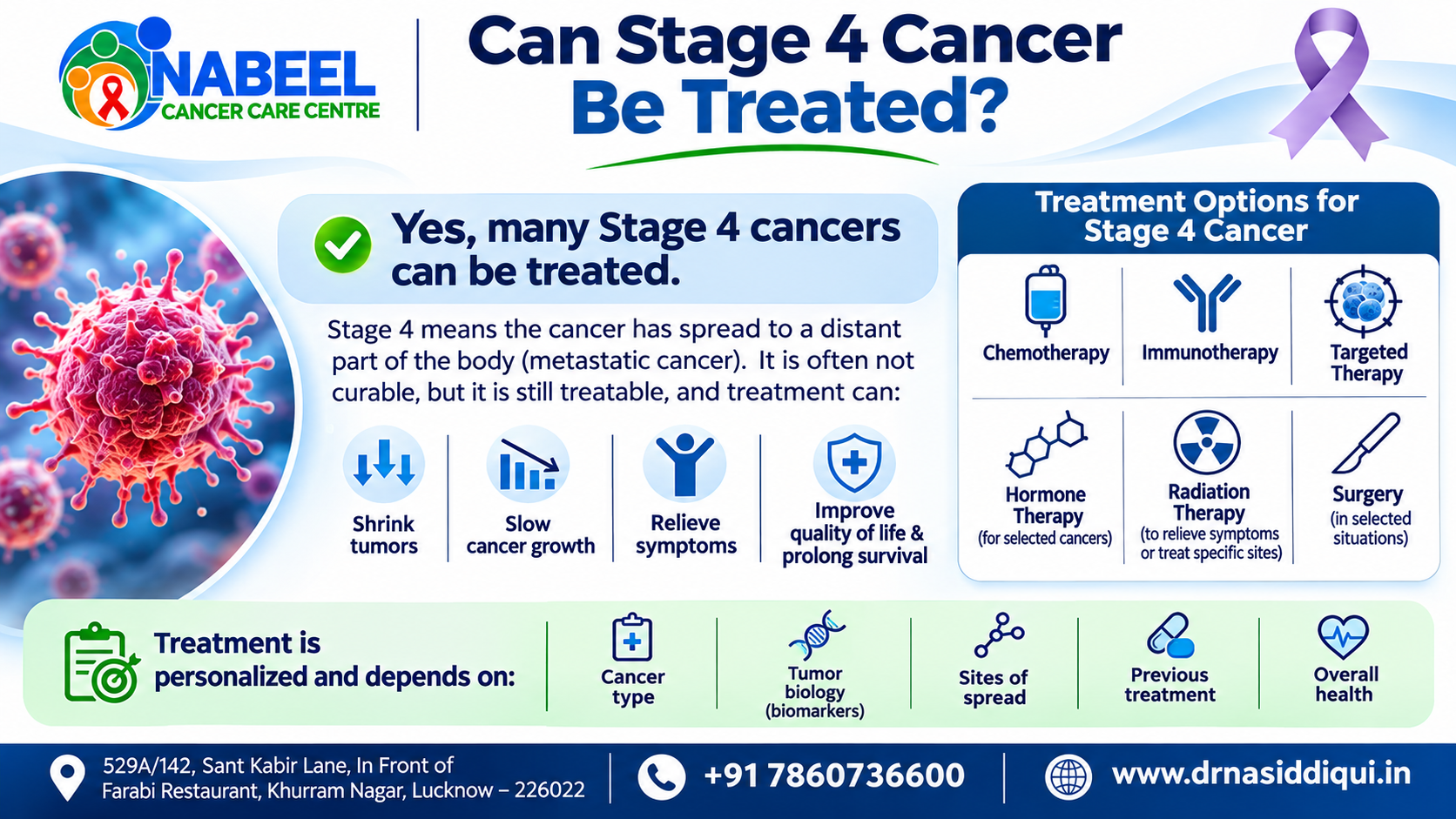
Can Stage 4 Cancer Be Treated?
Yes. Many Stage 4 cancers can be treated.
However, treatment does not mean the same thing for every patient.
For many solid cancers, Stage 4 means that cancer has spread from the organ where it started to a distant part of the body. This is called metastatic cancer.
Although many metastatic cancers are not considered curable with currently available treatments, they may still be treatable.
In fact, treatment can sometimes:
- Shrink tumors
- Slow cancer growth
- Delay progression
- Relieve symptoms
- Prevent complications
- Maintain physical activity
- Improve quality of life
- Extend survival
Moreover, some patients can live for years with advanced cancer that remains well controlled.
Therefore, a Stage 4 diagnosis should not automatically be interpreted as meaning that no treatment is possible.
The correct treatment depends on the exact cancer type, tumor biology, extent of spread, biomarkers, previous treatment and the patient’s overall health.
Patients seeking detailed treatment information can visit Stage 4 Cancer Treatment in Lucknow – Dr. N. A. Siddiqui.
What Does Stage 4 Cancer Mean?
For many solid tumors, Stage 4 indicates that cancer has spread to a distant organ or tissue.
For example:
- Breast cancer may spread to bone, liver, lung or brain
- Lung cancer may spread to brain, bone, liver or adrenal glands
- Prostate cancer commonly spreads to bone
- Colon cancer may spread to liver or lung
- Kidney cancer may spread to lung, bone or other organs
Importantly, cancer keeps the name of the organ where it originally started.
For instance, breast cancer that spreads to the liver remains metastatic breast cancer. It does not become liver cancer.
Therefore, treatment is usually selected according to the original cancer and its biological characteristics.
For a broader explanation, visit Metastatic Cancer Treatment in Lucknow.
Is Stage 4 Cancer Always Terminal?
No.
This is an important misconception.
Many advanced solid cancers cannot currently be described as curable. However, not curable does not mean untreatable.
Some cancers can remain stable or respond to treatment for long periods.
Furthermore, modern therapies such as:
- Targeted therapy
- Immunotherapy
- Hormone therapy
- New chemotherapy combinations
have significantly changed treatment for selected cancers.
Therefore, prognosis should be discussed according to the exact diagnosis rather than the stage number alone.
What Is the Goal of Stage 4 Cancer Treatment?
Treatment goals vary.
For some patients, the main objective is to shrink the cancer.
For others, treatment aims to keep the disease stable for as long as possible.
In addition, treatment may focus on:
- Reducing pain
- Improving breathing
- Controlling bleeding
- Improving appetite
- Maintaining mobility
- Preventing fractures
- Reducing pressure on important organs
- Improving daily function
Consequently, effective advanced-cancer care should focus on both cancer control and quality of life.
Can Stage 4 Cancer Be Cured?
There is no single answer.
For many metastatic solid cancers, treatment focuses on long-term control rather than cure.
However, selected situations may be different.
For example, some cancers with only a small number of metastatic sites may be treated more aggressively using a combination of:
- Systemic therapy
- Surgery
- Focused radiation
In addition, some cancer types are especially sensitive to treatment.
Therefore, whether cure is possible depends on the exact disease and individual clinical situation.
What Is Oligometastatic Cancer?
Some patients have only a limited number of distant cancer deposits.
This is sometimes described as oligometastatic disease.
In carefully selected cases, treatment may combine systemic therapy with local treatment such as surgery or stereotactic radiation.
However, this approach is not suitable for every patient.
Therefore, multidisciplinary assessment is important before deciding on aggressive local treatment.
What Determines Whether Stage 4 Cancer Can Be Treated?
Several factors affect treatment options.
Cancer Type
Different cancers respond differently to treatment.
For example, advanced breast cancer is treated differently from lung, colorectal, prostate or kidney cancer.
Tumor Biology
Two patients with cancer in the same organ may have biologically different tumors.
Therefore, biomarker and molecular results can influence treatment.
Sites of Spread
Doctors consider:
- Which organs are involved
- Number of metastatic sites
- Size of tumors
- Whether important organs are affected
Previous Treatment
Treatment choices may depend on whether the patient has already received:
- Chemotherapy
- Radiation
- Immunotherapy
- Targeted therapy
- Hormone therapy
- Surgery
General Health
Physical fitness, kidney function, liver function and other medical conditions also influence treatment selection.
Why Is Biopsy Important?
Before treatment is selected, doctors generally need to know exactly what type of cancer is present.
A biopsy can provide information about:
- Cancer type
- Histological subtype
- Tumor grade
- Receptors
- Biomarkers
- Molecular characteristics
However, a repeat biopsy is not always necessary if previous tissue is adequate.
In contrast, another biopsy may sometimes be considered if the diagnosis is uncertain or additional molecular testing is required.
For detailed information, visit Biopsy for Cancer in Lucknow.
What Tests Are Needed Before Treatment?
Evaluation may include:
- Histopathology
- Blood tests
- CT scan
- MRI
- PET-CT in selected cases
- Immunohistochemistry
- Molecular testing
- Biomarker testing
Therefore, treatment should usually begin only after the cancer diagnosis and extent of disease are understood as clearly as possible.
For a full explanation, read Cancer Tests & Diagnosis in Lucknow.
Why Is Molecular Testing Important?
Modern advanced-cancer treatment increasingly depends on tumor biology.
Depending on the cancer, doctors may consider biomarkers involving:
- EGFR
- ALK
- ROS1
- KRAS
- BRAF
- HER2
- BRCA
- PD-L1
- MSI/MMR
- Other cancer-specific abnormalities
As a result, some patients may become eligible for a treatment that specifically matches the biology of their cancer.
However, not every cancer requires every molecular test.
Therefore, testing should be selected according to the diagnosis.
What Treatments Are Available?
There is no single treatment for all advanced cancers.
Instead, treatment may include:
- Chemotherapy
- Immunotherapy
- Targeted therapy
- Hormone therapy
- Radiation therapy
- Surgery in selected situations
- Supportive and palliative care
The treatment plan may use one approach or a combination.
Chemotherapy for Advanced Cancer
Chemotherapy remains important for many Stage 4 cancers.
Because chemotherapy travels through the bloodstream, it can treat cancer cells in multiple areas of the body.
However, chemotherapy regimens differ according to the primary cancer.
For example, chemotherapy used for metastatic breast cancer is different from treatment for advanced lung or colorectal cancer.
Patients can learn more at Chemotherapy in Lucknow – Dr. N. A. Siddiqui.
Immunotherapy
Immunotherapy helps the immune system recognize or attack cancer.
It has become important for selected patients with cancers such as:
- Lung cancer
- Kidney cancer
- Bladder cancer
- Melanoma
- Head and neck cancer
- Certain gastrointestinal cancers
However, immunotherapy does not work for every patient.
Therefore, doctors consider the cancer type, biomarkers, previous treatment and overall health.
For more information, visit Immunotherapy for Cancer in Lucknow.
Targeted Therapy
Targeted therapy acts on specific molecular abnormalities that help certain cancers grow.
For example, some advanced lung cancers may have actionable changes involving genes such as EGFR or ALK.
Likewise, breast, colorectal, ovarian and other cancers may have treatment-relevant biomarkers.
Therefore, appropriately selected patients may benefit considerably from targeted treatment.
For detailed information, visit Targeted Therapy in Lucknow – Dr. N. A. Siddiqui.
Hormone Therapy
Some cancers depend on hormones.
Therefore, hormone therapy is particularly important in selected:
- Metastatic breast cancers
- Advanced prostate cancers
In addition, hormonal treatment can sometimes be combined with targeted therapy or chemotherapy.
For more information, visit Hormone Therapy for Cancer in Lucknow.
Can Radiation Therapy Help?
Yes.
Although metastatic cancer is a systemic disease, radiation therapy can still have an important role.
For example, radiation may be used for:
- Painful bone metastases
- Brain metastases
- Spinal lesions
- Tumor-related bleeding
- Pressure on nearby structures
- Other symptomatic areas
Therefore, systemic and local treatment may sometimes be used together.
Is Surgery Possible in Stage 4 Cancer?
Sometimes.
Advanced cancer does not automatically mean surgery can never be performed.
However, surgery is usually considered only in selected circumstances.
It may be used to:
- Relieve an obstruction
- Control bleeding
- Treat complications
- Remove selected tumors
- Treat limited metastatic disease
Therefore, the value of surgery depends heavily on cancer type and disease extent.
Treatment Depends on the Type of Cancer
Advanced Breast Cancer
Treatment may include:
- Hormone therapy
- Chemotherapy
- HER2-targeted therapy
- Other targeted medicines
- Immunotherapy in selected patients
Therefore, ER, PR and HER2 results are important for treatment planning.
Advanced Lung Cancer
Treatment may include:
- Targeted therapy
- Immunotherapy
- Chemotherapy
- Chemo-immunotherapy
- Radiation in selected situations
Moreover, molecular testing can strongly influence treatment in advanced non-small-cell lung cancer.
Advanced Colorectal Cancer
Treatment may involve:
- Chemotherapy
- Targeted therapy
- Immunotherapy in selected biomarker-defined tumors
- Surgery or focused treatment in carefully selected liver or lung metastases
Advanced Prostate Cancer
Treatment may include:
- Hormone therapy
- Androgen-receptor-directed treatment
- Chemotherapy
- Radiation
- Other prostate-specific systemic therapies
Advanced Kidney Cancer
Treatment may involve:
- Immunotherapy
- Targeted therapy
- Combination treatment
Advanced Ovarian Cancer
Treatment may include:
- Surgery
- Chemotherapy
- Selected targeted therapies
- Maintenance treatment
Therefore, treatment must be disease-specific rather than based only on the Stage 4 label.
How Do Doctors Know If Treatment Is Working?
Treatment response is assessed at planned intervals.
Doctors may use:
- Symptoms
- Physical examination
- Blood tests
- CT scan
- MRI
- PET-CT when appropriate
- Tumor markers in selected cancers
The disease may be described as:
Responding: The cancer has decreased.
Stable: There is no significant progression.
Progressive: Cancer has grown or new areas have appeared.
If progression occurs, another treatment strategy may be considered.
What Happens If the First Treatment Stops Working?
One treatment stopping working does not always mean that no options remain.
Depending on the cancer, another option may include:
- Different chemotherapy
- Targeted therapy
- Immunotherapy
- Hormone therapy
- Radiation
- Another systemic medicine
- Clinical trials when appropriate
Furthermore, repeat biomarker testing may occasionally identify a new treatment opportunity.
Can Someone Live for Years With Stage 4 Cancer?
Yes, some patients can.
However, survival varies greatly according to:
- Cancer type
- Tumor biology
- Disease extent
- Biomarkers
- Available treatments
- General health
- Treatment response
Therefore, internet survival statistics cannot accurately predict how long an individual patient will live.
The National Cancer Institute notes that some people can live for years with metastatic cancer that remains well controlled.
Does Palliative Care Mean Treatment Has Stopped?
No.
Palliative care can be provided alongside active cancer treatment.
It may help manage:
- Pain
- Fatigue
- Nausea
- Breathlessness
- Poor appetite
- Constipation
- Sleep problems
- Treatment side effects
- Emotional concerns
Therefore, palliative care is not the same as giving up.
It aims to improve comfort and quality of life throughout cancer treatment.
For detailed information, visit Palliative Cancer Care in Lucknow.
Should You Get a Second Opinion?
A second oncology opinion can be useful when:
- Advanced cancer has recently been diagnosed
- Pathology is unclear
- Several treatments are possible
- Biomarker testing has not been discussed
- Cancer has progressed
- A major change in treatment is being considered
A second opinion does not necessarily mean the original treatment recommendation was wrong.
Instead, it provides another expert review of the diagnosis and available options.
For more information, visit Cancer Second Opinion in Lucknow.
What Records Should You Bring to an Oncology Consultation?
Bring available:
- Biopsy and pathology reports
- Immunohistochemistry reports
- CT, MRI or PET-CT reports
- Imaging CDs
- Molecular reports
- Biomarker tests
- Previous chemotherapy records
- Immunotherapy records
- Surgery documents
- Radiation details
- Recent blood tests
- Current medicine list
Complete records can help avoid unnecessary repetition of tests.
Stage 4 Cancer Treatment in Lucknow – Dr. N. A. Siddiqui
Dr. N. A. Siddiqui is a Consultant Medical Oncologist & Hematologist in Lucknow.
His qualifications include:
- MBBS
- MD (Medicine)
- DNB (Medical Oncology)
For patients with advanced or metastatic cancer, medical-oncology evaluation may include review of:
- Pathology
- Cancer type
- Sites of spread
- Previous treatments
- Biomarker results
- Molecular reports
- General health
- Symptoms
- Treatment goals
Based on these findings, a treatment plan may involve chemotherapy, immunotherapy, targeted therapy, hormone therapy and supportive care.
For dedicated advanced-cancer treatment information, visit Stage 4 Cancer Treatment in Lucknow – Dr. N. A. Siddiqui.
Patients with distant cancer spread can also visit Metastatic Cancer Treatment in Lucknow.
For broader oncology consultation, visit Dr. N. A. Siddiqui – Cancer Doctor in Lucknow.
Nabeel Cancer Care Centre
529A/142, Sant Kabir Lane, In Front of Farabi Restaurant, Khurram Nagar, Lucknow – 226022
Appointment: +91 7860736600
Website: www.drnasiddiqui.in
Frequently Asked Questions
Can Stage 4 cancer be treated?
Yes. Many advanced cancers have treatment options. The treatment goal depends on cancer type, disease extent, tumor biology and overall health.
Is Stage 4 cancer curable?
Many metastatic solid cancers are treated with the goal of long-term control rather than cure. However, selected cancers and selected patients may have different outcomes.
Does every patient need chemotherapy?
No. Treatment may involve chemotherapy, targeted therapy, immunotherapy, hormone therapy, radiation or combinations.
Can immunotherapy treat Stage 4 cancer?
Yes, in selected cancers and patients. However, immunotherapy is not appropriate for every tumor.
Can targeted therapy help?
Yes, when testing identifies an actionable molecular target.
Can Stage 4 cancer go into remission?
Some cancers can respond strongly to treatment. However, the duration and meaning of remission vary considerably.
Can someone live for years with metastatic cancer?
Yes. Some metastatic cancers can remain controlled for years, although outcomes differ significantly between patients.
Can surgery be done?
Yes, in selected situations. Surgery may be used for complications or limited metastatic disease in carefully selected patients.
Should biomarker testing be done?
It can be very important in selected advanced cancers because results may influence targeted therapy or immunotherapy choices.
Should I get a second opinion?
A second opinion may be useful when the diagnosis is new, treatment choices are complex or cancer has progressed.
Does palliative care mean treatment is ending?
No. Palliative care can be provided alongside active cancer treatment to control symptoms and improve quality of life.
Conclusion
Can Stage 4 cancer be treated? Yes, many Stage 4 cancers can be treated.
However, there is no universal treatment or prognosis.
The most appropriate plan depends on:
- Original cancer type
- Pathology
- Extent of spread
- Biomarkers
- Molecular characteristics
- Previous treatment
- General health
- Treatment response
Modern advanced-cancer care may involve chemotherapy, immunotherapy, targeted therapy, hormone therapy, radiation, selected surgery and supportive care.
Therefore, patients should not assume that a Stage 4 diagnosis means that nothing more can be done.
Instead, the most useful next step is to establish the exact cancer type, understand where it has spread, review molecular or biomarker results and discuss realistic treatment goals.
If you are seeking Stage 4 cancer treatment or an oncology consultation in Lucknow, Dr. N. A. Siddiqui provides individualized medical-oncology evaluation and treatment planning for patients with advanced and metastatic cancer.
Medical Disclaimer: This article is for general educational purposes only. It does not provide an individual diagnosis, prognosis or treatment recommendation. Cancer treatment varies according to disease type, stage, biology, previous therapy and individual health.