

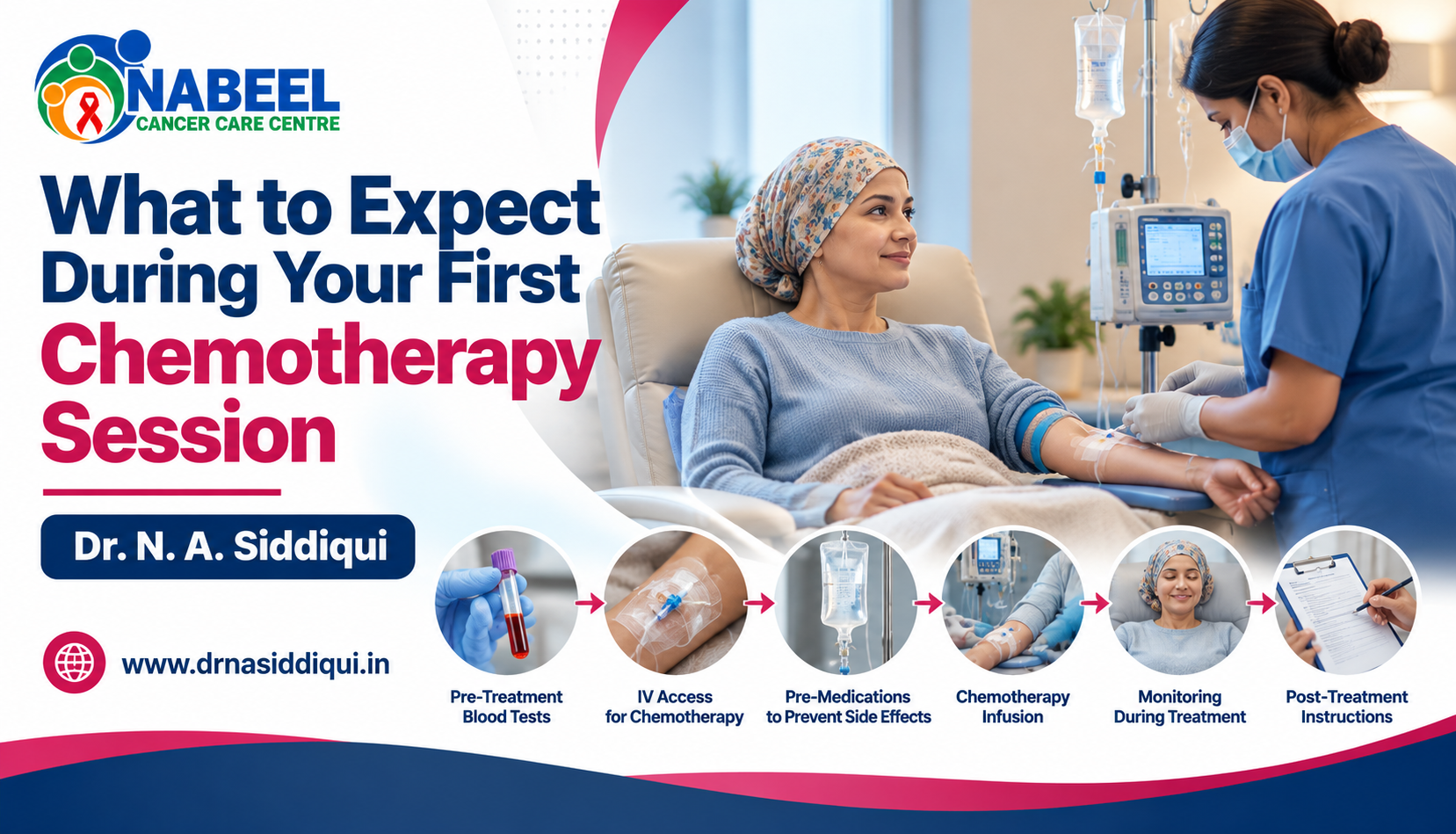
What to Expect During Your First Chemotherapy Session – Dr. N. A. Siddiqui
Starting chemotherapy for the first time can bring many questions and understandable anxiety.
Patients often wonder:
How long will chemotherapy take? Will it hurt? Will I feel sick immediately? Can I eat before treatment? Will I lose my hair? Can I go home the same day?
Knowing what usually happens can make the first treatment day feel more manageable.
Chemotherapy is not one single medicine or one standard procedure. Different cancers require different drugs, doses, schedules and supportive medicines. Your first chemotherapy experience will therefore depend on your diagnosis and prescribed treatment plan.
The American Cancer Society notes that preparing in advance and understanding what will happen during the first infusion can help patients feel more comfortable. Blood tests, vital signs, IV or port access, pre-medications and treatment monitoring are common parts of the process.
This guide explains the process step by step.
What Is Chemotherapy?
Chemotherapy uses medicines to kill cancer cells or prevent them from continuing to grow and divide.
Many chemotherapy medicines circulate through the bloodstream, allowing them to reach cancer cells in different parts of the body. This is why chemotherapy is described as a systemic cancer treatment.
Depending on the cancer, chemotherapy may be used:
- Before surgery to shrink a tumor
- After surgery to reduce recurrence risk
- Along with radiation therapy
- As the main treatment for certain cancers
- To control advanced or metastatic cancer
- To relieve cancer-related symptoms in selected situations
Chemotherapy may also be combined with immunotherapy, targeted therapy or other cancer treatments.
For a detailed overview of chemotherapy services and treatment planning, see Chemotherapy in Lucknow – Dr. N. A. Siddiqui.
Before Your First Chemotherapy Session
Your first chemotherapy session actually begins before the infusion day.
The oncology team first needs to confirm the exact diagnosis, understand the stage of cancer and select an appropriate treatment regimen.
Your oncologist may review:
- Biopsy and pathology report
- Cancer stage
- Previous surgery or radiation
- CT, MRI or PET-CT findings
- Biomarker results where relevant
- Other medical conditions
- Current medicines
- Allergies
- Previous treatment history
- Kidney and liver function
- General physical condition
The oncologist should also explain the goal of treatment.
Depending on your situation, chemotherapy may be given with curative intent, before or after surgery, or to control advanced disease and symptoms.
Understanding why chemotherapy is being given is just as important as knowing which medicine you will receive.
Blood Tests Before Chemotherapy
Blood tests are an important safety check before chemotherapy.
Common investigations include:
Complete Blood Count (CBC): evaluates hemoglobin, white blood cells, neutrophils and platelets.
Kidney Function Tests: certain chemotherapy medicines are removed from the body through the kidneys.
Liver Function Tests: the liver processes many cancer medicines.
Other tests may be required depending on the chemotherapy regimen.
Some patients may also need heart tests such as an ECG or echocardiogram before medicines that can affect cardiac function.
Cancer centers commonly check blood counts before treatment, and additional organ-function tests depend on the medicines prescribed.
If your results are not within a safe range, chemotherapy may sometimes be delayed, adjusted or reassessed.
A short treatment delay recommended by your oncologist does not automatically mean the cancer is worsening or treatment has failed. Safety is part of good chemotherapy planning.
What Should You Do the Day Before Your First Chemotherapy?
Follow the specific instructions given by your oncology team, because requirements differ between treatment regimens.
In general, it can be helpful to:
- Get adequate sleep
- Drink fluids normally unless you have been told to restrict fluids
- Keep prescribed medicines ready
- Bring your medical records if requested
- Prepare a list of current medications and supplements
- Arrange transport if possible
- Keep your oncology team’s contact number saved
- Prepare comfortable clothes for treatment day
Do not suddenly start herbal medicines, supplements or alternative treatments without telling your oncologist. Some products can interact with cancer medicines.
If your team has prescribed medicines that must be taken the night before or morning of chemotherapy, follow those instructions carefully.
Can You Eat Before Chemotherapy?
For many chemotherapy treatments, patients can eat before coming to the infusion unit unless they have been specifically instructed otherwise.
The American Cancer Society suggests a light meal on the morning of treatment unless the treating team has given different instructions.
Heavy, greasy foods may not be comfortable for everyone.
A simple meal might include foods that you already tolerate well.
Do not fast merely because you are receiving chemotherapy unless your medical team has specifically requested fasting.
What Should You Wear?
Comfort matters.
Wear loose, comfortable clothing that provides easy access to your arm if a peripheral IV will be used.
If you have a chemotherapy port in the chest, a shirt that allows easy access to the port area can be convenient.
American Cancer Society guidance similarly recommends comfortable clothing with easy access to the IV or port area.
Arriving for Your First Chemotherapy Session
When you arrive at the chemotherapy unit, the healthcare team may first confirm:
- Your identity
- Cancer treatment plan
- Current medicines
- Allergies
- Recent symptoms
- Blood-test results
Your temperature, blood pressure, pulse, oxygen level and weight may also be checked.
Weight can matter because doses of many chemotherapy medicines are calculated using body size.
Your first visit may take longer than later visits because the team may need extra time for education, safety checks, drug preparation and observation.
Clinical Assessment Before Treatment
Tell your oncology team if you have developed anything new since your previous visit.
Examples include:
- Fever
- Cough or signs of infection
- Vomiting
- Diarrhea
- Reduced fluid intake
- Unusual bleeding
- Severe weakness
- New medicines
- Rash
- Breathlessness
- Numbness or tingling
- Significant pain
Do not hide symptoms because you are worried chemotherapy might be postponed.
Sometimes delaying treatment is the safest decision.
How Is Chemotherapy Given?
Chemotherapy can be administered in several ways.
For many patients, medicines are given intravenously through:
- A peripheral IV cannula
- PICC line
- Central venous catheter
- Implanted chemotherapy port
Not every patient requires a port.
The appropriate access depends on the drugs, frequency and expected duration of treatment, as well as the condition of the patient’s veins.
Some chemotherapy medicines can also be taken orally as tablets or capsules.
Chemotherapy may be administered in an outpatient clinic, infusion center, hospital or other appropriate setting depending on the treatment.
What Happens Before the Chemotherapy Drug Is Given?
You may receive pre-medications before chemotherapy starts.
These medicines are intended to prevent or reduce predictable side effects.
They can include:
- Anti-nausea medicines
- Steroids
- Anti-allergy medicines
- Other treatment-specific medicines
For chemotherapy regimens with a risk of nausea and vomiting, antiemetic medicines are commonly given before treatment because prevention is often more effective than trying to control severe nausea after it begins.
The exact pre-medication combination depends on your chemotherapy regimen.
What Happens During the Chemotherapy Infusion?
Once all safety checks have been completed, your chemotherapy medicine is prepared and administered according to the prescribed protocol.
You may sit in a reclining chair while the chemotherapy runs through your IV line or port.
The medicine may be given:
- As an injection
- As a short infusion
- Over several hours
- As several medicines given one after another
Treatment duration varies widely.
Some chemotherapy infusions can take around 30 minutes, while others require several hours. Time can also be needed for blood results, pharmacy preparation and medical review.
For your first session, avoid planning something important immediately afterward because the exact finishing time can be difficult to predict.
Does Chemotherapy Hurt While It Is Going In?
The chemotherapy itself often does not produce pain during the infusion.
You may feel brief discomfort when the IV cannula is inserted.
However, pain, burning, swelling or unusual discomfort around the IV site should be reported immediately.
You should also tell the nurse immediately if you experience any unusual symptoms during the infusion.
These might include:
- Itching
- Rash
- Dizziness
- Chills
- Chest tightness
- Breathlessness
- Facial swelling
- Sudden nausea
- Feeling suddenly unwell
Some medicines can cause infusion or allergic reactions, which is why patients are monitored during treatment.
The ACS advises patients to tell the infusion team immediately if something feels unusual rather than assuming it is normal.
Can Someone Stay With You?
This depends on the chemotherapy facility’s policies.
If permitted, having a family member or trusted person accompany you for the first treatment can be reassuring.
Even if the person cannot remain beside you throughout the infusion, arranging transport can be useful because pre-medications can sometimes cause sleepiness.
The American Cancer Society specifically recommends considering a ride for the first treatment because medicines administered with chemotherapy may make some patients drowsy.
What Can You Do While Chemotherapy Is Running?
If you feel comfortable, infusion time can be used to:
- Read
- Watch something on your phone or tablet
- Listen to music
- Rest
- Talk quietly
- Sleep
Bringing headphones, a charger and something to read can be useful if your treatment lasts several hours.
What Happens After Your First Chemotherapy?
After the infusion ends, the healthcare team may check you briefly and provide instructions for home.
You should understand:
- Which medicines to take after treatment
- When to take anti-nausea medicines
- When the next chemotherapy cycle is due
- Whether you need blood tests beforehand
- Which side effects are expected
- Which symptoms require urgent medical attention
- How to contact your oncology team
Save the emergency or after-hours oncology contact number before leaving the treatment facility.
This is particularly important during the first cycle because you do not yet know exactly how your body will respond.
Will You Feel Sick Immediately After Chemotherapy?
Not necessarily.
Some people expect to feel severely unwell as soon as chemotherapy finishes, but many patients do not.
The American Cancer Society notes that many side effects may develop later rather than immediately after the infusion.
Your experience will depend on:
- Drugs used
- Dose
- Cancer type
- Supportive medicines
- General health
- Previous treatments
- Individual response
Some patients may feel relatively normal after treatment, while others experience fatigue or nausea later that day or during the following days.
Common Side Effects After the First Chemotherapy Cycle
Possible side effects include:
- Fatigue
- Nausea
- Vomiting
- Reduced appetite
- Changes in taste
- Mouth ulcers
- Diarrhea
- Constipation
- Low blood counts
- Infection risk
- Hair loss with certain drugs
- Tingling or numbness with certain medicines
Not everyone gets all of these.
Chemotherapy affects fast-growing cancer cells but can also affect healthy fast-growing cells such as bone-marrow cells, hair follicles and cells lining the digestive tract. This explains many common chemotherapy side effects.
Will You Lose Your Hair After the First Chemotherapy?
Not every chemotherapy causes hair loss.
Whether hair falls out depends primarily on the specific medicines and doses.
Some regimens may cause:
- Complete hair loss
- Partial thinning
- Little noticeable hair change
Hair loss also does not generally happen during the infusion itself.
If your chemotherapy is expected to cause significant hair loss, your oncology team can explain the likely timing and whether scalp-cooling options are appropriate for your treatment.
What About Nausea and Vomiting?
Nausea can occur during chemotherapy, shortly afterward or sometimes later.
Modern anti-nausea medicines have substantially improved control of chemotherapy-associated nausea.
NCI notes that anti-nausea drugs given before treatment can prevent or reduce these symptoms and that delayed nausea can sometimes occur a day or more after chemotherapy.
Take prescribed anti-nausea medicines according to instructions rather than waiting until symptoms become severe.
Why Is Chemotherapy Given in Cycles?
Chemotherapy is commonly given in cycles.
A cycle contains a period of treatment followed by a planned period without chemotherapy.
The treatment-free interval allows healthy tissues to recover before the next cycle.
NCI explains that chemotherapy schedules differ according to the drugs, cancer, treatment goal and the patient’s response.
For example, one patient may receive chemotherapy every week while another receives it every two or three weeks.
You should follow your own schedule rather than comparing your treatment with another patient’s.
Is Day-Care Chemotherapy Possible?
Many chemotherapy regimens do not require an overnight hospital stay.
Patients can come to an oncology day unit, complete the necessary safety checks, receive treatment and return home the same day if medically stable.
However, not every regimen or patient is suitable for outpatient chemotherapy.
Factors include:
- Type of chemotherapy
- Infusion duration
- Blood-test results
- Previous reactions
- Other illnesses
- Overall clinical condition
For a detailed explanation, see Day Care Chemotherapy in Lucknow.
What Should You Eat After Chemotherapy?
There is no single chemotherapy diet suitable for every patient.
Unless your medical team has given specific restrictions, concentrate on maintaining adequate nutrition and hydration.
Small meals may be easier if appetite is reduced.
If treatment causes persistent nausea, mouth sores, diarrhea, constipation or major weight loss, dietary advice may need to be individualized.
NCI notes that chemotherapy can sometimes affect the lining of the mouth and intestines, making eating difficult, and advises discussing significant eating problems with the treating team.
Can You Work After Your First Chemotherapy?
Some people continue working during chemotherapy while others require time away.
It depends on:
- Type of treatment
- Side effects
- Nature of your job
- Treatment schedule
- Overall health
Your energy level after the first cycle can provide some indication of how treatment affects you, although later cycles may feel different.
NCI notes that many patients can work during chemotherapy by adjusting their schedule according to how they feel.
When Should You Call Your Cancer Care Team?
Before leaving your first chemotherapy session, make sure you understand the center’s emergency instructions.
Contact your cancer care team urgently for problems such as:
- Fever at or above the threshold your oncology team has given you
- Chills
- Signs of infection
- Unexplained bleeding or bruising
- Persistent vomiting
- Severe diarrhea
- Difficulty breathing
- Severe allergic symptoms
- Significant pain or swelling around an IV or catheter site
- Rapidly worsening symptoms
Chemotherapy can temporarily reduce infection-fighting white blood cells in some patients. NCI advises discussing fever with the oncology team before taking medicines that might mask it.
Do not wait until the next scheduled appointment if your oncology team has told you a symptom requires urgent contact.
Does Having More Side Effects Mean Chemotherapy Is Working Better?
No.
This is a common misconception.
One patient may have very few side effects and obtain an excellent response.
Another may experience significant side effects without receiving greater anti-cancer benefit.
NCI specifically notes that the severity of chemotherapy side effects does not indicate how effectively the treatment is fighting cancer.
Doctors assess response using appropriate clinical evaluation, blood tests, scans and other cancer-specific tests.
Questions to Ask Before Your First Chemotherapy
Before beginning treatment, it can be useful to ask your oncologist:
- What is the goal of my chemotherapy?
- Which chemotherapy medicines will I receive?
- How many cycles are planned?
- How often will treatment be given?
- How long will each session take?
- What blood tests are required?
- What are the most likely side effects of my specific regimen?
- Will my hair fall out?
- Which medicines should I take at home?
- Which symptoms require an urgent call?
- Can I work during treatment?
- How will we know whether chemotherapy is working?
Write down the answers or ask a family member to take notes if you find the amount of information overwhelming.
About Dr. N. A. Siddiqui – Medical Oncologist in Lucknow
Dr. N. A. Siddiqui is a Consultant Medical Oncologist & Hematologist in Lucknow.
His qualifications listed on his official website include MBBS, MD (Medicine), DNB (Medical Oncology), MRCP (UK), PDCR, Certificate in Immuno-Oncology and ESMO Certified Medical Oncologist. Best Cancer Doctor Lucknow
His medical oncology practice includes personalized treatment planning for chemotherapy and other systemic anti-cancer treatments.
Patients receiving chemotherapy may require assessment of their diagnosis, cancer stage, pathology, general medical condition and treatment goals before a regimen is selected.
For consultation and cancer-treatment information, visit Dr. N. A. Siddiqui – Cancer Doctor in Lucknow.
First Chemotherapy Session in Lucknow
If you or a family member has been advised chemotherapy, understanding the treatment plan before the first cycle can reduce uncertainty.
Your first session should not simply involve administering a medicine. Safe chemotherapy care includes confirming the diagnosis and regimen, reviewing blood results, checking the patient’s condition, administering appropriate pre-medications, monitoring during treatment and providing clear instructions for home.
For patients looking for chemotherapy consultation in Lucknow, Dr. N. A. Siddiqui provides individualized medical oncology assessment and chemotherapy treatment planning at Nabeel Cancer Care Centre.
Dr. N. A. Siddiqui
Consultant Medical Oncologist & Hematologist
Nabeel Cancer Care Centre
529A/142, Sant Kabir Lane,
In Front of Farabi Restaurant,
Khurram Nagar, Lucknow
Appointment: +91 7860736600
Main Website: www.drnasiddiqui.in
Cancer Education Blog: blog.drnasiddiqui.in
Frequently Asked Questions
How long does the first chemotherapy session take?
There is no fixed duration. Some infusions take a relatively short time, while others take several hours. The first appointment may also take longer because of blood tests, medical review, pharmacy preparation and patient education.
Is the first chemotherapy session painful?
The chemotherapy medicine itself is usually not painful while it is infused, although insertion of an IV may cause brief discomfort. Burning, pain or swelling around the IV should be reported immediately.
Can I eat before my first chemotherapy?
Many patients can have a light meal unless their oncology team has advised otherwise. Follow your treatment-specific instructions.
Do I need someone to drive me home?
It is particularly useful to arrange transport for the first session because some pre-medications can cause drowsiness.
Will I lose my hair after chemotherapy?
Not necessarily. Hair loss depends on the particular chemotherapy medicines and doses.
Will I feel sick immediately?
Some patients feel well immediately after treatment, while side effects may appear later. Your experience depends on the treatment regimen and individual response.
How do doctors know chemotherapy is working?
The oncology team may use symptoms, examination, blood tests, CT, MRI, PET-CT or other disease-specific tests. Side-effect severity does not indicate whether chemotherapy is effective. Conclusion
The first chemotherapy session can feel uncertain, but the process is carefully structured.
Typically, it involves reviewing blood tests and your current health, checking vital signs, establishing IV or port access, administering pre-medications, giving chemotherapy under supervision and providing instructions before you return home.
Most importantly, every chemotherapy regimen is different. Your experience should be explained according to the specific medicines you are receiving rather than based on another patient’s experience.
Understanding what to expect can help you arrive for your first treatment better prepared and more confident about when to ask questions or seek medical help.
Medical Disclaimer: This article provides general educational information and does not replace individualized advice from your treating oncologist. Always follow the instructions given by your own cancer-care team.