

Hormone Therapy for Cancer Explained: How Does It Work?
Cancer treatment is becoming increasingly personalized. As a result, not every patient requires chemotherapy, and not every cancer responds to the same medicines.
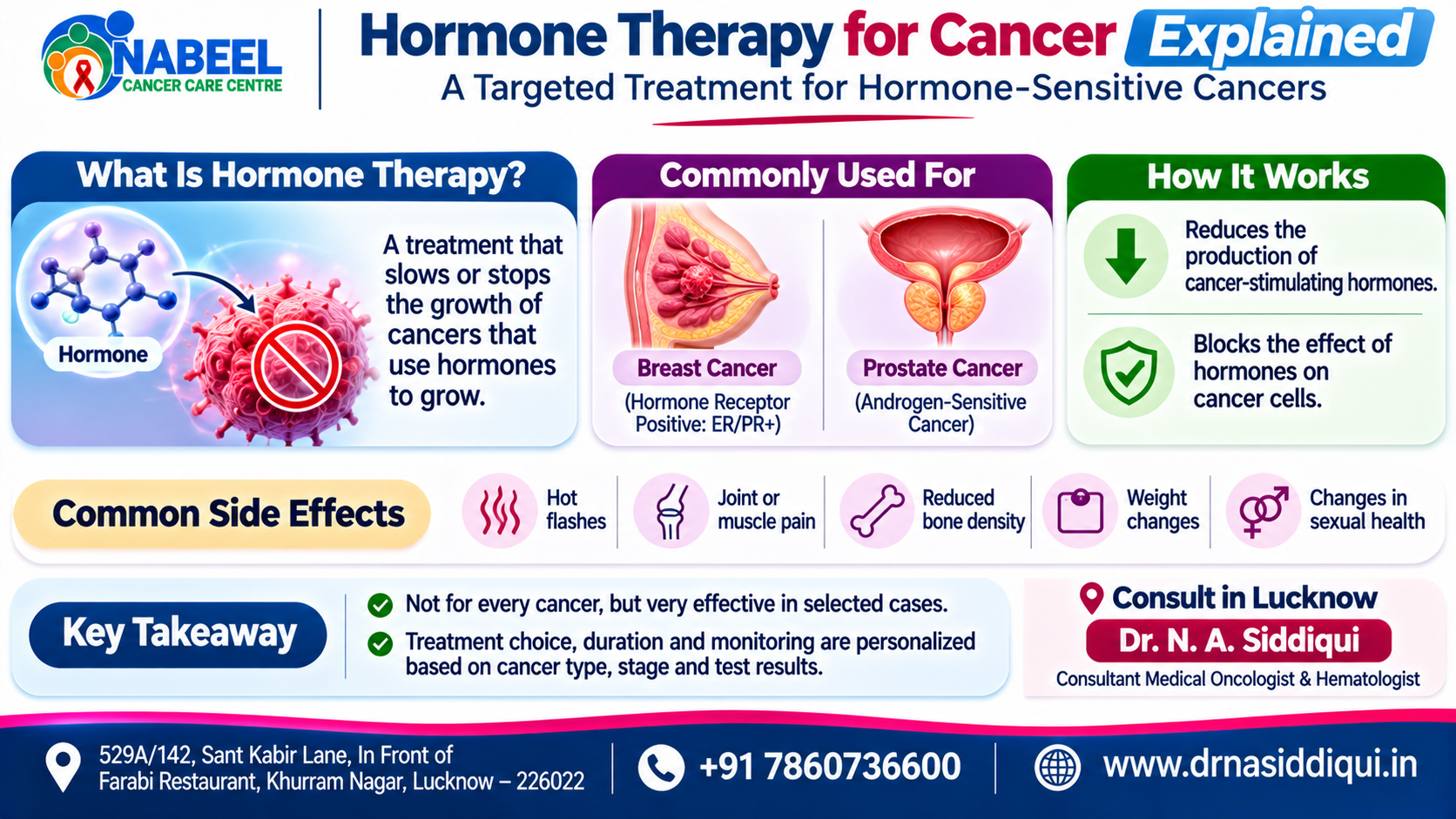
Some cancers depend on hormones in the body to grow. When this happens, hormone therapy can slow or stop cancer growth by reducing hormone production or blocking the effect of hormones on cancer cells.
Hormone therapy is also known as:
- Endocrine therapy
- Hormonal therapy
- Hormone treatment
It is used most commonly for hormone-sensitive breast cancer and prostate cancer.
However, hormone therapy is not suitable for every breast or prostate cancer. Therefore, doctors first need to understand the exact pathology, stage and biological characteristics of the tumor.
Patients who already have a confirmed hormone-sensitive cancer can learn more about Hormone Therapy for Cancer in Lucknow – Dr. N. A. Siddiqui.
What Is Hormone Therapy for Cancer?
Hormones are natural chemical messengers produced by different organs and glands.
They travel through the bloodstream and regulate many normal body functions.
However, certain cancers can use these hormones as growth signals.
For example, some breast-cancer cells contain estrogen receptors or progesterone receptors. Estrogen can stimulate these hormone-receptor-positive cells.
Similarly, many prostate cancers depend on male hormones called androgens, particularly testosterone, to grow.
Therefore, hormone therapy may work by either lowering the amount of a hormone in the body or preventing that hormone from stimulating cancer cells.
The National Cancer Institute describes hormone therapy as treatment that slows or stops the growth of cancers that use hormones to grow.
Which Cancers Are Treated With Hormone Therapy?
Hormone therapy has its strongest established role in selected breast and prostate cancers.
However, simply developing cancer in a hormone-related organ does not automatically mean hormone therapy will work.
Doctors must determine whether the cancer is actually dependent on hormonal signaling.
This is why biopsy and pathology are important before treatment decisions are made.
For a broader explanation of pathology, imaging and biomarker assessment, visit Cancer Tests & Diagnosis in Lucknow.
Hormone Therapy for Breast Cancer
Breast cancer is not one single disease.
An important part of breast-cancer testing is determining whether tumor cells contain:
ER – Estrogen Receptor
PR – Progesterone Receptor
Breast cancers containing one or both of these receptors are generally called hormone receptor-positive or HR-positive breast cancers.
In these cancers, estrogen or progesterone signaling can help cancer cells grow.
Therefore, endocrine treatment may be used to interfere with this signaling.
NCI reports that the majority of diagnosed breast cancers are hormone-receptor positive. However, hormone therapy does not work against breast cancers that lack the relevant hormone receptors.
For disease-specific information, visit Breast Cancer Doctor in Lucknow – Dr. N. A. Siddiqui.
What Is Tamoxifen?
Tamoxifen is a type of medicine known as a selective estrogen receptor modulator.
It attaches to estrogen receptors in breast tissue and can reduce estrogen’s ability to stimulate hormone-sensitive cancer cells.
Tamoxifen may be considered in appropriate premenopausal and postmenopausal patients.
However, treatment selection depends on several factors, including the patient’s age, menopausal status, cancer stage, recurrence risk and other treatments.
Therefore, patients should not compare their endocrine prescription directly with another breast-cancer patient’s treatment.
What Are Aromatase Inhibitors?
Aromatase inhibitors reduce estrogen production by blocking an enzyme called aromatase.
Common examples include letrozole, anastrozole and exemestane.
These medicines are particularly important in hormone-receptor-positive breast cancer after menopause.
However, in selected premenopausal patients, an aromatase inhibitor may be used together with ovarian-function suppression.
The treatment strategy therefore depends on both the tumor biology and the patient’s hormonal status.
What Is Ovarian Suppression?
Before menopause, the ovaries are an important source of estrogen.
Therefore, in selected breast-cancer patients, doctors may temporarily reduce ovarian estrogen production using specific medicines.
This is called ovarian-function suppression.
It may sometimes be combined with tamoxifen or an aromatase inhibitor.
However, ovarian suppression is not necessary for every patient with hormone-sensitive breast cancer.
The decision depends on recurrence risk, age, menopausal status and the overall treatment plan.
Hormone Therapy After Breast Cancer Surgery
Hormone therapy is often used after surgery for hormone-receptor-positive breast cancer.
This is called adjuvant endocrine therapy.
The purpose is to reduce the chance that cancer will return.
Unlike many chemotherapy regimens that are given for a limited number of cycles, hormone treatment may continue for several years.
However, the exact duration is individualized.
Some patients may benefit from extended treatment, whereas others may not need prolonged therapy.
Therefore, patients should not stop hormone treatment simply because they feel well or because several years have passed.
The decision to continue, switch or stop treatment should be discussed with the treating oncologist.
Hormone Therapy for Metastatic Breast Cancer
Hormone therapy can also be important when hormone-receptor-positive breast cancer has become recurrent or metastatic.
In advanced disease, endocrine therapy is often combined with modern targeted medicines in selected patients.
For example, treatment of HR-positive, HER2-negative metastatic breast cancer may involve endocrine therapy together with a targeted drug depending on the clinical situation.
In addition, molecular testing may sometimes identify other abnormalities that influence later treatment.
Therefore, advanced breast-cancer treatment increasingly combines information from:
Hormone receptors, HER2, molecular testing, previous therapies and the patient’s overall condition.
Patients with advanced disease can also read about Metastatic Cancer Treatment in Lucknow.
Hormone Therapy for Prostate Cancer
Prostate cancer is another major example of a hormone-sensitive cancer.
Many prostate cancers depend on androgen signaling for growth.
The most important androgen is testosterone.
Therefore, prostate-cancer hormone therapy usually aims to either reduce androgen levels or block their action on cancer cells.
This treatment strategy is often called androgen deprivation therapy or ADT.
How Does ADT Work?
Androgen-deprivation therapy can reduce the amount of testosterone produced by the body or interfere with androgen signaling.
Medical treatment may use medicines that affect hormonal signaling between the brain and testes.
In other situations, doctors may use medicines that directly block the androgen receptor or interfere with androgen production.
Therefore, the term “hormone therapy for prostate cancer” can include several different treatment strategies.
When Is Hormone Therapy Used for Prostate Cancer?
Hormone therapy may be used in several prostate-cancer settings.
For example, it may be combined with radiation therapy in selected higher-risk localized prostate cancers.
In addition, hormonal treatment is a central component of therapy for many patients with metastatic prostate cancer.
However, modern advanced prostate-cancer treatment often involves more than a hormone injection alone.
Depending on the disease, androgen deprivation may be combined with newer androgen-receptor pathway medicines, chemotherapy, radiation or other systemic treatments.
Therefore, treatment selection should depend on the disease stage, disease burden, previous therapy and patient fitness.
Is Hormone Therapy the Same as Chemotherapy?
No.
Hormone therapy and chemotherapy work differently.
Chemotherapy generally acts against rapidly growing cancer cells.
In contrast, hormone therapy reduces or blocks hormonal signals that certain cancer cells use for growth.
Therefore, a patient may receive hormone therapy without chemotherapy.
However, some patients need both treatments at different times or even as part of the same overall treatment strategy.
Patients considering chemotherapy can read Chemotherapy Treatment in Lucknow – Dr. N. A. Siddiqui.
Is Hormone Therapy the Same as Targeted Therapy?
No, although the two may sometimes be used together.
Hormone therapy primarily interferes with hormonal signaling.
Targeted therapy acts against specific molecular abnormalities or proteins within cancer cells.
For example, advanced hormone-receptor-positive breast cancer may sometimes be treated with endocrine therapy plus a targeted medicine.
Therefore, modern cancer treatment often combines different therapeutic approaches rather than treating them as mutually exclusive.
For more information, visit Targeted Therapy in Lucknow – Dr. N. A. Siddiqui.
How Do Doctors Know Whether Hormone Therapy Will Work?
Testing is essential.
For breast cancer, pathology commonly evaluates ER and PR.
If the cancer is hormone-receptor negative, standard endocrine therapy is unlikely to help.
For prostate cancer, treatment planning may involve PSA, biopsy pathology, Gleason or Grade Group, stage, imaging and previous treatment.
Therefore, hormone therapy should not be started based only on the organ where cancer began.
The biological characteristics of the cancer matter.
Hormone Therapy and Precision Oncology
Hormone treatment has become increasingly personalized.
For example, advanced breast-cancer treatment may involve additional testing for molecular alterations such as PIK3CA, ESR1, BRCA-related changes or other clinically relevant biomarkers, depending on the situation.
These findings can sometimes influence which endocrine or targeted combination is considered.
Therefore, modern hormone therapy is increasingly connected with precision oncology rather than being a simple one-medicine-fits-all approach.
Common Side Effects of Hormone Therapy
Hormone therapy can be used for months or years, so side-effect monitoring is important.
However, the side effects vary according to the cancer, medicine and individual patient.
Importantly, hormone therapy does not have exactly the same side-effect profile as chemotherapy.
For example, traditional chemotherapy-related nausea, severe bone-marrow suppression or significant hair loss are not typical features of many endocrine therapies.
Nevertheless, hormonal treatment can produce its own important effects.
Breast Cancer Hormone Therapy Side Effects
Depending on the treatment, patients may experience hot flashes, night sweats, vaginal dryness, menstrual changes, reduced sexual interest, joint or muscle discomfort and changes in bone density.
However, the exact side effects differ between tamoxifen, aromatase inhibitors and ovarian suppression.
Therefore, treatment-related symptoms should be discussed with the oncology team rather than tolerated silently.
Some symptoms can often be managed without stopping cancer treatment.
Prostate Cancer Hormone Therapy Side Effects
Androgen-deprivation therapy can produce different effects because testosterone levels are reduced.
Possible problems include hot flashes, reduced sexual desire, erectile difficulties, fatigue, loss of muscle mass, changes in body composition and weakening of bones.
Long-term treatment may also influence metabolic health.
Therefore, monitoring becomes especially important when hormone therapy is expected to continue for a prolonged period.
Hormone Therapy and Bone Health
Some hormonal treatments can reduce bone density.
This is particularly relevant for postmenopausal patients receiving certain breast-cancer endocrine therapies and men receiving long-term androgen deprivation for prostate cancer.
Therefore, depending on the patient’s risk factors, the oncology team may discuss bone-health assessment, exercise, dietary measures, vitamin D or calcium where appropriate, and bone-protective treatment in selected patients.
However, patients should not automatically begin high-dose supplements without medical advice.
Does Hormone Therapy Cause Hair Loss?
Hormone therapy generally does not cause the same pattern of major hair loss associated with some chemotherapy regimens.
However, changes in hair thickness or texture may occur with certain hormonal treatments.
Therefore, expected side effects should be discussed according to the exact medicine being prescribed.
Does Hormone Therapy Cause Weight Gain?
Weight and body-composition changes can occur during some hormonal treatments.
For example, androgen-deprivation therapy for prostate cancer may contribute to changes in fat and muscle composition.
However, weight change during cancer treatment can also result from diet, activity, menopause, other medicines and the cancer itself.
Therefore, unexplained or significant weight changes should be discussed with the treating team.
How Long Does Hormone Therapy Last?
There is no universal duration.
For early hormone-receptor-positive breast cancer, endocrine therapy often continues for several years.
However, exact duration depends on recurrence risk, menopausal status, side effects and individual treatment considerations.
For metastatic breast cancer, treatment may continue while the cancer remains controlled and the medicine remains appropriate.
In prostate cancer, duration depends heavily on the stage and purpose of therapy.
Some patients receiving radiation may need hormone therapy for a defined period.
In contrast, metastatic prostate cancer may require longer-term androgen suppression together with other systemic therapy.
Therefore, treatment duration should never be copied from another patient’s prescription.
What If Hormone Therapy Stops Working?
Cancer cells can change over time.
As a result, a cancer that initially responds to hormone therapy may later begin growing despite treatment.
This is called treatment resistance.
However, resistance to one hormonal treatment does not necessarily mean that all treatment options are exhausted.
Depending on the cancer, doctors may consider another endocrine medicine, endocrine therapy combined with targeted therapy, molecular testing, chemotherapy or another systemic treatment.
For prostate cancer, disease that progresses despite very low testosterone levels is known as castration-resistant prostate cancer.
Even then, additional androgen-pathway and non-hormonal treatments may still be available.
Can Hormone Therapy Replace Chemotherapy?
Sometimes—but not universally.
For many hormone-sensitive cancers, endocrine therapy can provide an effective non-chemotherapy treatment strategy.
However, there are situations where chemotherapy remains important.
For example, hormone-receptor-positive breast cancer may respond to endocrine therapy, whereas standard hormone therapy is not effective against triple-negative breast cancer because those tumors lack ER and PR receptors.
Likewise, some advanced prostate-cancer patients may benefit from both androgen deprivation and chemotherapy.
Therefore, treatment should follow cancer biology rather than the assumption that one class of treatment is always stronger or better.
Hormone Therapy in Stage 4 Cancer
Hormone therapy can play a major role in selected Stage 4 cancers.
For example, metastatic hormone-receptor-positive breast cancer may often be managed with endocrine-based treatment.
Similarly, hormonal therapy is a cornerstone of treatment for many patients with metastatic prostate cancer.
However, Stage 4 cancer does not automatically mean that hormone therapy is appropriate.
The cancer must be hormone sensitive.
For a broader overview of advanced-cancer treatment options, visit Stage 4 Cancer Treatment in Lucknow.
How Is Treatment Response Monitored?
Hormone therapy requires ongoing follow-up.
For breast cancer, monitoring may include clinical review, appropriate breast imaging and scans or blood tests when clinically indicated.
For prostate cancer, PSA is often an important part of monitoring.
However, response assessment may also require imaging, symptoms and other clinical information.
Therefore, treatment should not be continued solely on the basis that the patient feels well.
Objective follow-up remains important.
Should You Stop Hormone Therapy Because of Side Effects?
Do not stop prescribed cancer hormone therapy without discussing it with your oncologist.
This is especially important because endocrine treatment may continue for a long period and patients may feel completely well while taking it.
If side effects occur, the oncology team may sometimes consider supportive treatment, medication changes or another endocrine strategy.
Therefore, early communication is usually more useful than stopping therapy independently.
Is Cancer Hormone Therapy the Same as Hormone Replacement Therapy?
No.
This distinction is important.
Cancer hormone therapy is designed to reduce or block hormonal stimulation of cancer cells.
Hormone replacement therapy, in contrast, may provide hormones to treat symptoms related to hormone deficiency, such as certain menopausal symptoms.
Therefore, the two therapies have almost opposite objectives in many situations.
What Should You Bring to a Hormone Therapy Consultation?
If you already have a breast- or prostate-cancer diagnosis, bring your available biopsy and pathology reports, ER/PR/HER2 results where relevant, PSA reports, CT/MRI/PET-CT reports, previous surgery and treatment records, molecular or genetic test reports, current prescriptions and any previous hormone-therapy details.
This allows the oncologist to understand what has already been done and helps avoid unnecessary repetition of tests.
Hormone Therapy for Cancer in Lucknow – Dr. N. A. Siddiqui
Dr. N. A. Siddiqui is a Consultant Medical Oncologist & Hematologist in Lucknow.
His qualifications include MBBS, MD (Medicine), DNB (Medical Oncology), MRCP (UK), PDCR, Certificate in Immuno-Oncology and ESMO certification in Medical Oncology.
His oncology practice includes individualized treatment planning involving chemotherapy, immunotherapy, targeted therapy and hormone therapy for appropriate cancers.
For patients with hormone-sensitive cancers, treatment planning may involve review of pathology, ER/PR/HER2 status, cancer stage, menopausal status, PSA, prostate-cancer characteristics, previous endocrine treatment, molecular tests, bone health and other medical conditions.
Patients seeking a dedicated consultation can visit Hormone Therapy for Cancer in Lucknow – Dr. N. A. Siddiqui.
For broader cancer-treatment planning, visit Cancer Doctor in Lucknow – Dr. N. A. Siddiqui.
Nabeel Cancer Care Centre
529A/142, Sant Kabir Lane, In Front of Farabi Restaurant, Khurram Nagar, Lucknow – 226022
Appointment: +91 7860736600
Website: www.drnasiddiqui.in
Frequently Asked Questions
Is hormone therapy used for all cancers?
No. It is mainly used when cancer growth is influenced by hormones, particularly selected breast and prostate cancers.
Is hormone therapy chemotherapy?
No. Hormone therapy blocks or reduces hormonal signals, whereas chemotherapy generally targets rapidly growing cancer cells.
How do I know whether breast cancer is hormone sensitive?
The tumor tissue is tested for estrogen and progesterone receptors. ER-positive and/or PR-positive breast cancers may benefit from endocrine therapy.
Can hormone therapy treat Stage 4 breast cancer?
Yes. Hormone therapy can be an important treatment for selected hormone-receptor-positive metastatic breast cancers. In some situations, it is combined with targeted therapy.
Can hormone therapy treat metastatic prostate cancer?
Yes. Androgen-deprivation therapy is an important component of treatment for many metastatic prostate cancers and may be combined with additional systemic therapies.
Does hormone therapy cause hair loss?
Major hair loss is less characteristic of standard endocrine therapy than of certain chemotherapy regimens. However, individual medicines can affect hair differently.
Can hormone therapy cause bone weakness?
Some endocrine treatments can reduce bone density. Therefore, bone-health monitoring may be appropriate for selected patients.
Is hormone therapy always a tablet?
No. Depending on the cancer and medicine, hormone treatment may be given as tablets, injections or, in certain circumstances, through surgical approaches that reduce hormone production.
How long does hormone therapy continue?
Treatment duration varies considerably. Some breast-cancer patients receive endocrine therapy for several years, while prostate-cancer treatment duration depends on the stage and treatment goal.
Can I stop hormone therapy if I feel well?
Do not stop prescribed hormone therapy without speaking with your oncology team. Feeling well does not mean the treatment is no longer needed.
What happens if hormone therapy stops working?
Further options may include another hormone treatment, targeted therapy, chemotherapy, additional molecular testing or another cancer-specific systemic treatment.
Conclusion
Hormone therapy is an important form of cancer treatment, but it is only useful when the cancer is influenced by hormonal signaling.
Its most established roles are in selected breast cancers and prostate cancers.
Unlike chemotherapy, hormone therapy does not primarily work by attacking rapidly dividing cells. Instead, it reduces hormone production or blocks hormone signals that certain cancer cells use to grow.
Therefore, the right treatment depends on accurate pathology and cancer biology.
For breast cancer, ER and PR testing is particularly important.
For prostate cancer, stage, PSA, pathology, imaging and hormone sensitivity all influence treatment planning.
Hormone therapy may be used alone, combined with targeted therapy, combined with chemotherapy or incorporated into a broader treatment strategy.
Most importantly, treatment selection, duration and side-effect management should be individualized.
If you are looking for information or consultation regarding hormone therapy for cancer in Lucknow, Dr. N. A. Siddiqui provides medical-oncology evaluation and individualized treatment planning for appropriate hormone-sensitive cancers.
Medical Disclaimer: This article is for general educational purposes only and does not replace an individual diagnosis or treatment recommendation. Hormone therapy selection, medicine choice, treatment duration and monitoring depend on cancer type, stage, pathology, previous treatments and individual health.