
Targeted Therapy vs Chemotherapy in Lucknow: Which Is Better?
Cancer treatment has changed significantly in recent years. Today, medical oncologists may use chemotherapy, targeted therapy, immunotherapy, hormone therapy or combinations of these treatments depending on the cancer.
Therefore, one of the most common questions patients ask is:
“Which is better—targeted therapy or chemotherapy?”
There is no single answer for every patient.
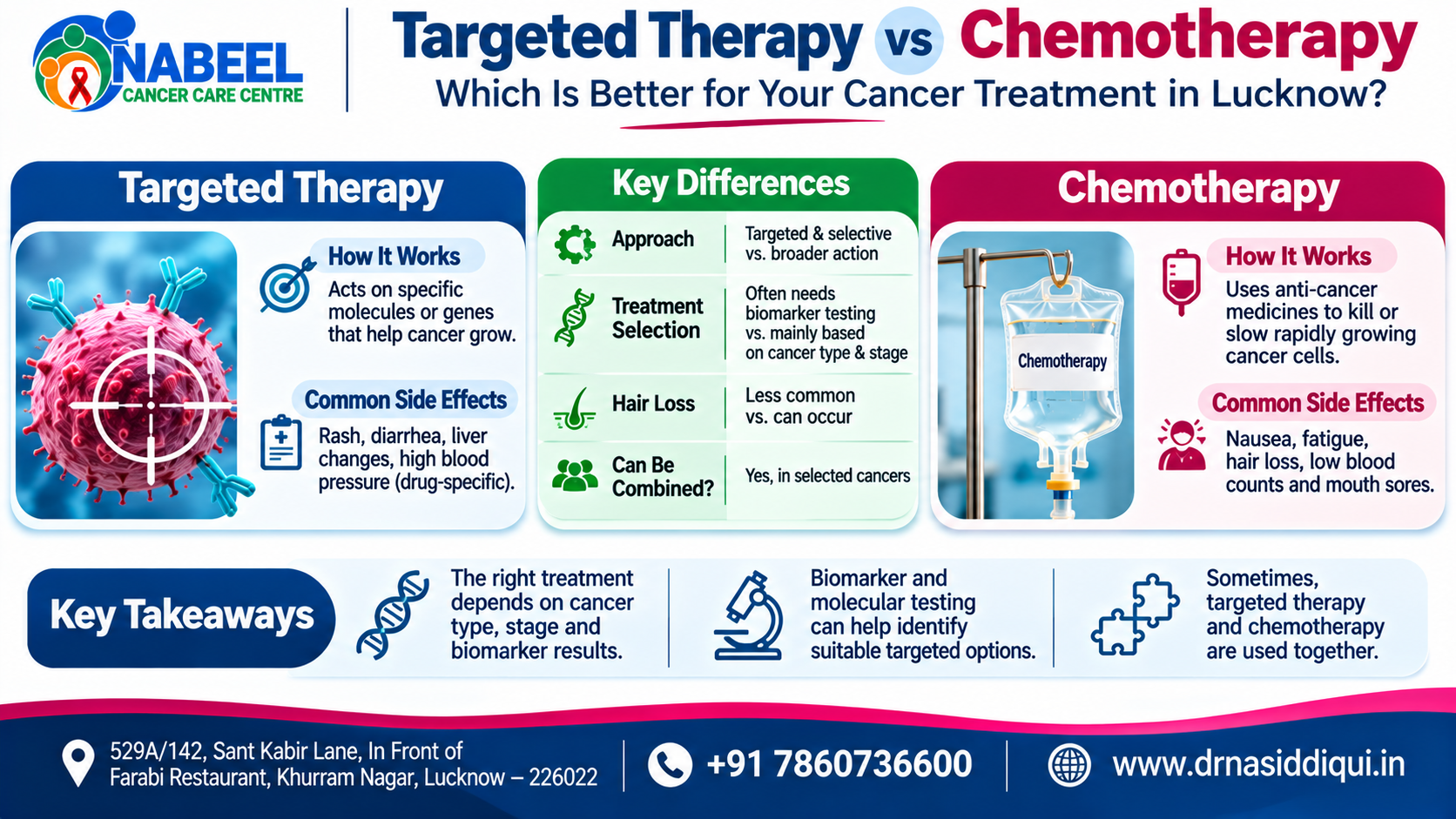
Chemotherapy generally attacks rapidly growing cancer cells. In contrast, targeted therapy acts on specific proteins, genes or biological pathways that certain cancers depend on for growth.
Consequently, targeted therapy can be highly effective when the cancer contains an appropriate treatment target. However, it is not suitable for every patient.
If you want to understand targeted treatment in more detail, read Targeted Therapy in Lucknow – Dr. N. A. Siddiqui.
The correct treatment may depend on:
- Cancer type
- Cancer stage
- Biopsy and pathology
- Biomarker results
- Molecular alterations
- Previous treatment
- General health
- Treatment goals
What Is Chemotherapy?
Chemotherapy uses anti-cancer medicines to destroy cancer cells or slow their growth.
Because many chemotherapy medicines travel through the bloodstream, they can treat cancer cells in different parts of the body.
Depending on the diagnosis, chemotherapy may be given:
- Before surgery
- After surgery
- Along with radiation
- As the main cancer treatment
- For recurrent cancer
- For advanced or metastatic cancer
- To help control cancer-related symptoms
For example, chemotherapy given before surgery may be called neoadjuvant chemotherapy.
Meanwhile, chemotherapy given after surgery to reduce the risk of recurrence may be called adjuvant chemotherapy.
Patients who need detailed information about treatment can visit Chemotherapy in Lucknow – Dr. N. A. Siddiqui.
What Is Targeted Therapy?
Targeted therapy is a form of cancer treatment designed to interfere with specific molecular features that help cancer cells grow, divide or survive.
These targets may include:
- Abnormal proteins
- Gene mutations
- Growth-factor receptors
- Signaling pathways
- Blood-vessel growth pathways
- Other molecular abnormalities
Therefore, targeted therapy is an important part of modern precision cancer treatment.
However, targeted therapy should not be prescribed simply because a cancer has been diagnosed.
Instead, doctors may need to first identify whether the tumor has a relevant biomarker or molecular target.
Targeted Therapy vs Chemotherapy: Key Differences
| Feature | Targeted Therapy | Chemotherapy |
|---|---|---|
| How it works | Targets specific molecular features of cancer | Attacks rapidly growing cells |
| Patient selection | Often depends on biomarker testing | Usually based on cancer type, stage and treatment protocol |
| Effect on normal cells | More selective, but can still affect normal tissues | Can affect healthy rapidly dividing cells |
| Hair loss | Less common with many targeted medicines | Can occur with some chemotherapy drugs |
| Blood counts | Effect depends on the medicine | Can commonly reduce blood counts |
| Common side effects | Rash, diarrhea, liver changes, blood-pressure changes, mouth or nail problems | Nausea, fatigue, hair loss, low blood counts, mouth sores, neuropathy |
| Can treatments be combined? | Yes | Yes |
Importantly, these are broad differences.
Individual medicines may behave differently. Therefore, treatment should always be personalized.
Is Targeted Therapy Better Than Chemotherapy?
Not necessarily.
The word “targeted” sometimes makes patients believe targeted therapy must automatically be safer or more effective.
However, targeted therapy works only when the biology of the cancer supports its use.
For example, if the cancer does not contain the relevant molecular target, a targeted medicine may provide little or no benefit.
In contrast, chemotherapy may still be an effective and evidence-based treatment.
Therefore, instead of asking:
“Which treatment is newer?”
the more useful question is:
“Which treatment is most appropriate for my specific cancer?”
Why Is Biomarker Testing Important?
Biomarker testing has become increasingly important in modern oncology.
It may look for:
- Gene mutations
- Proteins
- Receptors
- Gene rearrangements
- Other molecular characteristics
Examples of treatment-related biomarkers in selected cancers may include:
- EGFR
- ALK
- ROS1
- BRAF
- KRAS
- HER2
- BRCA1/BRCA2
- RET
- MET
- NTRK
However, not every patient requires every test.
Instead, testing should be selected according to the specific cancer.
For a detailed explanation of biopsy, pathology, biomarker testing, NGS and imaging, read Cancer Tests & Diagnosis in Lucknow.
What Is Next-Generation Sequencing?
Next-Generation Sequencing, or NGS, can examine many genes or genetic regions at the same time.
In selected cancers, NGS may identify an actionable alteration.
However, an NGS report may contain different types of findings, including:
- Clinically actionable alterations
- Findings with limited evidence
- Investigational findings
- Variants of uncertain significance
Therefore, finding a mutation does not automatically mean a targeted drug should be used.
The result needs to be interpreted in the context of:
- Cancer type
- Stage
- Previous treatment
- Available approved treatments
- Strength of scientific evidence
- Patient health
Targeted Therapy in Lung Cancer
Lung cancer is one of the strongest examples of biomarker-guided treatment.
In selected non-small-cell lung cancers, testing may look for abnormalities involving genes such as:
- EGFR
- ALK
- ROS1
- BRAF
- KRAS
- MET
- RET
- NTRK
If a clinically relevant target is identified, a matching targeted medicine may sometimes become an important treatment option.
Therefore, adequate pathology and molecular testing can be crucial before treatment is finalized.
Targeted Therapy in Breast Cancer
Breast cancer treatment is also strongly influenced by biomarkers.
Treatment planning may consider:
- HER2
- Estrogen receptor
- Progesterone receptor
- BRCA-related findings in selected patients
- Other disease-specific markers
For example, HER2-positive breast cancer may benefit from HER2-directed targeted treatments.
However, chemotherapy may still be required depending on stage and clinical circumstances.
Therefore, targeted therapy and chemotherapy are not always alternatives.
Sometimes both are part of the same treatment plan.
Targeted Therapy in Colorectal Cancer
Some advanced colorectal cancers undergo molecular testing before systemic treatment is selected.
Depending on the clinical setting, testing may evaluate:
- RAS
- BRAF
- HER2
- Other relevant biomarkers
These results may help determine whether certain targeted treatments are appropriate.
Nevertheless, chemotherapy remains important in many colorectal-cancer treatment plans.
Targeted Therapy in Ovarian Cancer
Selected ovarian cancers may benefit from biomarker-guided treatment.
For example, BRCA-related or DNA-repair findings can influence treatment in some patients.
However, surgery and chemotherapy continue to be important parts of treatment for many ovarian cancers.
Therefore, molecular results should be considered within the entire treatment plan.
Does Targeted Therapy Have Fewer Side Effects?
Sometimes the side-effect pattern is different from chemotherapy.
However, targeted therapy is not side-effect-free.
Possible side effects may include:
- Rash
- Diarrhea
- Fatigue
- Liver-function changes
- High blood pressure
- Mouth sores
- Nail changes
- Hand-foot syndrome with selected drugs
- Other medicine-specific effects
Therefore, targeted therapy still requires specialist supervision and regular monitoring.
Common Chemotherapy Side Effects
Chemotherapy side effects depend on the medicines used.
Possible effects include:
- Nausea
- Vomiting
- Fatigue
- Hair loss
- Mouth sores
- Loss of appetite
- Low white blood cells
- Infection risk
- Anemia
- Low platelets
- Diarrhea
- Constipation
- Peripheral neuropathy
However, many chemotherapy side effects can now be prevented, reduced or actively managed.
For more information, read Chemotherapy in Lucknow.
Does Targeted Therapy Cause Hair Loss?
Hair loss is generally less typical with many targeted therapies than with certain chemotherapy drugs.
However, individual medicines differ.
Some targeted medicines can affect:
- Hair texture
- Skin
- Nails
Furthermore, when targeted therapy is combined with chemotherapy, chemotherapy-related hair loss may still occur.
Therefore, patients should ask about their specific medicine, not targeted therapy in general.
Is Targeted Therapy Always a Tablet?
No.
Many small-molecule targeted medicines are available as tablets or capsules.
However, some targeted therapies are given through intravenous infusion.
Therefore, targeted therapy may be:
- Oral
- Intravenous
- Used alone
- Used as part of combination treatment
The route depends on the particular medicine.
Can Targeted Therapy Be Taken at Home?
Some oral targeted medicines can be taken at home.
However, this does not mean they require less medical supervision.
Patients may still need monitoring such as:
- Blood counts
- Liver tests
- Kidney tests
- Blood-pressure monitoring
- ECG or heart monitoring for selected medicines
- Imaging
- Side-effect assessment
Therefore, patients should never change or stop targeted medicines without discussing it with their oncology team.
Can Targeted Therapy and Chemotherapy Be Used Together?
Yes.
Depending on the cancer, targeted therapy may be given:
- Alone
- Along with chemotherapy
- After chemotherapy
- With hormone therapy
- With another targeted treatment
For example, some HER2-positive breast cancers may require both chemotherapy and HER2-targeted treatment.
Therefore, treatment does not always involve choosing one therapy and rejecting the other.
Why Can Targeted Therapy Stop Working?
Cancer cells can change over time.
As a result, a cancer that initially responds to targeted treatment may eventually develop resistance.
Resistance may occur because:
- The molecular target changes
- New mutations appear
- Alternative growth pathways become active
Therefore, if the cancer progresses, doctors may consider another treatment.
In selected patients, repeat molecular testing or liquid biopsy may help identify another actionable target.
Can Chemotherapy Also Stop Working?
Yes.
Cancer can also develop resistance to chemotherapy.
If this occurs, treatment options may include:
- Another chemotherapy regimen
- Targeted therapy
- Immunotherapy
- Hormone therapy
- Another individualized systemic treatment
The next treatment should depend on the exact cancer and previous therapy.
Targeted Therapy for Stage 4 Cancer
Targeted therapy can play an important role in selected patients with advanced cancer.
However, Stage 4 cancer does not automatically mean targeted therapy will be suitable.
An appropriate molecular target must be present.
For example, targeted treatments may be considered in selected:
- Lung cancers
- Breast cancers
- Colorectal cancers
- Ovarian cancers
- Kidney cancers
- Blood cancers
For a broader explanation of advanced cancer options, visit Stage 4 Cancer Treatment in Lucknow.
Targeted Therapy in Metastatic Cancer
Metastatic cancer means cancer has spread from its original site to a distant part of the body.
In metastatic disease, systemic cancer treatment often becomes particularly important.
Depending on the diagnosis, treatment may include:
- Chemotherapy
- Targeted therapy
- Immunotherapy
- Hormone therapy
- Combination treatment
Therefore, biomarker testing may be especially useful in selected advanced cancers.
Learn more at Metastatic Cancer Treatment in Lucknow.
Can Targeted Therapy Cure Stage 4 Cancer?
There is no single answer.
Some targeted medicines can produce strong and prolonged disease control in selected patients.
However, this does not mean that every metastatic cancer is cured.
The treatment goal depends on:
- Cancer type
- Molecular target
- Extent of spread
- Response to treatment
- Overall health
Therefore, prognosis should be discussed individually.
Does a Mutation Automatically Mean Targeted Therapy Will Work?
No.
This is an important misconception.
A molecular report may identify a mutation, but there may not be an effective approved medicine for that mutation.
Even when a matching drug exists, treatment response cannot be guaranteed.
Therefore, treatment selection should consider:
- Cancer type
- Stage
- Molecular finding
- Strength of evidence
- Previous treatments
- Available guidelines
Is Targeted Therapy the Same as Immunotherapy?
No.
Targeted therapy acts on specific molecular targets that help cancer grow.
Immunotherapy, in contrast, helps the immune system recognize or attack cancer.
Chemotherapy is different from both.
Therefore, modern oncology may use different treatment classes depending on tumor biology.
For an overview of these modern options, see Latest Cancer Treatments in Lucknow.
How Do Doctors Choose Between Targeted Therapy and Chemotherapy?
Before deciding on treatment, a medical oncologist may review:
- Biopsy
- Histopathology
- Cancer type
- Tumor subtype
- Stage
- Sites of metastasis
- Biomarker testing
- Molecular results
- Previous treatment
- General health
- Treatment goals
Therefore, treatment selection should begin with accurate diagnosis.
For this reason, patients with incomplete pathology or molecular information may first need Cancer Tests & Diagnosis in Lucknow.
What Tests May Be Needed Before Targeted Therapy?
Depending on the cancer, testing may include:
- Histopathology
- Immunohistochemistry
- Mutation testing
- FISH
- PCR-based tests
- NGS
- Liquid biopsy in selected cases
- Other disease-specific molecular tests
However, all tests are not required for every patient.
The most useful test is one that can realistically influence diagnosis or treatment.
How Is Treatment Response Monitored?
Whether a patient receives chemotherapy or targeted therapy, doctors need to assess whether treatment is working.
Monitoring may include:
- Symptoms
- Physical examination
- Blood tests
- Tumor markers where useful
- CT
- MRI
- PET-CT in selected cases
In addition, doctors monitor side effects and organ function.
Therefore, treatment should be regularly reviewed rather than continued without assessment.
Questions to Ask Your Oncologist
Before treatment, useful questions include:
- What exact type of cancer do I have?
- What stage is my cancer?
- Do I need biomarker testing?
- Is there an actionable molecular target?
- Is targeted therapy suitable for me?
- Why is chemotherapy recommended?
- Can targeted therapy replace chemotherapy in my case?
- Do I need both treatments?
- What side effects should I expect?
- How will treatment response be checked?
- What happens if treatment stops working?
- Could repeat molecular testing be useful later?
Targeted Therapy and Chemotherapy in Lucknow – Dr. N. A. Siddiqui
Dr. N. A. Siddiqui is a Consultant Medical Oncologist & Hematologist in Lucknow.
His qualifications include:
- MBBS
- MD (Medicine)
- DNB (Medical Oncology)
- MRCP (UK)
- PDCR
- Certificate in Immuno-Oncology
- ESMO Certified Medical Oncologist
His medical-oncology practice includes individualized treatment planning involving:
- Chemotherapy
- Targeted therapy
- Immunotherapy
- Hormone therapy
- Biomarker-guided cancer treatment
- Advanced and metastatic cancer treatment
- Treatment monitoring
- Supportive oncology care
Patients who want to know whether a molecularly targeted medicine may be appropriate can read Targeted Therapy in Lucknow – Dr. N. A. Siddiqui.
For broader cancer-treatment consultation, visit Dr. N. A. Siddiqui – Cancer Doctor & Medical Oncologist in Lucknow.
Nabeel Cancer Care Centre
529A/142, Sant Kabir Lane, In Front of Farabi Restaurant, Khurram Nagar, Lucknow – 226022
Appointment: +91 7860736600
Website: www.drnasiddiqui.in
Frequently Asked Questions
Is targeted therapy better than chemotherapy?
Not always. Targeted therapy can be highly effective when a cancer has an appropriate molecular target. However, chemotherapy remains an important treatment for many cancers.
What is the main difference between targeted therapy and chemotherapy?
Chemotherapy broadly targets rapidly growing cells. In contrast, targeted therapy acts against specific molecular features involved in cancer growth.
Does everyone qualify for targeted therapy?
No. Eligibility depends on cancer type, stage and biomarker results.
Is genetic or biomarker testing required?
Many targeted medicines require a specific molecular alteration. Therefore, biomarker testing is often important before targeted therapy is selected.
Does targeted therapy have fewer side effects?
The side effects are different, not necessarily absent. Targeted drugs can cause rash, diarrhea, liver abnormalities, hypertension and other medicine-specific effects.
Is targeted therapy always a tablet?
No. Some targeted medicines are tablets or capsules, while others are given through intravenous infusion.
Can chemotherapy and targeted therapy be given together?
Yes. Certain cancers are treated using both chemotherapy and targeted medicines.
Can targeted therapy be used for Stage 4 cancer?
Yes, in selected cancers where an actionable molecular target is present.
Can targeted therapy stop working?
Yes. Cancer cells may develop resistance over time.
Is targeted therapy the same as immunotherapy?
No. Targeted therapy focuses on specific molecular abnormalities, whereas immunotherapy works by modifying or activating the immune response against cancer.
Do all cancer patients need NGS?
No. NGS can be useful in selected cancers, particularly advanced cancers, but it is not required for every patient.
Conclusion
Targeted therapy and chemotherapy are both important cancer treatments, but they work differently.
Chemotherapy attacks rapidly growing cells.
In contrast, targeted therapy focuses on specific molecular abnormalities or proteins involved in cancer growth.
Therefore, targeted therapy may be highly useful when an actionable target is present.
However, it should not automatically replace chemotherapy.
Depending on the diagnosis, treatment may involve:
- Chemotherapy alone
- Targeted therapy alone
- Chemotherapy plus targeted therapy
- Immunotherapy
- Hormone therapy
- Another individualized combination
Most importantly, treatment should begin with an accurate diagnosis, correct staging and appropriate biomarker testing.
If you are comparing targeted therapy vs chemotherapy in Lucknow, a medical-oncology consultation can help interpret your pathology and molecular reports and determine which approach has the strongest evidence for your individual cancer.
Medical Disclaimer: This article is for general educational purposes only. Cancer-treatment decisions vary according to cancer type, stage, pathology, biomarkers, previous therapy and individual health. Do not start, stop or change cancer treatment without advice from your treating oncology team.